


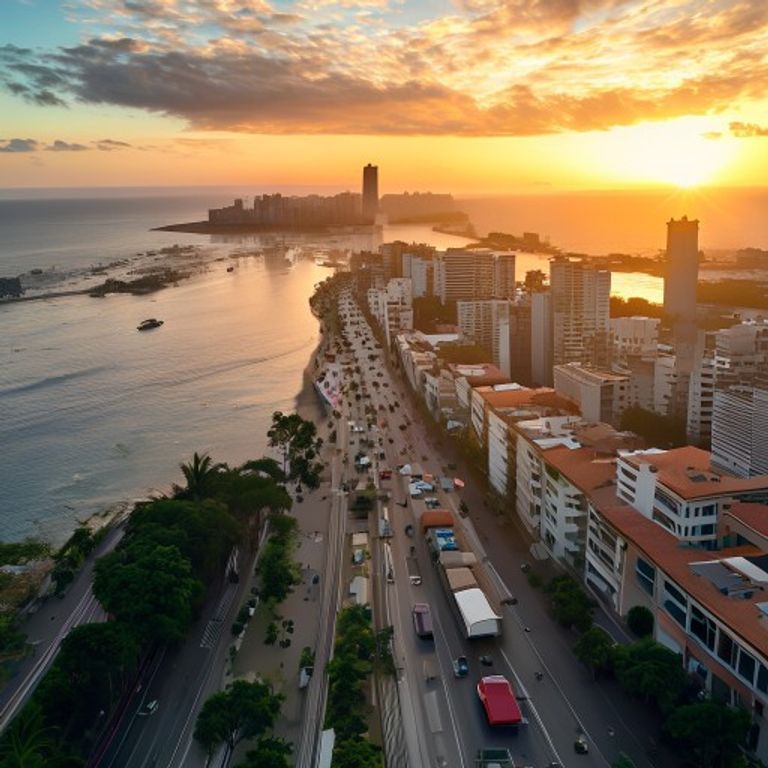
This municipality in the State of Santa Catarina has a literature that explores the coal cycle and working-class life, serving as a backdrop for works that discuss industrialization and social movements in the south of the state.
⚠️ Research elaborated with the aid of Deep Research is subject to referential ambiguity.
🖥️Clean HTML code using a proprietary tool.
👥Research by Guilherme Felipe, Curation by Sílvio Lôbo
The Voice of Coal and Memory: An Essay on Criciúma's Literature
The literature of Criciúma, a city in southern Santa Catarina, emerges as a multifaceted reflection of its unique history, marked by coal mining, strong European immigration, and the formation of a robust regional identity. Far from the country's major literary centers, Criciúma's production has carved out its own niche, revealing voices that sing of resilience, the austere beauty of the land, and the pulse of a community forged in work and hope. This essay seeks to outline this production, exploring its main authors, literary movements (or associations), publications, and its intrinsic link to local cultural identity.
The Genesis and Early Traces of an Expression
The genesis of literature in Criciúma is umbilicaly linked to the development of the city itself, which, although young compared to other centers, rapidly industrialized and attracted a wide range of cultures. The first vestiges of organized literary expression can be found in local newspapers and small cultural circles that began to emerge from the mid-20th century onwards. This is not a formal literary movement in the sense of the great national schools, but an organic process of chroniclers, poets, and historians who felt the need to narrate and interpret the reality that surrounded them.
In this period, literature often functioned as a record, a chronicle of daily life, the struggles of miners, the lives of immigrants, and the transforming landscape. The tone was frequently memorialistic, celebrating origins and documenting the city's evolution. The lack of formal publishing houses led many authors to resort to self-publishing or circulating their texts in local periodicals.
Marked Authors and Works: Voices That Resist
Criciúma's literature is rich in personalities who, with diverse styles and themes, contributed to solidifying this production. Among the most prominent names, we can highlight:
- Willy Zumblick (1913-2008): Although better known as a painter and historian, his chronicles and books on the history of Criciúma and the southern Santa Catarina region possess undeniable literary value. His narratives, rich in detail and memories, are fundamental to understanding local identity and served as inspiration for future generations of writers. He is a pillar of Criciúma's memory.
- Mário Belolli (1927-2009): A poet and chronicler, Belolli is one of the most authentic voices of Criciúma's poetry. His work, imbued with keen sensitivity, addresses daily life, the local landscape, social issues, and man's relationship with the land and work. His direct, yet profoundly poetic, language captures the soul of the city.
- Salum K. Salum (1930-2016): Another exponent of local literature, Salum was a poet, chronicler, and a tireless cultural promoter. His poetry is marked by existential reflections and a deep connection with Arab culture, from his roots, but always anchored in the Criciúma experience. He was one of the founders of the Criciúma Academy of Letters.
- Iria Tanit de Fátima (Marja Nunes): Under the pseudonym Marja Nunes, Iria Tanit is an important figure in the region's female poetry. Her work explores themes such as the female condition, nature, and the search for meaning, with lyrical and introspective language.
- Other notable names: The list extends with authors such as Nelson Corrêa (historian and chronicler), Lígia Pavan (contemporary poet), and Reginaldo Benedet (poet), who continue to enrich the literary landscape with their works, whether through poetry, prose, or historical and cultural research.
Associations, Publications, and the Strengthening of the Local Scene
The structuring of literature in Criciúma owes much to the organization of associations and the existence of publication outlets. The main catalyzing entity is the Criciúma Academy of Letters (ACL), founded in 1993. The ACL brings together writers, poets, historians, and researchers from the region, promoting literary events, publications, and cultural debate. It serves as a beacon for literary production, encouraging new talents and preserving the memory of the old.
In terms of publications, local newspapers, such as "A Tribuna" and "Diário Catarinense" (with its regional section), have played a crucial role over the decades, providing space for chronicles, poems, and opinion articles, allowing authors to reach a wider audience. Furthermore, the ACL and other cultural institutions, such as the Criciúma Cultural Foundation and UNESC (Universidade do Extremo Sul Catarinense), have been responsible for publishing anthologies and individual works, often with support from public calls or the university itself.
Despite the absence of major publishing houses in the city, the promotion of reading and writing has found an echo in independent bookstores, reading clubs, and events like the Criciúma Book Fair, which each year seeks to bring readers closer to local and national authors.
Criciúma's Cultural Identity Reflected in Books
Criciúma's literature is a vivid mirror of the region's cultural identity. Several themes emerge recurrently, revealing the particularities of a society shaped by challenges and achievements:
- Coal Mining: The coal cycle is a central theme, present in narratives that address the hard work in the mines, accidents, strikes, the formation of working-class neighborhoods, and the social issues arising from mineral exploitation. It is the story of a people who built their city "underground."
- Immigration and Ethnic Formation: The strong presence of Italian, German, Polish, and other ethnic immigrants is frequently explored. The books narrate the difficulties of adaptation, the maintenance of traditions, the fusion of cultures, and the construction of a new identity in Brazil. Italian culture, in particular, resonates in many texts.
- Landscape and Regionalism: The region's natural beauty, the transition from rural to urban, the rivers, the mountains, and the transformations of the landscape are constant elements. The language, at times, incorporates regionalisms and dialects, lending authenticity to the works.
- Resilience and Optimism: Despite historical and social adversities, there is a current of resilience and optimism that permeates Criciúma's literature. It is the celebration of the people's ability to overcome obstacles and build a future, even in the face of past scars.
- Memory and Local History: The concern for preserving historical memory is notable. Many authors dedicate themselves to recording facts, characters, and anecdotes that shaped Criciúma, ensuring that future generations understand their roots.
In summary, Criciúma's literature is not just a collection of texts; it is the soul of a city expressed in words. It is the testimony of struggle, hope, cultural diversity, and the human capacity to transform reality into art. Even without the clamor of major metropolises, Criciúma has woven a rich and significant literary tapestry that continues to inspire and narrate the voice of its people.



