


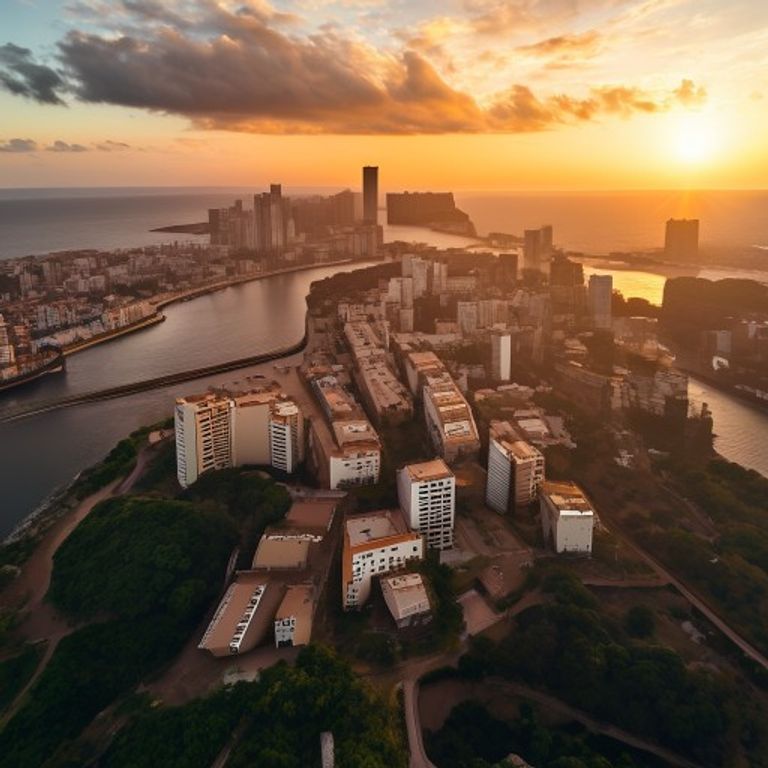
This municipality in the state of Paraná is an important hub for fostering reading and literary production, housing several writers and collectives who explore the identity of the interior and the city's urban planning in their works.
⚠️ Research conducted with the aid of Deep Research is subject to referential ambiguity.
🖥️Clean HTML code using a proprietary tool.
👥 Research by Guilherme Felipe, Curation by Sílvio Lôbo
The Literary Tapestry of Maringá: Voices, Scenarios, and Identity
Maringá, the "Song City" or "Garden City," built amidst the Paraná coffee plantations as a modernist urban project, has transcended its economic and urbanistic vocation to foster a rich and multifaceted literary production. Far from major publishing centers, but deeply rooted in the experience of Brazil's interior, Maringá's literature has woven its own tapestry, reflecting the dynamics of a young, planned, and cosmopolitan city, yet with an agrarian heart and a migrant soul. This essay proposes a dive into the waters of this production, exploring its main authors, movements, dissemination channels, and, above all, how local cultural identity is mirrored and refracted in its pages.
Pillars of Foundation and Early Voices
Maringá's literary history, like the city itself, is relatively recent. Born in the mid-20th century, it does not possess the centuries of tradition of Ouro Preto or Olinda. However, this youth has allowed for organic flourishing, often linked to the very narrative of its development. The first literary voices emerged concurrently with the city's growth, often as chroniclers of its own formation. Poetry and chronicles were prominent early genres, documenting the transformations from a village to a metropolis, the arrival of different ethnicities, and the clash between lush nature and human intervention. A seminal name in this period is Mário Ruas, considered one of the pioneers. Although not a native, his arrival in Maringá in 1948, when the city was still in its early stages, and his work as a journalist and writer, made him a reference figure. His chronicles and poems captured the spirit of pioneering, the incipient beauty of the landscape, and the optimism of the founders, contributing to the construction of a local imaginary. He represented the bridge between the founding experience and its first artistic transposition.
Marked Authors and Works
The vitality of Maringá's literature lies in the diversity of its authors and the resonance of their works, many of which have achieved national projection.
- Domingos Pellegrini Jr.: Undoubtedly, the most emblematic name in Maringá's literature. Born in the city in 1949, Pellegrini is an excellent narrator who, like few others, captured the soul of Paraná's interior and, specifically, of Maringá. His debut work, "O Caso do Martelo" (The Case of the Hammer) (1976), already revealed his talent for agile and engaging prose. But it was with "O Homem que Não Queria Ser Rei" (The Man Who Didn't Want to Be King) (1978), winner of the Jabuti Prize, that he consolidated himself, bringing to light the complexities of human relationships and the dramas of everyday life in a regional setting. His production spans novels, short stories, chronicles, and children's and young adult literature, always with colloquial language, humor, and sensitivity, making him an astute chronicler of the small and large tragedies and joys of life in Maringá and Paraná.
- Elias Ajouz: A poet of fine sensitivity and depth, Ajouz (1940-2022) was a constant and striking voice in Maringá's poetry. His work, permeated by existential reflections, time, and memory, often dialogues with the city itself, its gardens, and its people, but expands to universal issues. Titles like "A Rosa e o Tempo" (The Rose and Time) and "O Rosto da Palavra" (The Face of the Word) are examples of his contribution, characterized by lyrical refinement and the search for essence.
- Luiza Trindade: A poet and children's and young adult author, Luiza Trindade is another important figure. Her poetry, sometimes marked by delicacy and other times by subtle acidity, explores themes such as the female condition, nature, and everyday life. Her foray into literature for children and young people is also notable, with works that promote reading and reflection in new generations.
- Maurício de Almeida: Representing a more contemporary generation, Maurício de Almeida has stood out with his thought-provoking prose. His novel "Os Condenados" (The Condemned), for example, delves into social and existential issues, with dense narrative and complex characters, revealing the capacity of Maringá's literature to address universal themes from a local perspective.
- Miguel Sanches Neto: Although more associated with Ponta Grossa and the State University of Ponta Grossa (UEPG), where he works, Miguel Sanches Neto is a figure of great relevance in Paraná's literary scene, and his work frequently dialogues with the state's interior, influencing and being read in Maringá. His production, which spans fiction and essays, has a significant impact on the understanding of Paraná's identity and history.
Dissemination Channels and the Role of Publications
The consolidation of a literary scene intrinsically depends on dissemination channels and a publishing ecosystem. In Maringá, this process occurred through various avenues:
- Local Press: Newspapers like "O Diário do Norte do Paraná" and the now-defunct "Jornal do Povo" played a crucial role. Besides reporting on cultural events, many maintained literary supplements or columns, publishing chronicles, poems, and reviews by local authors. It was in these spaces that many of the first voices found their audience.
- State University of Maringá (UEM): UEM is a radiating hub of culture and knowledge. The university press (Eduem) plays a fundamental role in publishing research works, but also fiction and poetry by local and regional authors, in addition to promoting literary events, lectures, and contests, encouraging new generations of writers and critics. The Portuguese Language and Literature courses also foster research and literary criticism on local production.
- Magazines and Anthologies: Over time, Maringá saw the emergence of cultural magazines and anthologies that brought together poets and prose writers, offering a space for experimentation and dissemination. These publications, often short-lived, were vital for the effervescence of the scene.
- Literary Events: Book fairs, seminars, and writers' gatherings are constant in the city, promoting exchange between authors, readers, and publishers, and keeping the literary flame alive.
Maringá's Identity Reflected in Literature
Maringá's literature is a multifaceted mirror of its cultural identity. The city, planned amidst the exuberance of coffee and marked by immigration from various parts of Brazil and the world (Italians, Japanese, Germans, etc.), reflects these layers in its narratives:
- The Urban and the Rural: The tension between the planned modernity of the "Garden City" and its agrarian roots (the memory of coffee, neighboring farms) is a recurring theme. Literature explores the nostalgia for a rural past that has faded before the advance of concrete, but which still pulses in the collective memory.
- Migration and Identity Building: Maringá is a city of migrants. Local literature frequently addresses experiences of displacement, the search for new opportunities, the fusion of cultures, and the complexity of forming a new identity in a "new" territory. Characters seeking their place in the world, carrying the marks of their origins, are common.
- The "Song City" and Melancholy: The nickname "Song City" evokes an aura of poetry and beauty. However, Maringá's literature is not limited to an idyllic view. There is a subtle melancholy, a critical look at the unfulfilled promises of progress, urban loneliness, and the existential dramas that unfold under the shadows of the planned trees.
- The Everyday and the Universal: Authors like Domingos Pellegrini Jr. are masters at transforming the trivial everyday life of Maringá and its inhabitants into narratives that resonate universally. Through local situations and characters, they touch upon themes such as love, loss, betrayal, hope, and disillusionment, proving that the particular is the gateway to the universal.
Contemporary Perspectives and the Future
Currently, Maringá's literature continues to diversify. New authors emerge, many connected to UEM and social networks, exploring new forms and themes. There is a growing appreciation for contemporary poetry, experimental prose, and genres such as the fantastic and science fiction, which are beginning to find their space. The internet and digital platforms open new channels for publication and dissemination, allowing Maringá's voice to reach ever-larger audiences, breaking down the geographical barriers that once limited its diffusion.
Conclusion
Maringá's literature is a vibrant testament to the human capacity to create meaning and beauty from the fertile ground of experience. Far from being a mere appendix to Brazilian literature, it constitutes an autonomous body, with its particularities, its unique voices, and its deep connection to the soul of a city that has known how to flourish in every sense. Through its authors, its publications, and the incessant reflection on its own identity, Maringá continues to write important chapters in the grand narrative of national literature, proving that the "Garden City" is also a garden of inexhaustible words and stories.



