


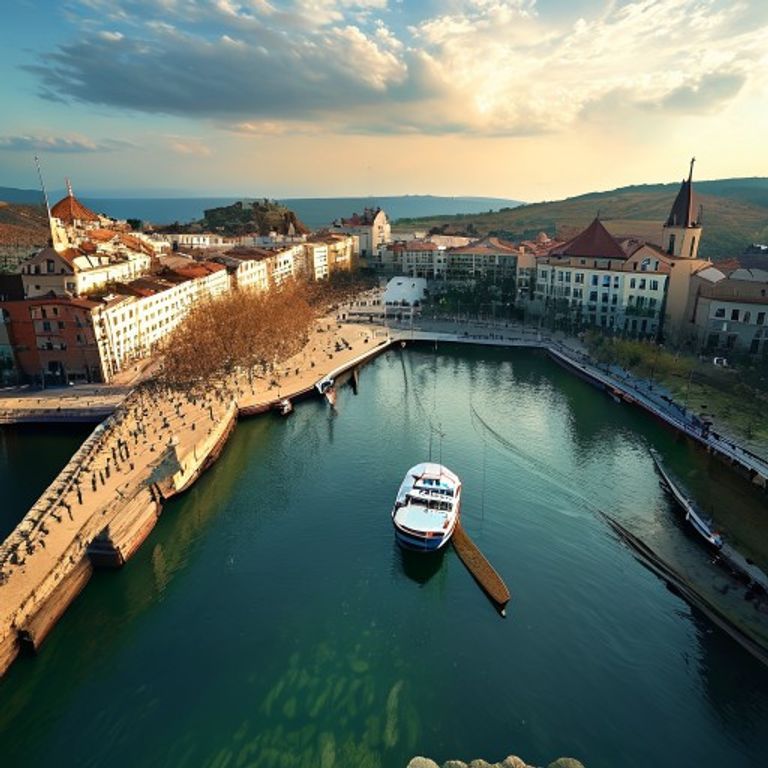
This municipality in the state of Amapá serves as a muse for chronicles that praise the beauty of its beaches and riverside life, being a meeting point for poets seeking the tranquility of the countryside.
⚠️ Research elaborated with the aid of Deep Research is subject to referential ambiguity.
🖥️Clean HTML code using a proprietary tool.
👥 Research by Guilherme Felipe, Curation by Sílvio Lôbo
The Resonance of the Tides: A Study of Porto Grande's Literature
Porto Grande, a city of ports and horizons that fade into the Atlantic, has been, throughout its history, not just a commercial hub but a fertile ground for literary expression. The region's multifaceted identity, shaped by arrivals and departures, the fusion of cultures, and the imposing presence of the sea, has resonated in a rich and diverse literature, capable of engaging with both the particular and the universal. This essay proposes a dive into the depths of this production, exploring its main authors, movements, publications, and the undeniable mark of local identity on its pages.
Founding Voices and Early Traces
The emergence of literature in Porto Grande can be traced back to the late 19th and early 20th centuries, with authors who, immersed in a transitional setting, sought to record the singularities of their environment. Joaquim da Costa e Silva, with his lyrical and descriptive prose, is frequently cited as one of the pioneers. His seminal work, *Marés da Alma* (1905), is a compendium of short stories and chronicles that paint the daily lives of fishermen, the mysticism surrounding the ocean, and the legends that populated the coastal villages. Costa e Silva established a fundamental link with regional naturalism, albeit with touches of late romanticism, by humanizing the landscape and infusing it with an almost mythical character. The "Generation of the Fog," an informal group of poets and prose writers who met in portside cafes in the early 1920s, explored Symbolist and Parnassian themes, seeking a more refined language, but without completely detaching themselves from local roots. Their publications, often in ephemeral periodicals, paved the way for future experimentation.
Modernism and the Affirmation of Identity
Modernism arrived in Porto Grande not as an abrupt rupture, but as a wave that gradually reshaped the literary landscape. The 1930s marked the rise of figures like Maria Eduarda Guimarães. In her novel *Cais em Vertigem* (1938), Guimarães bared the city's soul, exploring accelerated modernization, urban alienation, and the social conflicts underlying apparent prosperity. Her language, more direct and experimental, with stream of consciousness and incisive dialogues, broke away from the complacent descriptions of her predecessors, delving into the psychological complexities of her characters and social tensions. The "Lighthouse Group," formed by young intellectuals and artists, became the epicenter of local Modernism, promoting debates, launches, and the publication of the influential *Revista Atlântica*, which, despite its limited circulation, was vital for disseminating new aesthetic ideas and consolidating a distinct literary voice for Porto Grande, less dependent on larger literary centers.
Post-War and Engaged Literature
The 1950s and 1960s brought literature with a more social and political bent, in tune with the winds of change and the turmoil of the national scene. Antônio Valente emerged as one of the main exponents of this period. His novel *Os Náufragos da Terra Firme* (1962) is a poignant portrayal of the living conditions of port workers and the most marginalized segments of the city. With poignant realism and a clear concern for social denunciation, Valente gave voice to the invisible, exploring themes such as injustice, exploitation, and the struggle for dignity. Porto Grande's engaged literature reflected not only the local reality but also the anxieties of a nation in search of its identity and social justice, culminating in a body of work that echoed resistance and hope.
Contemporaneity: Diversity and Experimentation
From the 1980s onwards and into the 21st century, Porto Grande's literature has expanded in forms and themes, embracing diversity and experimentation. Authors like Clara Sampaio and Rafael Almeida represent this effervescence. Sampaio, with works like *Sussurros da Mangueira* (1995), blends magical realism with the region's oral history, bringing to light female narratives and the richness of Afro-descendant and indigenous cultures that intertwine in the formation of Porto Grande. Her prose is sensory, evoking the scents, colors, and sounds of the city and its surroundings, rescuing almost forgotten memories and folklore. Rafael Almeida, on the other hand, is a chronicler of contemporaneity. In *Roteiros da Noite Grande* (2010), he captures the urban pulse, digital connections, and the complexity of human relationships in a globalized Porto Grande, with agile language and a critical eye on the challenges of modernity. The city's contemporary literature engages with the global without losing its local accent, exploring new genres, from science fiction to visual poetry, and incorporating previously marginalized voices.
Essential Publications and the Literary Ecosystem
The development of literature in Porto Grande would not have been possible without a robust ecosystem of publications and cultural initiatives:
- Revista Atlântica: As mentioned, it was fundamental during the modernist period and, with interruptions, remained relevant, adapting to new aesthetics.
- Suplemento Literário da Gazeta Portuária: For decades, it was the main outlet for new talent, publishing short stories, poems, and critical reviews, serving as a barometer of local literary production.
- Editora Vento Sul: Founded in the 1990s, it is an independent publishing house that specializes in local authors, giving visibility to emerging and experimental voices, and is crucial for maintaining diverse production.
- Book Clubs and Book Fairs: Community and institutional initiatives that promote encounters between readers and writers, strengthening the literary scene and ensuring the perpetuation of the taste for reading.
Porto Grande's Identity in Literature
Porto Grande's literature is a multifaceted mirror of its cultural identity. Recurring and structuring elements permeate the works, regardless of period or style:
- The Sea and the Port: An almost omnipresent presence, sometimes as a source of livelihood, sometimes as a metaphor for life, separation, hope, or loneliness. The port is the gateway and exit, a symbol of constant transformation and human diversity.
- Cultural Mélange: The history of migrations and the formation of a mixed population are central themes. Literature reflects the coexistence and, at times, the conflicts of different ethnicities and traditions, from the indigenous peoples to European and African influences.
- Urban and Natural Duality: The tension between the city's progress and the exuberant nature (mangroves, restingas, beaches) is a narrative engine, highlighting the choices and impacts of development.
- Resilience and Struggle: Whether against the harshness of nature, social injustices, or existential challenges, Porto Grande's literature often celebrates the human capacity to persevere and reinvent oneself.
- Mysticism and Popular Imagination: Legends, superstitions, and popular religiosity, often linked to the sea and the land, enrich the narrative tapestry, lending a touch of magical realism to the local reality.
The language used by the authors, even in varied styles, often incorporates regionalisms and cadences that refer to the way of speaking of the people of Porto Grande, reinforcing authenticity and connection to the place. In summary, Porto Grande's literature is a living, dynamic heritage intrinsically linked to its land and its people. It is a testament to the human capacity to transform experiences and landscapes into narratives that transcend time and space, inviting the reader to unravel the layers of a city that, in its pages, reveals itself in all its complexity, beauty, and inexhaustible humanity.



