


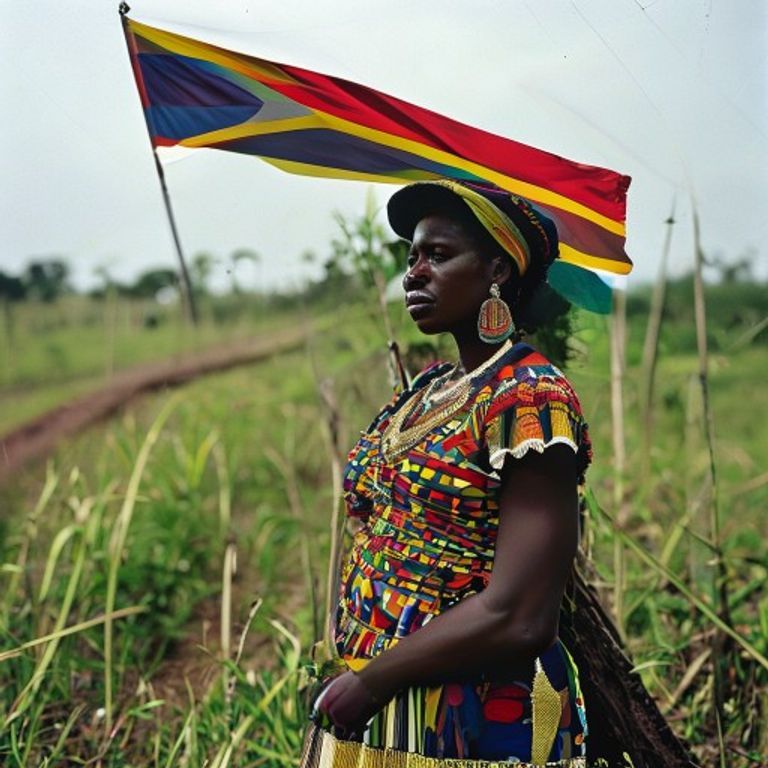
A geological and cultural giant, the DRC is the second largest country in Africa. Rich in vital minerals for global technology (such as cobalt), it is home to the world's second-largest tropical rainforest. The Congo River defines its geography. Despite historical conflicts in the east, the country pulses with creativity, being the birthplace of Congolese Rumba and possessing an impressive urban vitality in Kinshasa.
1. Historical Context and Roots
To begin, it is essential to explain that written literature in the DRC emerges from the encounter (often violent) between oral tradition and Belgian colonization.
-
Oral Tradition: Before alphabetic writing, literature existed through "oraliture": epics, proverbs, and tales transmitted by griots (storytellers). This oral foundation influences the structure of modern Congolese novels to this day.
-
The Role of Missions: Writing was primarily introduced by Belgian Catholic missionaries. The first texts written by Congolese were often religious or ethnographic essays requested by the colonizers to understand local culture.
-
The "Language": The official literature of the DRC is predominantly in French (administrative language), but there is a vital production in national languages such as Lingala, Swahili, Kikongo, and Tshiluba.
2. Phases of Congolese Literature
Professor and literary critic Mukala Kadima-Nzuji (the foremost authority on the subject) divides DRC literature into clear phases that you can use in your slides:
A. Colonial Period (1945–1960)
The emergence of the "Évolués" (the elite educated by the Belgians). They wrote in newspapers like La Voix du Congolais.
-
Focus: Claiming dignity and valuing autochthonous culture, but still under Belgian tutelage.
-
Highlight: Poetry influenced by the Négritude movement (which valued Black identity).
B. Post-Independence and the Mobutu Era (1960–1990)
With independence and the subsequent dictatorship of Mobutu Sese Seko (who renamed the country Zaire), literature became divided:
-
Legitimization Literature: Works that exalted "Authenticity" (Mobutu's cultural policy).
-
Contestation Literature: Writers who criticized corruption and authoritarianism, often using metaphors to evade censorship or writing from exile.
C. Contemporary Literature (1990–Present)
Marked by civil wars and the diaspora. Today's authors speak about the urban chaos of Kinshasa, violence, mining, and life abroad.
3. Key Writers and Works
Here are four essential authors who cover different spectrums of DRC literature.
V.Y. Mudimbe (Valentin-Yves Mudimbe)
One of the greatest living African philosophers and novelists. His work is dense, intellectual, and questions how the West "invented" Africa.
-
Profile: Academic, lives in the USA, focuses on the existential crisis of the African intellectual.
-
Key Work: Entre les eaux (Between the Waters) - Narrates the story of an African priest torn between the Catholic Church (Western) and Marxist revolution.
-
Key Work: L’Écart (The Deviation) - About a young historian who goes mad trying to write the history of his tribe.
Zamenga Batukezanga
The opposite of Mudimbe. He was the most popular writer in the DRC. He wrote for the people, with simple language, mixing French with local expressions. His books were sold in markets and pharmacies.
-
Profile: Focused on morality, daily life, and the adaptation of tradition to modern life.
-
Key Work: Un Croco à Luozi (A Crocodile in Luozi).
-
Key Work: Les Hauts et les Bas (The Ups and Downs) - Depicts the difficulties of urban life in Kinshasa.
Antoine-Roger Bolamba
A central figure of the pre-independence period and poetry.
-
Profile: Journalist and politician, he was heavily influenced by surrealism and Négritude.
-
Key Work: Esanzo: Chants pour mon pays (Esanzo: Songs for my country) - A collection of poems published in 1955, fundamental for the affirmation of Congolese identity.
Fiston Mwanza Mujila
The current and international voice of the DRC. He lives in Austria but writes about the madness of Congolese cities.
-
Profile: Frenetic style, imitating the rhythm of Jazz and Congolese Rumba.
-
Key Work: Tram 83 (published in Brazil by Deep Vellum/Trinta Zero Nove). The book is set in a city reminiscent of Lubumbashi, in a bar where miners, prostitutes, and students meet. It is a globally awarded work.
4. Golden Tip for Presentation
Differentiate the DRC (Kinshasa) from the Republic of the Congo (Brazzaville). Many people confuse them. Alain Mabanckou and Sony Labou Tansi (although the latter was born in the DRC, he built his career in the neighboring country) are often associated with "Little Congo" (Brazzaville). For your presentation to be 100% accurate about the DRC, focus on the names above (Mudimbe, Zamenga, Mujila).
5. Bibliographical References
To ensure the credibility of your work, use these sources:
-
KADIMA-NZUJI, Mukala. La littérature zaïroise de langue française (1945-1990). Paris: Karthala, 1984. (This is the "bible" of Congolese literature).
-
MUDIMBE, V. Y. The Invention of Africa: Gnosis, Philosophy, and the Order of Knowledge. (There is a Portuguese translation, useful for citing the philosophical context).
-
DJUNGU-SIMBA, Charles. "L'état des lieux des lettres congolaises". In: Notre Librairie, nº 128, "Littérature congolaise (RDC)", 1997.
-
HALEN, Pierre. "Notes pour une historiographie de la littérature congolaise". In: Études littéraires africaines, 2008.

Editor's Note: Research conducted with the assistance of Deep Research is subject to referential ambiguity and may confuse facts and people. Although Sílvio de Souza Lôbo Júnior has reviewed the material to resolve such inconsistencies, it is advised that inaccuracies may persist. We count on your help for clarifications and suggestions. Contact the Editor.



