


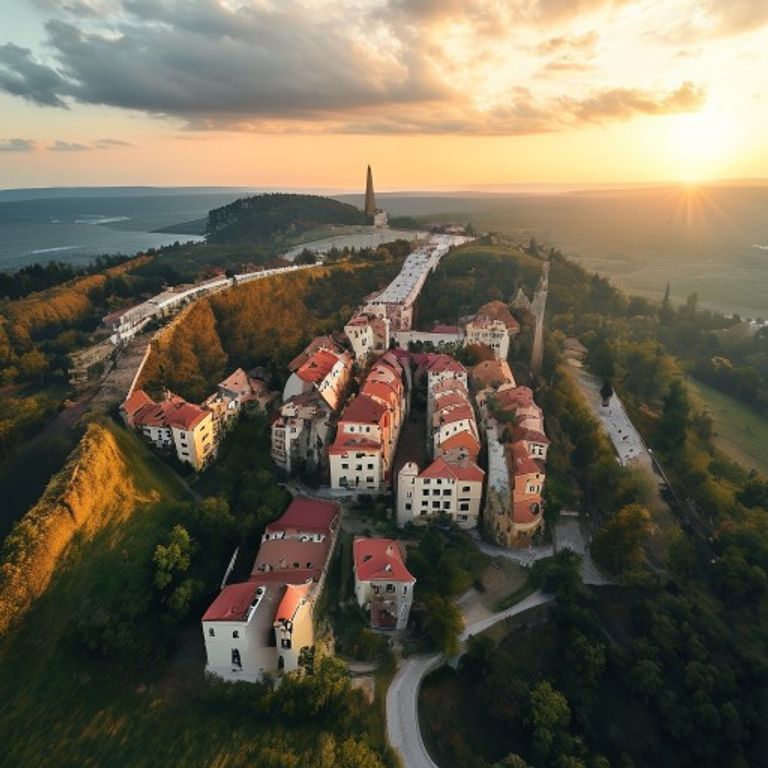
The heart of the Balkans, Serbia is a nation of indomitable spirit and legendary nightlife in Belgrade. A land of medieval Orthodox monasteries and raspberries, it has a history marked by conflict and resilience. The Serbian people are known for their intense hospitality, passion for sports (tennis, basketball), and a cuisine rich in grilled meats.
⚠️ Research elaborated with the help of Deep Research is subject to referential ambiguity.
🖥️Clean HTML code with the use of a proprietary tool.
👥Research by Guilherme Felipe, Curation by Sílvio Lôbo
The Soul of Serbia in Words: An Analysis of Serbian Literature
Serbian literature, with its deep roots in the country's history and unique cultural identity, is a vibrant mirror of its struggles, triumphs, and the soul of its people. This essay aims to explore the most significant facets of Serbian literary production, from its pioneers to contemporary voices, outlining the movements that shaped its course and the works that have become indelible landmarks.
The Origins and Formation of a Literary Identity
The origins of Serbian literature are intrinsically linked to the Christianization and the formation of the medieval Serbian state. Oral tradition, rich in epics and legends, served as the foundation for the first written manifestations. The Slavic language and the Cyrillic alphabet, introduced by Saints Cyril and Methodius, were the primary vehicles of this cultural expression. Epic poetry, focusing on national heroes, battles, and the struggle for faith, dominated the early centuries, establishing a patriotic and religious tone that would resonate for generations.
The Rise of Romanticism and Nation-Building
The 19th century marked a period of literary effervescence, driven by nationalist fervor and the desire for emancipation from Ottoman rule. Serbian Romanticism, with its emphasis on emotion, folklore, and the glorification of the past, found a central figure in Vuk Stefanović Karadžić. His reform of the Serbian literary language, based on popular speech, and his vast collection of folk songs and tales were crucial for linguistic unification and the consolidation of a national literary identity. Poets like Jovan Jovanović Zmaj, known for his patriotic and lyrical poems, and Laza Kostić, with his philosophical and experimental poetry, set the tone for this era.
The 20th Century: Modernism, Socialist Realism, and the Diversity of Voices
The 20th century witnessed a plurality of literary movements and styles in Serbia. Modernism brought new forms of expression, exploring subjectivity and formal experimentation. Authors like Ivo Andrić, a Nobel laureate in Literature in 1961, stand out for his rich and profound prose, which portrays the complexity of life in the Balkans under Ottoman rule, with works such as "The Bridge on the Drina" and "The Impatient."
The post-World War II period and the socialist era saw the rise of Socialist Realism, which aimed to depict the construction of the new society and communist ideals. However, even within this current, authors emerged who infused their works with nuances and questions.
The second half of the 20th century was also marked by dissident and critical voices, who addressed social and existential themes with depth. Danilo Kiš, one of the most important Serbian and European writers, explored the complexities of identity, memory, and history in works such as "A Tomb for Boris Davidovich" and "Garden, Ashes." His work, often marked by biting irony and a profound sense of tragedy, transcended borders and influenced generations of writers.
Other prominent 20th-century authors include:
- Miloš Crnjanski, known for his lyrical and expressionist style, especially in "A Serbian Migration."
- Meša Selimović, whose works explore morality, religion, and identity in Balkan lands, as in "Dervish and Death."
- Borislav Pekić, who experimented with historical and philosophical fiction, authoring "The Time of Slaves."
Contemporary Serbian Literature: Challenges and New Perspectives
Contemporary Serbian literature reflects the challenges and transformations of a country that has gone through wars, political transitions, and a search for its redefinition on the global stage. Current voices address themes such as the memory of conflicts, national identity in a globalized world, social issues, and the existential dilemmas of the individual. Literary production is diversifying, exploring genres such as historical novels, thrillers, science fiction, and autofiction.
Authors such as Svetislav Basara, with his ironic and irreverent prose, Mirko Kovač (based in Croatia, but with strong influence on Serbian literature), with his experimental and poetic approach to reality, and Gordana Kuić, who portrays the lives of women and minorities in a transforming Belgrade, are examples of the vitality of contemporary Serbian literature.
Serbian Cultural Identity Reflected in Literature
Serbian cultural identity is an undeniable thread running through its literary production. Works frequently delve into Orthodox religious traditions, the rich folklore tapestry, the turbulent history of the Balkan region, and the complexities of inter-ethnic relations. Resilience, nostalgia, the struggle for freedom, and the search for a place in the world are recurring themes that echo the Serbian spirit.
Family, community, and a sense of belonging are pillars that sustain many narratives. At the same time, Serbian literature does not shy away from exploring the divisions, traumas, and contradictions that have shaped the Serbian people's experience. This honesty, often painful, lends the literature a depth and authenticity that makes it universal.
Conclusion
Serbian literature is a literary treasure that offers a unique glimpse into the soul of a nation. From medieval epics to contemporary voices, Serbian authors have dedicated themselves to unraveling the complexities of human existence, forging an identity amidst adversity, and celebrating the richness of their culture. Through their words, Serbia reveals itself not just as a point on the map, but as a universe of stories, emotions, and reflections that deserve to be discovered and appreciated.



