


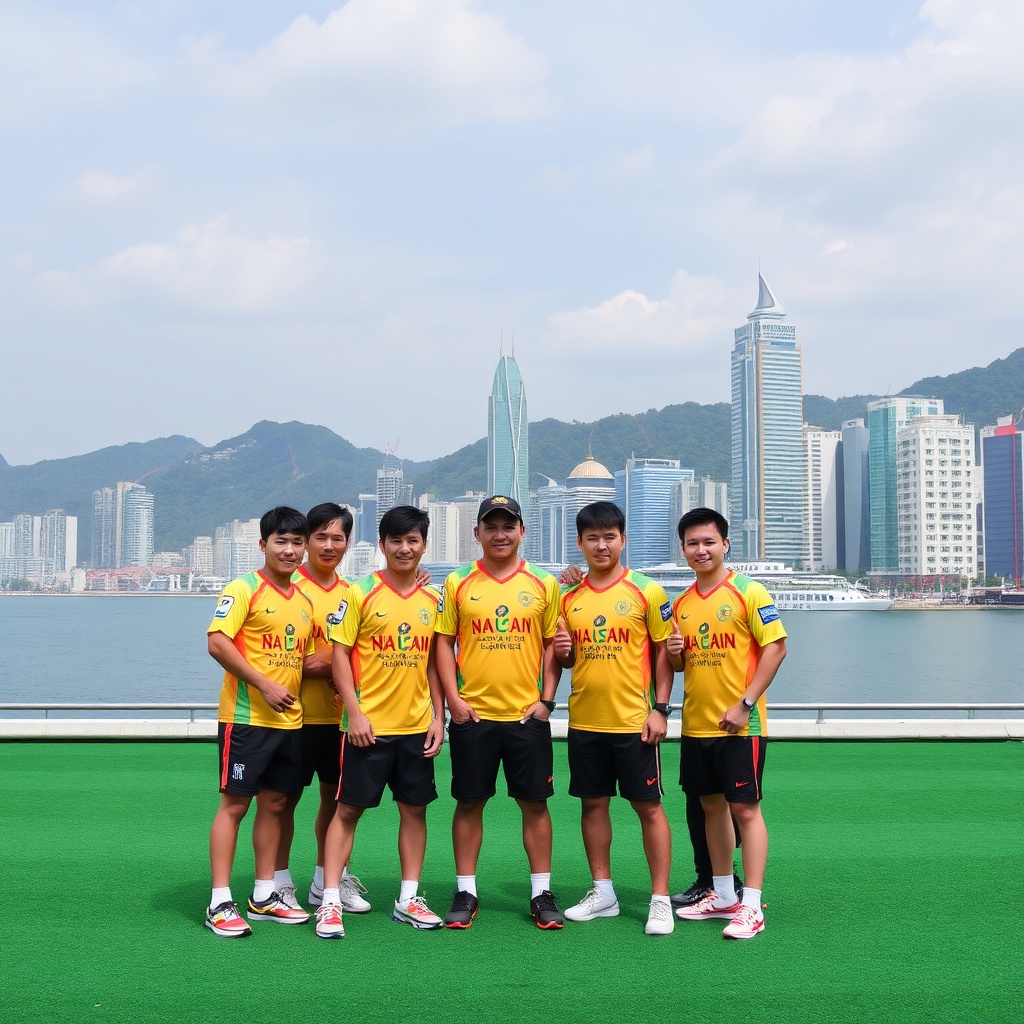
Under the colossal shadow of the neon skyscrapers that define the "Las Vegas of the East," where billions of dollars circulate daily through the baccarat tables of the Cotai Strip, there exists a sporting universe that operates in a parallel dimension, almost invisible to the eyes of mass tourism. This is the football of Macau, one of the smallest and most unique member associations of FIFA. Representing a Special Administrative Region (SAR) of the People's Republic of China, the Macau national team—historically known as the "Green" team due to the color of its flag adorned with the lotus flower—carries in its DNA a complex patchwork of identity. It blends the Portuguese colonial past, Chinese geopolitical sovereignty, persistent amateurism, and the economic gigantism of one of the richest regions on the planet, which, paradoxically, neglects its own football. Analyzing the Macau national team is not just about dissecting the tactics of a team accustomed to the depths of the FIFA Rankings, but rather deciphering a fascinating socio-political essay on how the world's most popular sport survives and resists in a territory of a few square kilometers, squeezed between state promotion and corporate apathy.
1. Origins and Formation of National Identity
The history of football in Macau is inevitably intertwined with the history of the Portuguese presence in the Pearl River Delta. Introduced in the early 20th century by sailors, military personnel, and civil servants from Lisbon, the sport quickly took root on the peninsula and the islands of Taipa and Coloane. The founding of the Macau Football Association (MFA) in 1939 formalized a practice that was already feverish in Catholic schools and barracks. For decades, local football developed under a dual-faced colonial aegis: on one hand, it served as an element of social distinction and preservation of the Lusitanian identity for the metropolitan elite and the Macanese community (the Luso-descendants born in the territory); on the other, it functioned as one of the rare bridges of integration with the overwhelming majority of the ethnic Chinese population.
This cultural syncretism shaped the territory's first clubs. Institutions such as Sporting Clube de Macau (founded in 1926) and Benfica de Macau (established in 1951) were born as direct branches of Portugal's giants, replicating their colors, symbols, and rivalries. In parallel, clubs of purely Chinese origin or community character, such as the now-defunct Lam Pak or Monte Carlo, emerged to give a voice to the local youth who did not see themselves fully represented in the colonial structures. The national team, therefore, was born divided between these two worlds. Until the mid-1970s, it was common for the best players in the territory—many of them of Portuguese descent—to migrate to metropolitan football or to neighboring Hong Kong, which already had a professionalized and much more attractive league.
Macau's affiliation with the Asian Football Confederation (AFC) in 1976 and FIFA in 1978 marked the beginning of its official sporting emancipation, allowing the small territory of just over 30 square kilometers to compete under its own flag in World Cup and Asian Cup qualifiers. However, the true test of identity occurred in 1999, with the transfer of sovereignty from Portugal to China. Under the constitutional formula "One Country, Two Systems," Macau secured the right to maintain its sporting autonomy, keeping its national Olympic committee (though not recognized by the IOC) and its football federation affiliated independently with FIFA. This condition of "sporting independence within Chinese sovereignty" created a peculiar scenario: on the pitch, the Macau team represents a unique local identity, where the national anthem played is China's "March of the Volunteers," but the flag hoisted is the green one with the lotus flower, and the federation's official communication still preserves, at least formally, bilingualism in Portuguese and Cantonese.
The preservation of this hybrid identity is directly reflected in the historical composition of its call-ups. Over the last few decades, the Macau team has been a meeting point for three distinct profiles of athletes: local ethnic Chinese players, who constitute the numerical base of the territory's football; Macanese athletes of Luso-root, who carry the technical heritage of European football; and naturalized foreign players—mostly of Portuguese or Brazilian origin—who found a new sporting homeland in Macau. This mix, while rich from an anthropological point of view, imposes constant challenges of tactical and linguistic cohesion, turning the national team's dressing room into a microcosm of contemporary Macanese society itself.
2. Golden Era, Great Campaigns, and Eternal Idols
Speaking of a "Golden Era" for a team that historically occupies the most modest positions in world football requires a calibration of expectations. For Macau, glory is not measured in continental trophies or World Cup qualifications, but in moments of competitive dignity and the overcoming of geographical and demographic limits. The high point of this trajectory occurred indisputably in 2016, during the first and only edition of the AFC Solidarity Cup, held in Malaysia. The tournament, created specifically to provide an international calendar for teams eliminated early in the preliminary stages of World Cup and Asian Cup qualifiers, became the stage for the greatest epic of Macanese football.
Under the technical command of local coach Tam Iao San, Macau presented a pragmatic style of football, based on solid defensive organization and extremely efficient quick transitions. In the group stage, the team debuted with a 2-1 victory over Mongolia, followed by a 1-1 draw against Laos and a categorical 2-1 victory over Sri Lanka. In the semifinals, in a dramatic duel against Brunei, Macau fought for a 1-1 draw in regulation time and secured qualification for the historic final by winning the penalty shootout 4-3, under the leadership of goalkeeper Ho Man Fai. Although the final against Nepal ended in a painful 1-0 defeat under a torrential downpour in Kuching, the silver medal was received in the territory as an unprecedented achievement, proving that, under the right preparation conditions, Macau could compete on equal terms at its continental level.
This historic campaign consolidated the status of national heroes for a generation of players. The main name of this era is striker Leong Ka Hang. Possessing formidable speed and a sense of positioning rare for local standards, Leong was elected the Most Valuable Player (MVP) of the 2016 Solidarity Cup. His trajectory is a beacon of hope for local football: he was one of the very few players born in Macau to manage to turn professional abroad, having successfully defended first-division clubs in Hong Kong, such as Wofoo Tai Po and Pegasus FC. His presence on the team not only raised the technical level of the attack but also served as inspiration for the young amateurs who shared the dressing room with him.
Another fundamental pillar of this recent history is the Portuguese-born striker Nicholas Torrão, affectionately known as Niki Torrão. Born in South Africa but raised on Macanese soil, Torrão embodies the physical strength and presence in the box that the territory's teams have historically lacked. With decisive goals in qualifiers and in the Solidarity Cup itself, he became a reference for leadership and commitment. Alongside him, names like defender Filipe Duarte (trained in the youth ranks of Benfica in Portugal and naturalized Macanese) and veteran goalkeeper Chan Tat Sun—who for over two decades defended Macau's goal with miraculous displays against Asian powerhouses—complete the gallery of eternal idols of a football team that learned to celebrate its small and rare victories as if they were world titles.
3. Rivalries, Crises, and Behind-the-Scenes Power
The geopolitics of football at the mouth of the Pearl River is marked by a historic and fraternal rivalry: the clash against Hong Kong. Known as the "Macau-Hong Kong Interport," this is one of the oldest bilateral tournaments in Asia, played almost annually since 1937. For Macau, facing Hong Kong has always been more than a sporting test; it was the opportunity to measure strength against the wealthy, cosmopolitan, and historically more developed neighbor in football. Although the record is widely favorable to Hong Kong, Macau's rare victories in the Interport are kept in the local collective memory as moments of profound affirmation of its regional identity.
However, the history of Macanese football is not made only of sporting romanticism. The behind-the-scenes of the Macau Football Association are often described by local critics as an environment of considerable administrative apathy and controversial decisions that, at times, undermined the development of the sport. The biggest and most dramatic of these crises occurred in June 2019, during the first round of the Asian Qualifiers for the 2022 World Cup. Macau had achieved a historic result in the first leg, beating the Sri Lanka team 1-0 in Zhuhai (a match played in the neighboring city due to renovations at the Macau stadium), with a goal by defender Filipe Duarte.
The prospect of advancing to the second round of the qualifiers for the first time in history was within reach. However, citing extreme security concerns following the Easter Sunday terrorist attacks in Sri Lanka, the MFA board decided unilaterally that the team would not travel to Colombo to play the return leg. The decision sparked unprecedented revolt among the national team players. In a rare display of unity and rebellion, the athletes released an open letter signed by almost the entire main squad and the youth teams, begging the federation to let them travel, even offering to cover the costs of private security and sign civil liability waivers.
The federation remained unyielding. In protest, the country's main players threatened to never wear the national team jersey again and boycotted local competitions. FIFA and the AFC applied the rules strictly: Macau was punished with a forfeit (3-0), a financial fine, and the consequent elimination from the tournament. The episode left deep scars. Local and international public opinion harshly criticized the MFA's stance, seen as cowardly and disconnected from the sporting spirit of the athletes who had battled on the pitch for that historic qualification. The crisis exposed the political fragility of a federation that, in the eyes of many analysts, prefers to avoid diplomatic and operational risks rather than support the legitimate sporting ambitions of its players.
4. The Current Moment: Tactics, Generation, and Challenges
Currently, the Macau national team is going through a complex process of generational and tactical transition, aggravated by the severe impacts of the COVID-19 pandemic, which almost completely paralyzed football in the territory between 2020 and 2022 due to the extreme isolation policies adopted by the local administration in alignment with Beijing. Under the technical command of experienced Portuguese coach Lázaro Oliveira, who took the job with the mission of modernizing the team's style of play, Macau is trying to restructure itself to become competitive again in the East Asian scene.
Tactically, the Macau team has historically resorted to a system of extreme defensive containment, using low blocks, often structured in a rigid 5-4-1 or 4-5-1, with the clear objective of minimizing damage against physically and technically superior opponents. Under Lázaro Oliveira's direction, there is a gradual attempt to implement a more dynamic model of play. The coach seeks to introduce concepts of quick offensive transition and greater compactness of the midfield lines, using the 4-3-3 or 4-2-3-1 system, but the transition hits the physical and technical limitations of a squad composed mostly of amateur or semi-professional athletes.
The current generation reflects this competitiveness gap. With the retirement or physical decline of pillars like Niki Torrão and Filipe Duarte, the team is looking for new leaders. Players like midfielder Lam Ka Seng and young striker Pang Chi Hang are trying to take the lead, but the lack of high-level international match rhythm is a constant obstacle. The base of the national team plays in the Macau Elite League, a championship that, although it has structured teams like Chao Pak Kei (CPK) and Benfica de Macau, lacks daily intensity and competitiveness.
The greatest tactical and physical challenge for the team lies in the amateur nature of its athletes. Most national team players have full-time jobs—many of them working in public administration, the hospitality sector, physical education, or the casino industry itself—and train only at night, two or three times a week. Facing teams that have fully professionalized athletes, such as neighbors Hong Kong, Taiwan, or the powerhouses of Southeast Asia, becomes a Herculean task. The lack of physical intensity in the final minutes of matches is a chronic symptom of this reality, where heart and tactical commitment try to compensate for the absence of a high-performance athlete routine.
5. Talent Development, Structure, and Future
To understand the future of football in Macau, one must analyze the physical and economic geography of the territory. Macau is one of the most densely populated regions on the planet. In such a small territorial space, land is a resource of astronomical value. Consequently, the construction of regulation-sized football fields competes directly with multi-billion dollar real estate projects or the expansion of entertainment and casino complexes. The result is a chronic shortage of quality sports infrastructure.
The Macau Olympic Complex Stadium, located in Taipa and with a capacity for about 16,000 spectators, is the main temple of local football, but its use is restricted and often shared with cultural and athletics events. Most Elite League clubs and youth teams train on synthetic grass fields of varying quality, often sharing the same space with weekend amateur leagues. Without dedicated and modern training centers, the technical development of Macau's young athletes is severely limited from childhood.
The talent development structure is based almost exclusively on the MFA's own youth development program, which organizes grassroots football schools, and on occasional initiatives by private clubs. However, the great bottleneck of Macanese football occurs in the transition from adolescence to adulthood. Faced with the absence of a professionalized league that offers competitive salaries and financial stability, the most promising young people in Macau face an inevitable dilemma around the age of 18: give up football to enter local universities or focus on lucrative careers within the economic machine of casinos and the civil service. For the overwhelming majority, football becomes just a luxury hobby.
Despite this challenging scenario, the future of football in Macau may find a lifeline in the regional integration promoted by the central government in Beijing. The Guangdong-Hong Kong-Macau Greater Bay Area project aims to create a megalopolis integrated economically and socially. In the sporting sphere, this integration opens doors for young talents from Macau to be integrated into professional club academies in the neighboring Guangdong province or to play in the professional leagues of mainland China (Chinese Super League and China League One) without occupying foreign player spots. This synergy, combined with the joint hosting of the 2025 National Games of China—which will have Macau as one of the venues—could act as the catalyst needed to attract private investment and for the definitive modernization of athlete training structures in the territory.
Macau's football, therefore, walks a tightrope between the preservation of its romantic and amateur identity and the urgent need for professionalization so as not to become irrelevant on the Asian football map. As long as the ball keeps rolling under the shadow of the casinos, the green-and-reds of the lotus flower will continue to prove that the passion for the game is not measured by the size of the territory, but by the dignity of those who wear the shirt and defend, against all odds, the colors of their sporting homeland.



