


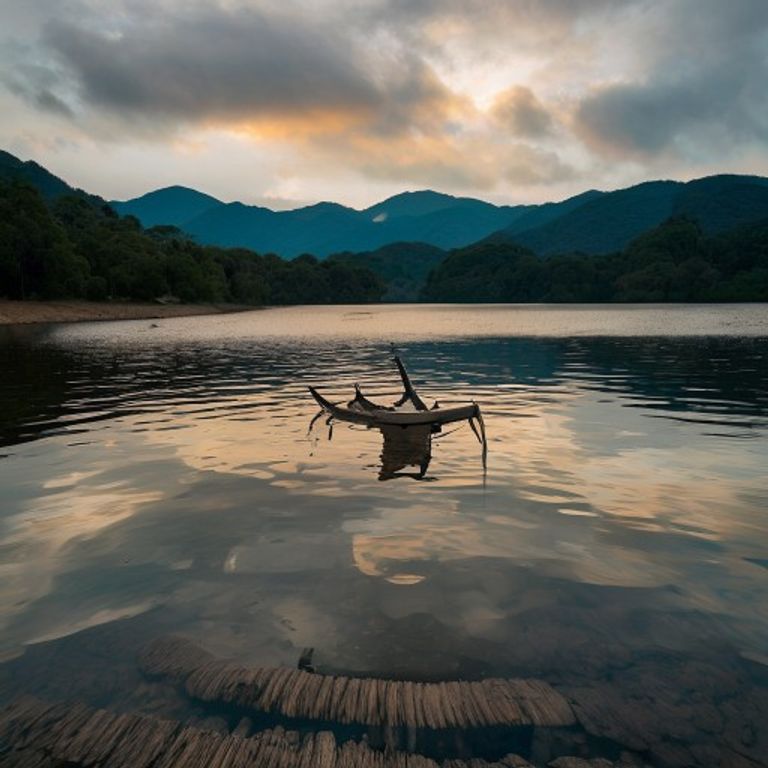
A controversial UFOlogy story from the thirties reports that a Canadian hunter found an Inuit village completely deserted, with pots still on the fire and sled dogs buried in the snow.
⚠️ Research elaborated with the aid of Deep Research is subject to referential ambiguity.
🖥️Clean HTML code using a proprietary tool.
👥 Research by Guilherme Felipe, Curation by Sílvio Lôbo
The Anjikuni Lake Enigma: When Silence Screams Mystery
The Arctic, vast and unforgiving, holds secrets that defy logic and human comprehension. Amidst the icy and remote landscapes of Canada, one lake in particular, Anjikuni, became the stage for one of the most intriguing and disturbing mysteries of the 20th century: the mass disappearance of an Inuit village and the subsequent absence of any trace of struggle or rational explanation.
1. The Context and the Incident: Where, When, and How the Mystery Began
Anjikuni Lake, located in the Kivalliq region of Nunavut, Canada, was home to a thriving and traditional Inuit community. In 1930, life followed its course, marked by hunting, fishing, and resilience in the face of climatic adversities. It was during the harsh winter of that year that the unthinkable happened. A lone Inuit hunter, known as Joseph Laberge, seeking supplies and shelter from a snowstorm, arrived at the village and found a desolate and inexplicable scene.
As he approached, Laberge noticed the absence of smoke from the chimneys, a usual sign of life in any settlement. Upon entering the tents and igloos, he was met with a surreal sight: food cooking on the fires, personal belongings scattered as if people had just stepped out for a brief walk, but with no sign of struggle, despair, or any indication of forced departure. All approximately 30 to 40 people who inhabited the village had vanished without a trace.
2. Timeline of Events
- Late 1930: Inuit hunter Joseph Laberge arrives at the village on Anjikuni Lake.
- Macabre Discovery: Laberge finds the village completely uninhabited, with evidence of abruptly interrupted life.
- Authorities Alerted: Laberge communicates his findings to the nearest Canadian authorities.
- Initial Investigation: The Royal Canadian Mounted Police (RCMP) begins an investigation, but severe weather conditions and the vastness of the region hinder efforts.
- Confused and Conflicting Reports: Over the years, the case has taken on legendary proportions, with accounts varying in detail but maintaining the core of the inexplicable disappearance.
- Decades of Silence: The case remains an archived enigma, periodically revived by journalistic investigations and public interest.
3. Main Theories
The absence of concrete explanations has opened a range of theories, from the most mundane to the most fantastic. It is crucial to distinguish between hypotheses that seek a logical basis and those that delve into speculation.
Probable Scientific and Police Hypotheses:
- Isolated Natural Disasters: One possibility is that an extreme and sudden natural event occurred, such as a localized earthquake, a massive snowslide, or a sudden flood (though unlikely in the Arctic winter). The hypothesis would be that the population was forced to abandon their homes in search of safety, later dispersing. However, the lack of destruction or bodies weakens this thesis.
- Epizootic or Contamination: A sudden and highly contagious disease could have led to rapid death and disappearance of bodies (e.g., if survivors, in panic, moved the dead to a location to avoid contamination, or if the disease itself caused erratic behavior). The lack of medical evidence, however, makes it difficult to prove this hypothesis.
- Forced Migration or Mass Escape: An external threat – such as an attack by fierce wild animals, or even intertribal conflict (although there is no record of such an event in the region at the time) – could have led the inhabitants to flee in desperation. The lack of signs of struggle and the abandonment of belongings make this option less likely, unless the escape was extremely rapid and organized under duress.
- Extreme Weather Conditions and Disorientation: A particularly violent and short-lived snowstorm could have disoriented the inhabitants, leading them to get lost in the frozen vastness. However, the amount of food left cooking and the absence of any preparation for the cold suggest something more than a simple outing.
Alternative, Conspiracy, or Paranormal Theories:
- Alien Abduction: This is one of the most popular and speculative theories. The idea is that beings from another planet took the village inhabitants. The lack of a logical explanation for the disappearance, the absence of struggle, and the isolated nature of the location are often cited as circumstantial "evidence."
- Paranormal/Supernatural Phenomena: Some theorize that unknown forces, spiritual entities, or psychic phenomena could be responsible for the disappearance. The narrative resembles tales of mysterious disappearances that permeate the folklore of various cultures.
- Secret Government Experiments: A conspiracy theory suggests that the Canadian government or another secret agency was involved in experiments that culminated in the village's disappearance, possibly using unknown technology or biological weapons. The lack of any concrete evidence, however, leaves this hypothesis in the realm of speculation.
- The "Green Fire" and UFOs: Witness reports (though often later and from indirect sources) mention the observation of a "green fire" in the sky before or during the period of the disappearance. This information, when present, is often linked to UFO sightings.
4. Controversies and Blind Spots
The official investigation of the Anjikuni case was marked by difficulties inherent to the region and the nature of the incident. Several points contribute to its nebulous character:
- Difficulty of Access and Limited Expertise: In the 1930s, access to Anjikuni Lake was extremely precarious, especially during winter. The Royal Canadian Mounted Police (RCMP) faced considerable logistical challenges in reaching the site, which may have limited the depth and scope of the initial investigation. Official reports on the investigation, if they exist in detail, are difficult to access publicly.
- Conflicting Testimonies and the Oral Nature of Witnesses: Many of the accounts of the case were transmitted orally over time, undergoing various interpretations and additions. Communication with Inuit communities, while essential, may have suffered from linguistic and cultural barriers that, without malice, could have distorted crucial details.
- Absence of Conclusive Forensic Evidence: The lack of bodies, signs of struggle, or excavation tools suggests an atypical event. Forensic research of the time, limited by conditions, would have had few tools to analyze such a peculiar scenario.
- The Role of Joseph Laberge: Although he is the main witness, details about his own account and his subsequent interaction with the authorities may have undergone alterations or been omitted in later records. His figure is central, but the absolute clarity of his original testimony is a point to consider.
- The "Buried" Nature of the Case: It is possible that, given the absence of apparent crimes or rational explanations, the case was treated with less urgency or depth by the authorities, contributing to its premature archiving or the lack of a comprehensive official record.
5. Curiosities and Legacy
The Anjikuni Lake Incident Case has transcended its origin as a local event to become an icon of unsolved mysteries. Its impact is notable:
- Influence on Popular Culture: The mystery has inspired books, documentaries, TV series episodes (such as in "The X-Files"), and countless discussions on online forums. It fuels the popular imagination about what can happen when civilization encounters the unknown in unexplored landscapes.
- Symbol of the Arctic Unknown: The case encapsulates the fascination and fear that the Arctic evokes. The vastness, isolation, and extreme conditions create a perfect backdrop for stories of inexplicable disappearances.
- Current Status: Officially, the case remains an unsolved mystery archived by Canadian authorities. Although it has not been formally reopened with new concrete clues, its legacy persists in the collective imagination, keeping alive the flame of investigation and speculation about what truly happened on that fateful night at Anjikuni Lake.
The enigma of Anjikuni Lake continues to echo, a somber reminder that, no matter how much science advances, there are still corners of our planet and our own existence that hold secrets that silence refuses to reveal.



