


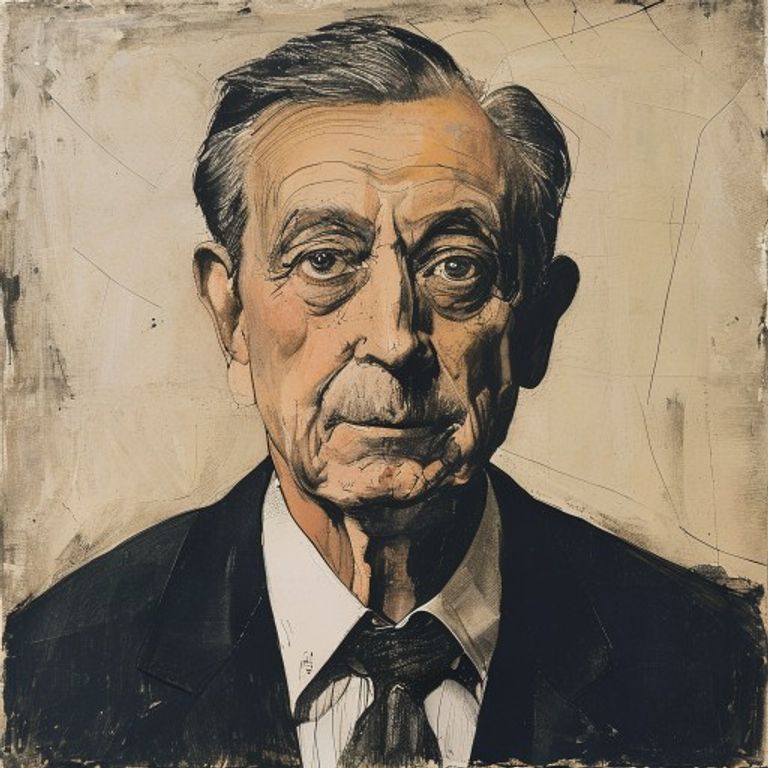
The gambler who allegedly fixed the 1919 World Series and was killed in 1928 for refusing to pay a high-stakes gambling debt.
⚠️ Research conducted with the aid of Deep Research is subject to referential ambiguity.
🖥️ Clean HTML code using a proprietary tool.
👥 Research by Guilherme Felipe, Curation by Sílvio Lôbo
The Enigma of Arnold Rothstein: The King of Bootlegging and the Bullet That Stopped New York
The name Arnold Rothstein evokes a dark golden age of organized crime in New York, a period of prohibition, clandestine betting, and ruthless loyalty. Known as "The Brain," Rothstein was not a violent enforcer, but a master strategist, a casino businessman, and, above all, the architect behind a financial empire built on bootlegging during Prohibition. However, the narrative of his meteoric rise and unquestionable power was abruptly interrupted on a cold November night, leaving a trail of mystery that, more than nine decades later, still haunts the corridors of criminal history.
1. The Context and the Incident: Where, When, and How the Mystery Began
The stage for the fall of Arnold Rothstein was the vibrant and corrupt metropolis of New York, at a time of cultural and economic transition. Prohibition, imposed in 1920, turned the country into a cauldron of illicit activities, and Rothstein positioned himself at the epicenter of this hurricane.
The incident that sealed his fate occurred on the night of November 4, 1928. Rothstein, a compulsive gambler and prominent figure in New York's gambling circles, was at a social dinner at Chumley's restaurant, a popular meeting spot for underworld figures located on West 14th Street. After dinner, he retired for a meeting at a hotel, and it was there that the tragedy unfolded. Rothstein was struck by a single shot, a projectile that hit him in the abdomen. He managed, with a final breath, to leave the hotel and take a few steps before collapsing on the street, where he was found by passersby. The crime took place in the vicinity of the Ritz-Carlton Hotel, on Central Park South, where Rothstein had been taken after being wounded.
The mystery was not just who fired the weapon, but also the motive behind the murder of a man who, despite his influence in the underworld, was known for avoiding direct physical confrontations and for paying his debts, even criminal ones. The absence of an apparent robbery and the fact that Rothstein had gone so far as to name a suspect before succumbing added layers of intrigue to the case.
2. Timeline of Events
Reconstructing the events that led to the death of Arnold Rothstein is crucial to understanding the complexity of the case:
- Years prior to 1928: Arnold Rothstein consolidates his empire in New York organized crime, especially in bootlegging and gambling. He becomes a feared and respected figure in the underworld.
- November 4, 1928, night: Rothstein attends a dinner at Chumley's, on West 14th Street.
- Shortly after dinner: Rothstein heads to a hotel for a meeting (the exact location is still a subject of debate, but generally associated with a hotel in the Central Park South area).
- During the meeting: Rothstein is wounded by a single gunshot to the abdomen.
- Immediately after being wounded: Rothstein manages to leave the hotel and falls on the street. He is found by passersby.
- Arrival at the hospital: Rothstein is taken to the Ritz-Carlton Hotel (some sources cite St. Luke's Hospital), where he receives initial medical attention.
- The dying confession: On his deathbed, Rothstein allegedly named George "Hump" McManus as his assailant.
- November 5, 1928: Arnold Rothstein dies from his injuries.
- Following days and weeks: The police begin a frantic investigation, interrogating numerous underworld figures and Rothstein's associates.
- Trial of George McManus: George McManus is arrested and brought to trial, but is acquitted in 1929.
3. The Main Theories
The death of Arnold Rothstein gave rise to a myriad of theories, from the most plausible from a police perspective to the most speculative and dark.
Police and Criminological Theories (The Most Likely)
- Revenge for Debts or Broken Deals: Rothstein, despite being a skilled negotiator, accumulated enemies throughout his career. One theory suggests that a gambling deal went wrong, leading one of his associates to seek revenge. The accusation against George McManus fits this line, assuming the motivation was a gambling debt or a disagreement related to an illicit business. The press of the time, citing police sources, frequently pointed to financial disputes as the primary motive.
- Gang War or Internal Conflict: Rothstein's rise was not without rivals. The possibility that his death was orchestrated by competing gangs, or even by members of his own organization who sought to take control, is a hypothesis considered. However, the precise style of the murder, a single clean shot, suggests something more personal or professional than an indiscriminate attack in a gang war.
- Personal Betrayal: The closeness with which Rothstein related to his associates made him vulnerable to internal betrayals. Someone close to him, with access and knowledge of his routine, could have orchestrated the murder. The fact that Rothstein was killed in a supposedly private environment raises the hypothesis of someone he trusted.
Alternative and Conspiracy Theories
- Involvement of "The Exterminator" (Dutch Schultz): Persistent rumors link the murder to Dutch Schultz, another prominent gangster of the time. Schultz, known for his brutality, reportedly had a disagreement with Rothstein. The theory suggests that Schultz orchestrated the death to get rid of a rival or to eliminate a debt. However, the direct link to Schultz was never proven by concrete evidence, and McManus's acquittal left this theory in the realm of speculation.
- Prohibition Infiltration: In a city where the line between crime and law enforcement was thin, some speculate that Rothstein's death could have been the result of a secret law enforcement operation that went terribly wrong, or an attempt to silence an informant. However, the lack of any evidence supporting this theory makes it less likely.
- The Shadow of Political Power: Rothstein was known for his contacts in high political and police circles. It is possible that he became a nuisance to powerful figures who sought to maintain the status quo or protect their own interests. The theory suggests that his death was a form of "cleanup" to prevent sensitive information from coming to light.
Paranormal Theories (Highly Speculative)
Although there is no concrete evidence, the mystical aura surrounding Rothstein and the inexplicable nature of some criminal mysteries have led to speculation about unnatural influences. However, these are purely speculative and lack any factual basis.
4. Controversies and Blind Spots
The official investigation into the murder of Arnold Rothstein is full of inconsistencies and gaps that have fueled the mystery for decades:
- Rothstein's Dying Confession: Rothstein's statement, which pointed to George McManus as the assailant, was crucial to the investigation. However, the reliability of a confession made in a moment of agony and under the influence of strong painkillers is questionable. The media of the time, citing detective Frank Clark, reported that Rothstein mentioned McManus's name with "difficulty." McManus's defense exploited this fragility.
- Acquittal of George McManus: Despite Rothstein's accusation, George McManus was acquitted in 1929. The evidence presented was considered insufficient to prove his guilt beyond a reasonable doubt. The jury may have been convinced that Rothstein's confession was unreliable or that there were reasonable doubts about the identity of the shooter.
- The Ambiguous "Crime Scene": The exact location of the shooting and the details of Rothstein's exit from the hotel are controversial. The confusion over where the crime actually occurred made it difficult to collect crucial forensic evidence.
- Conflicting Testimonies: Several individuals, many with involvement in the underworld, were interrogated. Their statements often contradicted each other or were vague, possibly due to fear of retaliation or a lack of willingness to cooperate with the police.
- Ignored or Missing Clues: The turbulent nature of the New York underworld, with its culture of secrecy and violence, suggests that many clues may have been deliberately hidden or destroyed. Official investigation files, if they exist in their entirety, have rarely been made public in detail.
- The Absence of a Weapon: The murder weapon was never found, adding another element of mystery to the investigation. Without the weapon, a direct link between the assailant and the crime becomes more difficult to establish.
5. Trivia and Legacy
The murder of Arnold Rothstein transcended the police realm to become a landmark in American criminal history, influencing popular culture and the collective imagination:
- The End of an Era: Rothstein's death is seen by many historians as a turning point, signaling the decline of the power of "The Brain" and the beginning of a new and more violent phase of organized crime in New York, dominated by figures like Lucky Luciano.
- Inspiration for Fiction: The figure of Rothstein and his murder have inspired countless books, films, and series. He is often portrayed as a complex character, a criminal genius who finally met his end. His story contributed to the enduring fascination with the Prohibition era.
- "The Most Famous Game in History": Rothstein is notorious for having been the man who "fixed" the 1919 World Series, the scandal known as the "Black Sox." He allegedly paid Chicago White Sox players to lose the series in exchange for million-dollar bets. This event, prior to his murder, solidified his reputation as a master manipulator.
- Current Status of the Case: The Arnold Rothstein case remains officially unsolved. Although George McManus was the main suspect and brought to trial, his acquittal left the door open for various theories. No other suspect has been formally charged, and the case files, although partially accessible, rarely offer new revelations. The enigma of the bullet that took the life of "The Brain" remains one of the darkest and most intriguing pages of American organized crime.
More than ninety years have passed, but the shadows of Arnold Rothstein continue to loom over New York. His death is a grim reminder that, even for the most powerful and astute, justice is not always relentless, and some mysteries, no matter how much one tries to unravel them, remain eternally shrouded in secrecy.



