


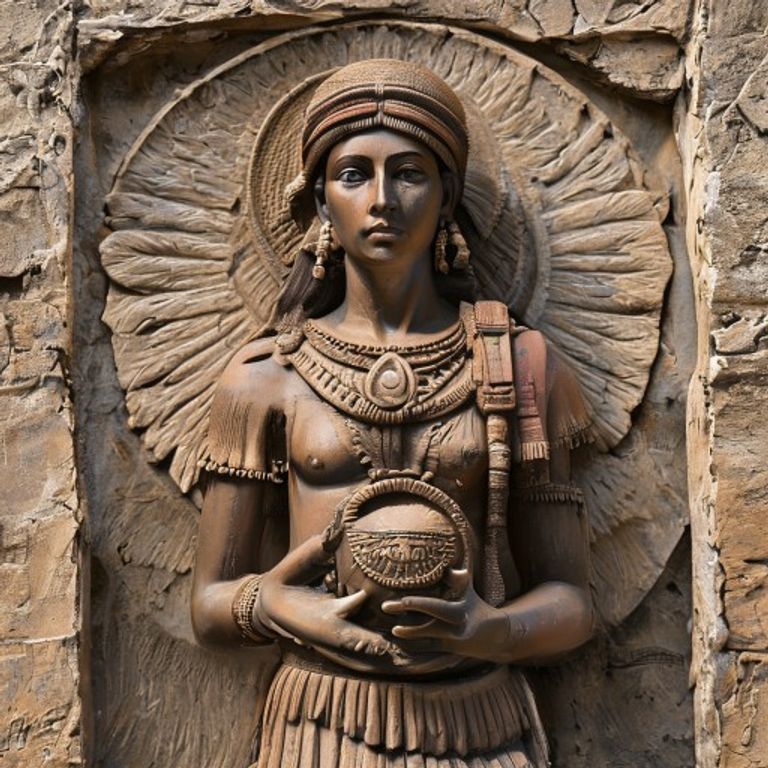
The oldest city in the Americas flourished in Peru without any evidence of war or weapons, focusing on trade and music for centuries.
⚠️ Research conducted with the aid of Deep Research is subject to referential ambiguity.
🖥️Clean HTML code using a proprietary tool.
👥 Research by Guilherme Felipe, Curation by Sílvio Lôbo
The Silent Enigma of Caral: A Lost Civilization That Defies Time
In the arid and forgotten lands of the Supe Valley, Peru, lie the remnants of a civilization that, for millennia, guarded its secrets in stone and sand. The Caral Archaeological Complex, also known as the "Caral-Supe Civilization," is not a mystery in the traditional police sense, but a historical enigma that unfolds into a deep investigative suspense. Its discovery and subsequent analysis have generated more questions than answers, shedding light on an incredibly ancient and sophisticated society that thrived in an era when writing was not yet a universal tool, making its understanding an exercise in deduction and interpretation of fragments from a monumental past.
The Context and the Incident: Where, When, and How the Mystery Began
The "mystery" of Caral does not refer to a specific, traumatic event, but to the very existence and subsequent disappearance of a society that reached its peak around 2600 BC, making it one of the oldest known in the Americas and contemporary to the great pyramids of Egypt. The site, located about 180 km north of Lima, Peru, remained hidden under centuries of oblivion and sediment, mistaken for mere natural elevations by previous explorers. It was the Peruvian archaeologist Ruth Shady Solís, starting in 1994, who led the systematic excavations that revealed the magnitude and importance of Caral. The true "discovery" of the mystery lies in the revelation of a complex and organized civilization, unprecedented for the region and the time, which showed no evidence of war or militarism, characteristics common in other ancient societies.
Timeline of Key Events
- c. 3000 BC - 1800 BC: Period of flourishing of the Caral Civilization, with the construction of its impressive monumental structures, urban centers, and religious complexes.
- c. 1800 BC: Evidence suggests a gradual decline and eventual abandonment of the main Caral site, the causes of which remain an enigma.
- 20th Century: Preliminary explorations in the region identify elevations, but without recognizing the importance of Caral.
- 1994: Beginning of excavations led by Ruth Shady Solís, marking the scientific rediscovery and revelation to the world of the Caral Archaeological Complex.
- 2000: Publication of the first detailed reports on the discovery, dating Caral as the oldest civilization in the Americas.
- 2009: The Caral Archaeological Complex is declared a UNESCO World Heritage Site, solidifying its global importance.
Main Theories
Theories about Caral range from solid archaeological explanations to bolder speculations, reflecting the scarcity of written records and the complexity of the find.
Scientific and Archaeological Hypotheses
- Theory of Environmental Adaptation and Resource Management: Suggests that Caral society prospered through exceptional mastery of irrigated agriculture, fishing, and long-distance trade. Its social organization would have been geared towards efficient management of these resources, allowing for the development of a complex society without the need for warlike conflicts. Evidence of irrigation systems and exchanges with coastal and Andean areas supports this view.
- Theory of Religious and Social Organization: The presence of imposing pyramids, plazas, and ceremonial buildings points to strong religious leadership and a highly stratified society. It is believed that religion played a central role in social cohesion and the maintenance of order, possibly through rituals and offerings documented in archaeological finds, such as quipus (although their nature is still debated for Caral, there are indications of recording systems).
- Theory of Gradual Collapse: The abandonment of Caral was not abrupt but a process of decline. Environmental factors, such as climate change affecting water availability or extreme natural events (like earthquakes or prolonged droughts), are speculated as possible causes. Social disorganization or loss of confidence in religious leadership could have accelerated this process.
Alternative and Speculative Theories
- Theory of Transoceanic Connections: Some bolder researchers, though a minority in academia, propose that Caral's sophistication might indicate contact with civilizations from other continents. This theory is based on its antiquity and architectural complexity, compared to other ancient civilizations. However, concrete material evidence to corroborate such claims is lacking.
- Paranormal or Extraterrestrial Theories: In broader speculative circles, the magnitude of the constructions and the apparent absence of war remnants lead some to postulate supernatural or extraterrestrial interventions. The lack of scientific evidence makes these theories unlikely for the academic community, but they persist in the popular imagination.
Controversies and Blind Spots
The investigation into Caral, while rigorous in many aspects, carries its own blind spots and areas of controversy, inherent to the nature of ancient archaeology.
- The Nature of the Quipus: While Ruth Shady and her team identified what appear to be the earliest quipus in the Americas at Caral, the decoding and full understanding of their recording system and possible writing remain a developing field of research. Official reports indicate their discovery, but their complete interpretation remains a challenge.
- Causes of Abandonment: The absence of clear signs of violence or a sudden natural disaster leaves the question of Caral's abandonment open. Geological and paleoclimatic studies offer clues, but the exact cause of the decline is still a subject of ongoing debate and research.
- Lack of Evidence of War: The apparent absence of fortifications, weapons, and remains indicating conflict is a point of perplexity. The dominant interpretation is that Caral was a peaceful society, but the possibility of non-violent warfare or a culture that did not leave military traces cannot be entirely ruled out without further evidence.
- Debates on Chronology and Influence: Although Caral's dating as the oldest civilization in the Americas is widely accepted, the extent of its influence on other ancient cultures in the region is a topic of academic discussion, with different schools of thought proposing various theories about cultural diffusion.
Curiosities and Legacy
The case of Caral transcends archaeology, fueling the popular imagination and the search for answers about the origins of human civilization.
- The "Mother of American Civilizations": Caral is often referred to as the "Mother of American Civilizations" due to its antiquity, establishing a temporal benchmark for cultural development in the region.
- Monumental Architecture Without Metal Tools: The construction of its pyramids and buildings using only stone and wood tools is a testament to the ingenuity and social organization of its inhabitants.
- Global Recognition: The UNESCO declaration as a World Heritage Site has solidified Caral as one of the most important archaeological sites on the planet.
- Tourism and Continuous Research: The site attracts thousands of visitors annually and continues to be a focus of archaeological research, with new discoveries emerging regularly. The mystery of Caral has not been "solved" in the traditional sense, but has transformed into a legacy of discoveries that continue to shape our understanding of the past.
The case of Caral remains a fascinating chapter in our quest to understand human history. An enigma etched in stone, whispering secrets of a forgotten era, and which, with each new discovery, challenges us to re-evaluate what we thought we knew about the past.



