


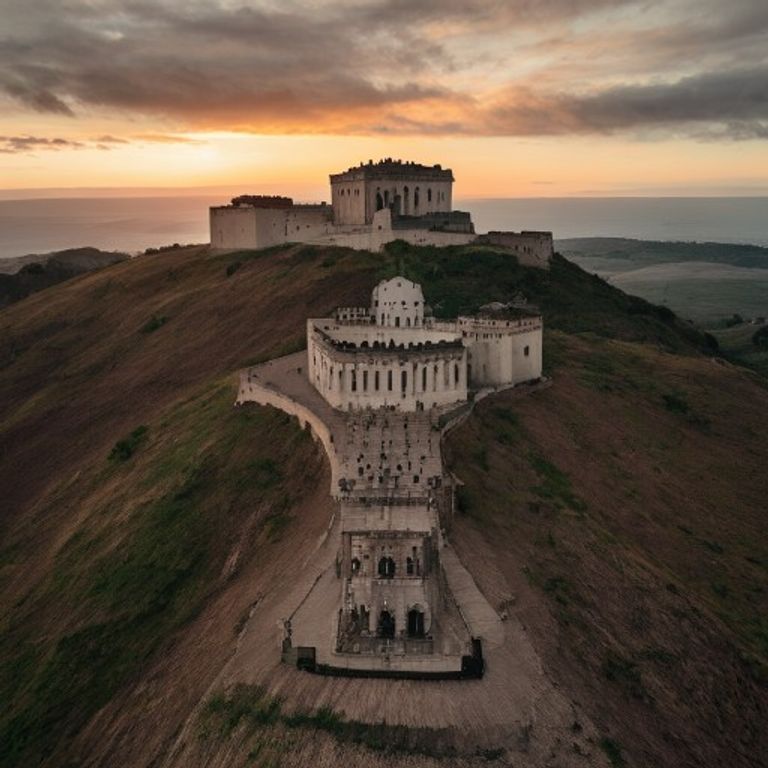
Accounts from ancient explorers regarding stone walls and lost cities in Mato Grosso that would have belonged to civilizations predating current indigenous peoples.
⚠️ Research conducted with the aid of Deep Research is subject to referential ambiguity.
🖥️ Clean HTML code using a proprietary tool.
👥 Research by Guilherme Felipe, Curation by Sílvio Lôbo
The Silent Enigma: Unraveling the Cuiabá Fortifications Case
By a senior investigative journalist. Deep within the depths of Brazilian history, there are enigmas that resist time, defying logic and fueling the imagination. The so-called "Cuiabá Fortifications Case" is one of these persistent mysteries, an intertwining of events that, despite decades passing, still raises questions without definitive answers. This article aims to explore the layers of this intricate puzzle, separating the factual from the speculative with the analytical rigor that the subject demands.
1. The Context and the Incident: Where, When, and How the Mystery Began
The mystery surrounding the Cuiabá Fortifications does not refer to a single traumatic event, but rather to a set of reports, discoveries, and disappearances that spanned a considerable period, with greater intensity between the 1950s and 1970s. The setting is the state of Mato Grosso, more specifically the region of Cuiabá and its surroundings, a vast territory with a rich history marked by the exploitation of natural resources and the presence of isolated settlements. The core of the enigma lies in a series of alleged ancient constructions, identified as fortifications or defensive structures of unknown origin. Reports from local residents, explorers, and even some scientific expeditions mentioned the existence of walls, tunnels, and underground shelters in remote locations, often hidden by the dense vegetation of the Cerrado and the Amazon. The peculiarity of these "fortifications" lay in their unusual architecture, the use of locally unidentified materials, and the absence of any historical record that could attribute them to known civilizations or colonial enterprises. The "incident" that gave rise to the case's notoriety, however, was the difficulty in locating and documenting these structures conclusively. Often, when expeditions or researchers arrived at the locations indicated by reports, they found only ephemeral traces, or the "fortifications" had been destroyed or altered by time and human action. This volatility and the elusive nature of the discoveries created fertile ground for speculation and the establishment of a mystery that persists to this day.
2. Timeline of Events
Reconstructing a precise timeline for the Cuiabá Fortifications Case is a challenge, given the fragmentary and sometimes anecdotal nature of the records. However, we can outline the main milestones: * Late 19th and Early 20th Century: First scattered and unofficial reports of "ancient walls" found by prospectors and pioneers in the region. These mentions were largely oral and unsystematized. * 1950s: Increased attention to these reports. Several accounts from residents of villages near Cuiabá, such as Acorizal and Santo Antônio do Leverger, gain traction, describing underground and raised structures. Amateur explorers and some local geologists begin to investigate more systematically, but with inconclusive results. * 1960s: Intensification of searches. Local newspapers and even some national publications begin to cover the subject, fueling public interest. A name that emerges frequently is that of Alfredo Jorge da Silva, a researcher and writer who dedicated part of his life to the study of regional mysteries and who reported finding significant traces. Reports of tunnels and underground "chambers" become more detailed. * 1970s: Last wave of more intense expeditions. The lack of conclusive findings and funding for long-term research begins to dissipate the momentum. The narratives gradually migrate to the field of folklore and alternative theories. * 1980s onwards: The case becomes just another item in the list of regional mysteries, with little to no significant official investigation. Information is disseminated mainly through books on ufology, esotericism, folklore, and the internet.
3. The Main Theories
The enigmatic character of the Cuiabá Fortifications has given rise to a myriad of theories, ranging from more plausible explanations to frankly esoteric hypotheses.
Conventional Theories (Scientific and Historical):
* Traces of Unknown Pre-Columbian Civilizations: This is one of the most speculated theories among historians and archaeologists. South America, before the arrival of Europeans, housed several complex civilizations, and it is possible that advanced engineering structures, not yet documented, exist in the region. The lack of artifacts or burials associated with the alleged fortifications, however, weakens this hypothesis for the specific findings reported. * Ancient Colonial or Military Defense Structures: Another line of investigation explores the possibility that the fortifications were remnants of abandoned military outposts or defense attempts during periods of conflict, perhaps during the Portuguese occupation or in border disputes. The described architecture, however, rarely aligns with the patterns of European military construction of the time. * Natural Geological Phenomena: Some rock formations with an artificial appearance, or natural cavities that could be interpreted as tunnels, could have been mistaken for man-made structures. Erosion and the action of time can, in some cases, create deceptive appearances. * More Recent and Forgotten Constructions: It is possible that the structures are the work of populations post-dating colonization, perhaps Quilombolas, indigenous people with specific construction techniques, or even isolated groups that built shelters or irrigation systems that were suddenly forgotten by official history.
Alternative and Conspiracy Theories:
* Alien Presence (Ufology): This is perhaps the most popularized theory. The "unusual" architecture, the supposedly unidentified materials, and the "mysterious" nature of the constructions lead many to believe in their extraterrestrial origin. The idea that ancient astronauts built or left advanced technological traces in the region is a pillar of this belief. The lack of tangible evidence, such as metallic artifacts or specific energy patterns, however, remains an obstacle. * Advanced Ancient Civilizations (Atlantis, Lemuria): Theories that postulate the existence of extremely advanced pre-diluvian civilizations, such as Atlantis or Lemuria, often associate the discoveries in Cuiabá with these supposed lost continents. The idea is that these peoples would have established colonies or left technologies in various parts of the world. * Secret Operations or Hidden Military Installations: Some conspiracy theories suggest that the "fortifications" could actually be secret military installations, underground bases, or bunkers built during the Cold War or in contexts of government secrecy, and that the narrative of "ancient fortifications" would be a smokescreen.
4. Controversies and Blind Spots
The main obstacle to resolving the mystery of the Cuiabá Fortifications lies in the lack of concrete evidence and the fragility of the investigations carried out. * Limited or Non-existent Official Investigations: The official history of Brazil rarely addresses the topic with the necessary depth. Reports from government agencies, such as the National Institute of Historic and Artistic Heritage (IPHAN) or archaeological institutions, on the alleged fortifications are scarce or non-existent. The lack of funding and political priority has always been a hindrance. * Destruction and Alteration of Sites: One of the biggest problems faced by expeditions was the very ephemeral nature of the "fortifications." Many reports indicated that, upon being found, the structures were already in ruins or had been dismantled for use as construction material in nearby villages. The action of time and the lack of preservation turned potential evidence into mere memories. * Conflicting Testimonies and Lack of Clear Chronology: Witness accounts are varied and sometimes contradictory. The absence of precise dates for the discoveries and the difficulty in locating the people who supposedly saw the structures in their prime make factual reconstruction a monumental challenge. * Inconclusive or Absent Forensics: There are no records of robust and widely publicized geological or archaeological forensics that have analyzed the materials or architecture of the alleged fortifications definitively. Most existing analyses are informal and based on secondary reports. * Ignored Clues and Fragmented Actions: What seems to have been missing was a coordination of efforts. Several expeditions and individuals investigated the topic in isolation, without the exchange of information and the application of rigorous scientific methodologies. This allowed potential clues to be lost and the case to fragment into a series of anecdotes.
5. Curiosities and Legacy
The Cuiabá Fortifications Case, despite its unresolved nature, has left an undeniable cultural legacy. * Regional Folklore and Mystery Tourism: The mystery has integrated into Mato Grosso folklore, being frequently cited in local stories, urban legends, and as an attraction for mystery tourism. The region has become associated with enigmas and an unknown ancestral past. * Influence on Brazilian Ufology: The case contributed significantly to the imagery of Brazilian ufology, being frequently cited in debates about alien presence in the country's past. The idea that Brazil holds cosmic and terrestrial secrets is strengthened by narratives like this. * Iconic Character of the Mystery: The term "Cuiabá Fortifications" has become synonymous with unsolved historical and archaeological enigmas in the region. The difficulty in unraveling it has turned it into a symbol of the persistence of the unknown. * Current Status: Currently, the case remains shelved in the official sphere and is treated predominantly as a folkloric mystery and of interest to researchers of anomalous phenomena. Although public interest fluctuates, the enigma of the Cuiabá Fortifications continues to inhabit the border between history, legend, and the inexplicable, waiting, perhaps one day, for a light that can dispel the shadows that surround it. The search for definitive answers to the Cuiabá Fortifications Case may have faded with time, but the mystery itself remains alive, an invitation to reflect on the limits of our historical knowledge and on the vastness of enigmas that our planet still holds.



