


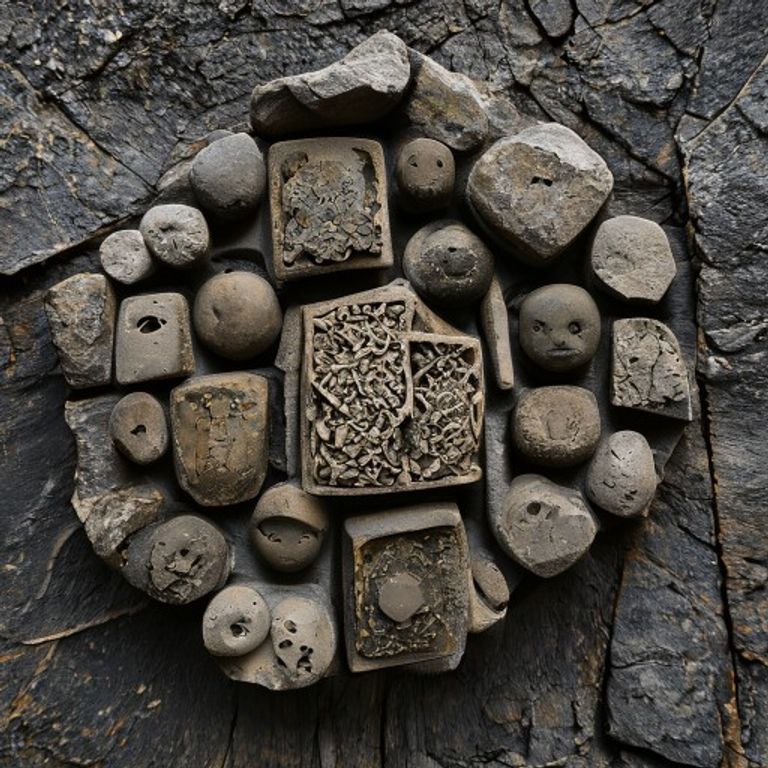
An immense rock in Massachusetts bears ancient, undeciphered petroglyphs that experts attribute to Phoenicians, Vikings, or indigenous peoples.
⚠️ Research conducted with the aid of Deep Research may be subject to referential ambiguity.
🖥️ Clean HTML code using a proprietary tool.
👥 Research by Guilherme Felipe, Curation by Sílvio Lôbo
The Enigma of Dighton Rock: A Silent Cry from History
Amidst the dense forests of Massachusetts, hidden beneath the veil of time and speculation, lies a rock that has defied centuries of interpretation: Dighton Rock. An enigmatic monolith covered in ancient inscriptions, this historical artifact is not merely a testament to lost cultures but also the epicenter of one of the most persistent mysteries in American archaeology and history. This article delves into the origins, theories, and controversies surrounding this geological and human enigma, seeking to unravel the secrets the rock holds.
1. The Context and the Incident: Where, When, and How the Mystery Began
Dighton Rock, officially known as Dighton Rock, is located on the banks of the Taunton River in the town of Dighton, Massachusetts, United States. Its formal discovery, or at least the first detailed description that entered the historical annals, dates back to the 17th century. However, the nature of the inscriptions suggests that its origin is significantly older, dating back to a pre-Columbian period.
The "incident" that gave rise to the mystery was not a singular event but rather the continuous fascination and the Western society's inability to decipher the marks left on the rock. Early accounts, such as that of Reverend John Cotton in 1680 and, later, Father Paul Dudley in 1721, described the rock as bearing "strange figures" and "hieroglyphs," indicating a profound ignorance about its authorship and meaning.
The rock itself is a conglomerate block weighing over 40 tons, resting on a natural base in a location accessible only during low tide. The inscriptions cover a large part of its surface, displaying a variety of symbols and figures that do not correspond to any known alphabet or pre-existing indigenous art style in local traditions. This uniqueness is at the heart of the enigma.
2. Timeline of Events
- 17th Century (Estimated): Creation of the inscriptions on Dighton Rock by an unknown group.
- 1680: Reverend John Cotton reports the existence of the rock and its "strange figures" in a letter.
- 1721: Father Paul Dudley visits the rock and makes the first detailed description and attempt at interpretation, suggesting a possible Phoenician origin.
- 1730s: French explorer Samuel Champlain may have made a brief reference to the rock, although the identification is controversial.
- 18th and 19th Centuries: Various explorers, historians, and curious individuals examine the rock, generating a myriad of theories about its origin, from indigenous peoples to ancient and exotic civilizations.
- 1870s: The beginning of more systematic attempts to copy and analyze the inscriptions, with new hypotheses emerging.
- 1918: The rock is acquired by the government of Massachusetts and transferred to a safer location.
- 1950s: A new attempt to remove the rock, this time for more in-depth analysis, generating controversy.
- 1963: The rock is removed from its original location and put on display at Dighton Rock State Park, in its own museum, where it remains to this day.
- Late 20th and Early 21st Centuries: Archaeological and linguistic studies continue to investigate the rock, but without a definitive consensus on its origin or meaning.
3. The Main Theories
The indecipherable nature of the Dighton Rock inscriptions has given rise to a wide range of theories, each with its own logic and set of proponents. Some are based on archaeological and linguistic evidence, while others delve into the realm of speculation and the inexplicable.
3.1. Indigenous Origin Theories
The most conservative hypothesis, though not always the most accepted due to the unique characteristics of the inscriptions, is that the rock was the work of Native American peoples. Various tribes inhabited the region, and the practice of marking rocks with petroglyphs is not uncommon. However, the figures on Dighton Rock differ significantly from the artistic styles and writing systems (when they existed) known from tribes such as the Wampanoag or the Narragansett.
- Logic: Explores the presence of indigenous cultures in the region and the practice of rock art.
- Controversy: The inscriptions do not resemble other known petroglyphs from local tribes, raising doubts about this attribution.
3.2. Pre-Columbian Colonization Theories (European or African)
This category encompasses various hypotheses that posit the visit and settlement of European or African groups in North America before the arrival of Christopher Columbus.
- Phoenicians/Phoenician-Israelites: One of the earliest and most persistent theories, popularized by Father Paul Dudley. It suggests that Phoenician navigators left the inscriptions.
- Logic: Based on supposed similarities between the rock's symbols and the Phoenician alphabet, and on biblical accounts of ancient voyages.
- Controversy: The similarities are tenuous and contested by linguists. There is no concrete archaeological evidence of Phoenician presence in the Americas.
- Norsemen/Vikings: The Viking presence at L'Anse aux Meadows in Canada raises the possibility of further explorations to the south. Some inscriptions may resemble Norse runes.
- Logic: Explores the possibility of more extensive Viking explorations.
- Controversy: Evidence of Vikings at the Dighton Rock site is scarce and inconclusive.
- Africans (Malians/Mandinka): The theory suggests that navigators from the Mali Empire in the 14th century reached America.
- Logic: Based on African historical accounts of transatlantic voyages and some interpretations of symbols.
- Controversy: Direct archaeological evidence is lacking, and the interpretation of the symbols is highly speculative.
3.3. Post-Columbus European Colonization Theories (Hidden or Disputed)
Some theories suggest that the inscriptions are from European explorers, but for political or security reasons, they were kept secret.
- Portuguese/Spanish: Hypotheses linking the inscriptions to Portuguese or Spanish explorers who may have reached America before Columbus or who explored the coast in an undocumented manner.
- Logic: Explores the intense European maritime activity in the 15th century.
- Controversy: The lack of documentation and corresponding artifacts makes this theory difficult to prove.
- English or French (Pre-Official Exploration): Possibility that early explorers or settlers left the marks.
- Logic: The presence of European explorers in the region.
- Controversy: The inscriptions do not correspond to the known alphabets or art styles of these peoples in their most common form.
3.4. Pseudoscience and Paranormal Theories
The mystery of Dighton Rock has attracted theories that transcend conventional science and history.
- Extraterrestrials: Suggests that the inscriptions are messages left by visitors from other planets.
- Logic: The inexplicable and advanced nature of the symbols for the knowledge of the time.
- Controversy: Lack of any physical evidence of extraterrestrial activity and arbitrary interpretations of the symbols.
- Lost Civilizations (Atlantis, Lemuria): Posits that the inscriptions are remnants of ancient and advanced civilizations that have disappeared.
- Logic: The need for a grand explanation for a complex enigma.
- Controversy: Based on esoteric beliefs without scientific or historical foundation.
4. Controversies and Blind Spots
Over the years, the investigation and preservation of Dighton Rock have been marked by controversies, inconsistencies, and blind spots that fuel the mystery.
- Alterations and Damage to the Rock: Over time, the rock has suffered natural damage and possibly human alterations. The search for "new" inscriptions or attempts to interpret existing ones may have modified its surface. Reports indicate that in the past, people tried to "clean" or "draw" over the inscriptions to facilitate reading, but ended up damaging them.
- Subjective Interpretations: The lack of clear knowledge about the origin of the inscriptions has led to highly subjective interpretations. Each theory tends to "fit" the symbols according to its assumptions, without a rigorous and universally accepted scientific method.
- Disappearance of Evidence: Archives and artifacts related to previous explorations and studies may have been lost or disappeared, making it difficult to fully reconstruct the history of the investigation.
- Controversy in Removal and Display: The removal of the rock from its original location in 1963 to be placed in a museum was controversial. Critics argue that the rock lost its geological and environmental context, and that the display structure is not ideal for its preservation and continued study.
- Lack of Academic Consensus: Despite numerous studies, there is no scientific or academic consensus on the origin, authorship, or meaning of the inscriptions. Hypotheses remain fragmented and, in many cases, without conclusive proof.
5. Curiosities and Legacy
Dighton Rock has transcended its status as a mere rock with inscriptions to become a cultural icon and a lasting symbol of mystery.
- Literary and Artistic Inspiration: The enigma of Dighton Rock has inspired countless short stories, novels, poems, and works of art, exploring the possibilities of lost civilizations, visitors from other worlds, and the nature of time.
- A Symbol of Untold History: The rock represents the human desire to unravel the secrets of the past and find meaning in ancient enigmas. It serves as a reminder that our understanding of history may be incomplete and that the past still holds many secrets.
- Current Status: Dighton Rock continues to be a site of interest for historians, archaeologists, linguists, and mystery enthusiasts. Although it has been removed from its original location, its display at Dighton Rock State Park ensures its accessibility for study and admiration. However, the mystery itself remains intact. There is no indication that the case has been officially reopened in the sense of a police or criminal investigation, but academic research into its origins and meaning continues to be an active, albeit frustrating, field of inquiry.
Dighton Rock, with its indescribable markings, continues to pose a silent challenge to us. It is a testament that, no matter how much we advance in our understanding of the world, there are still ancient enigmas waiting to be deciphered, whispering stories from a past that refuses to be fully revealed.



