


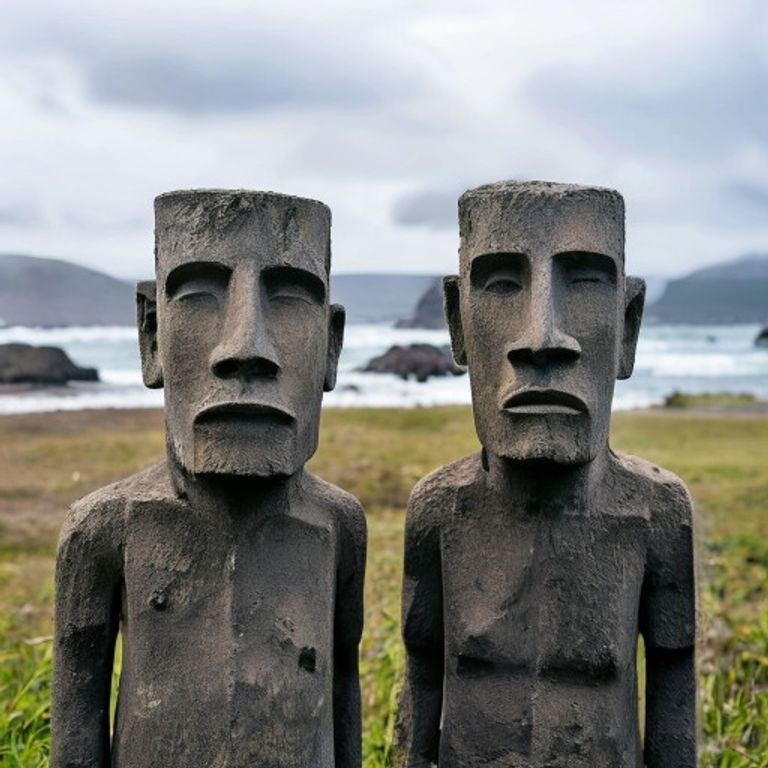
Hundreds of giant stone statues were carved and transported across the isolated Pacific island by an ancient civilization using methods that continue to be debated.
⚠️ Research conducted with the assistance of Deep Research is subject to referential ambiguity.
🖥️Clean HTML code using a proprietary tool.
👥 Research by Guilherme Felipe, Curation by Sílvio Lôbo
The Enigma of the Silent Giants: Unraveling the Mystery of the Easter Island Moai
By [Your Senior Investigative Journalist Name]
Easter Island, a remote speck of land in the vast Pacific Ocean, is globally renowned for its enigmatic Moai, colossal stone statues that hold ancient secrets. But the mystery lies not only in their creation and transportation, but in a specific period of their history, a dark chapter of decline and abandonment that has intrigued historians, archaeologists, and investigators for decades. This is not a crime in the conventional sense, but a civilizational collapse whose exact causes remain a disturbing enigma.
1. The Context and the Incident: The Fall of a Monumental Civilization
The mystery of the Moai does not refer to a single event of disappearance or destruction, but rather to the dramatic decline of the Rapa Nui civilization, which flourished on the island between the 13th and 17th centuries. Easter Island, or Rapa Nui in its native tongue, is geologically young and isolated, a natural laboratory for the development of a unique culture. The Rapa Nui, with remarkable ingenuity, carved hundreds of Moai from volcanic stone, each representing a venerated ancestor, and erected them on ceremonial platforms called ahu. The scale and complexity of this undertaking suggest a highly organized and resource-rich society.
The "incident," therefore, is the subsequent gradual abandonment of this culture and its monuments. When the first European explorers, such as the Dutchman Jacob Roggeveen in 1722, arrived on the island, they found a drastically reduced population, living in precarious conditions, and many Moai toppled or damaged. The question that echoes through the centuries is: how could a society capable of such achievement collapse so completely?
2. Timeline of Events: A Gradual and Tragic Decline
The chronological reconstruction of the events that led to the decline of the Rapa Nui civilization is a fragmented mosaic, compiled from archaeological evidence, explorer accounts, and genetic studies.
- 13th - 17th Centuries: Peak of the Rapa Nui civilization. Large-scale construction of the Moai, development of sophisticated agricultural techniques, and establishment of a complex social structure.
- 17th Century Onwards: Beginning of the decline. Evidence suggests a decrease in Moai production and an increase in internal conflicts.
- 1722: Arrival of Jacob Roggeveen. Reports a small population and precarious conditions. Observes toppled Moai.
- 1774: Visit by James Cook. Confirms the continuous decline and describes an island with few trees and limited resources.
- 18th - 19th Centuries: Intensification of contact with Europeans. Introduction of diseases, slavery (particularly by Peruvian expeditions in the 19th century), and the consequent decimation of the native population.
- 20th Century Onwards: Rediscovery and preservation efforts. Commencement of archaeological research and attempts to understand the collapse.
3. Main Theories: Seeking the Cause of Abandonment
The multiplicity of theories about the Rapa Nui collapse reflects the complexity of the case and the lack of a single definitive answer. Explanations range from well-founded scientific hypotheses to bolder speculations.
3.1. Scientific and Archaeological Hypotheses (Most Probable)
- Ecological Exhaustion (Classic Theory): Proposed by researchers like Jared Diamond, this theory suggests that the Rapa Nui population exceeded the island's ecological carrying capacity. Massive deforestation for Moai transport, canoe construction, and wood for cooking would have led to soil erosion, loss of biodiversity, and resource scarcity. The logic is a self-destructive cycle where the pursuit of social prestige (through the Moai) led to the destruction of the very environment that sustained society. Evidence includes the absence of large trees on the island when Europeans arrived and signs of severe erosion.
- Introduction of Invasive Species: The arrival of Polynesian rats (Rattus exulans) with the first settlers or later vessels may have devastated plantations and forests, competing for food resources with humans and exacerbating ecological exhaustion. Pollen records confirm the presence of these rats.
- Climate Change: While less emphasized than ecological exhaustion, periods of prolonged drought or other climatic anomalies may have affected agriculture, leading to food shortages and social stress.
- Internal Conflicts and Clan Warfare: Archaeological evidence, such as human bones with signs of violence and the deliberate toppling of many Moai, suggests that Rapa Nui society may have fragmented into rival clans who warred over scarce resources. The toppling of rival clans' Moai would have been an act of devaluation and a demonstration of power.
3.2. Alternative and Paranormal Theories (Speculative)
- External Influence (Ancient Astronaut Theories): Some theories, without solid scientific basis, suggest the intervention of advanced civilizations or extraterrestrials in the construction of the Moai and the island's history itself. The sophistication of the engineering and the origin of the stone for carving at Rano Raraku are often cited as "proof" of external intervention. The logic here is the denial of human capability to achieve such feats.
- Rare Natural Cataclysms: The possibility of devastating tsunamis or other rare geological events, although not directly proven by evidence for the period of collapse, could have severely impacted the population and their ability to maintain social structure.
- Diseases Introduced Before Europeans: While European diseases are a documented factor in the decline in the 18th and 19th centuries, some speculate that earlier contact with South American mainland vessels could have introduced devastating pathogens before the official arrival of explorers.
4. Controversies and Blind Spots: Ignored Clues and Dusty Archives
The investigation into the Rapa Nui decline is rife with controversies and blind spots that fuel the mystery.
- The Role of Deforestation: Although the ecological exhaustion theory is widely accepted, there are debates about the extent and exact chronology of deforestation. Some researchers argue that deforestation occurred at a slower pace or that other factors were more decisive. Ice core and pollen analysis reports are not entirely conclusive about the speed of deforestation.
- Interpretation of Conflicts: The evidence of conflict is strong, but the extent of civil war and whether it was the primary cause or a consequence of resource scarcity is a point of contention. Explorer accounts, such as those of Cook, mention the existence of different factions but provide little detail about the nature of these conflicts.
- Lack of Written Records: The Rapa Nui civilization did not develop a formal writing system, leaving us reliant on archaeological interpretations and external accounts, which may be incomplete or biased. The Rongorongo writing system, found on some artifacts, has never been deciphered, and its content remains a mystery.
- Declassification of Archives: While not a "crime" in the modern sense, the lack of access to all archives from early explorations and possible anthropological investigations (if they formally existed) may obscure crucial information. Archives from expeditions, such as Roggeveen's, contain valuable descriptions, but a complete analysis of all documents from that era is a challenge.
- The Legacy of Slavery: The Peruvian slave expeditions in the 19th century are a dark spot in the island's history, decimating a large part of the remaining population and destroying what was left of the culture. Although this occurred after the main "collapse," the brutality and impact on collective memory are undeniable and may have obscured the understanding of the original causes.
5. Curiosities and Legacy: Echoes of a Silent Past
The mystery of the Moai and the collapse of the Rapa Nui civilization continue to fascinate and inspire.
- Cultural Impact: Easter Island has become a global symbol of mystery and lost civilizations. The Moai are recognizable icons worldwide, appearing in films, books, and art. The case serves as a case study on the dangers of resource exploitation and ecological collapse.
- Current Status: The "case" has never been formally reopened or shelved, as it is not a police inquiry. However, archaeological and anthropological research continues actively. New dating methods, DNA analysis, and environmental studies are constantly refining our understanding of the Rapa Nui past.
- Preservation and Tourism: Easter Island is a UNESCO World Heritage Site, and the preservation of its archaeological sites is a priority. Tourism is a vital source of income, but it also presents challenges for conservation.
- The Lesson of the Giants: The Moai, silently standing or toppled, remind us of the fragility of civilizations and the importance of balance between humans and the environment. The history of Easter Island is a cautionary tale, etched in stone, about the dangers of arrogance and unsustainability.
The enigma of the Moai and the collapse of the society that created them remains one of the greatest unsolved mysteries of human history. The monumental stones invite us to unravel the shadows of a distant past, where human ingenuity met the unforgiving limits of nature and its own choices.



