


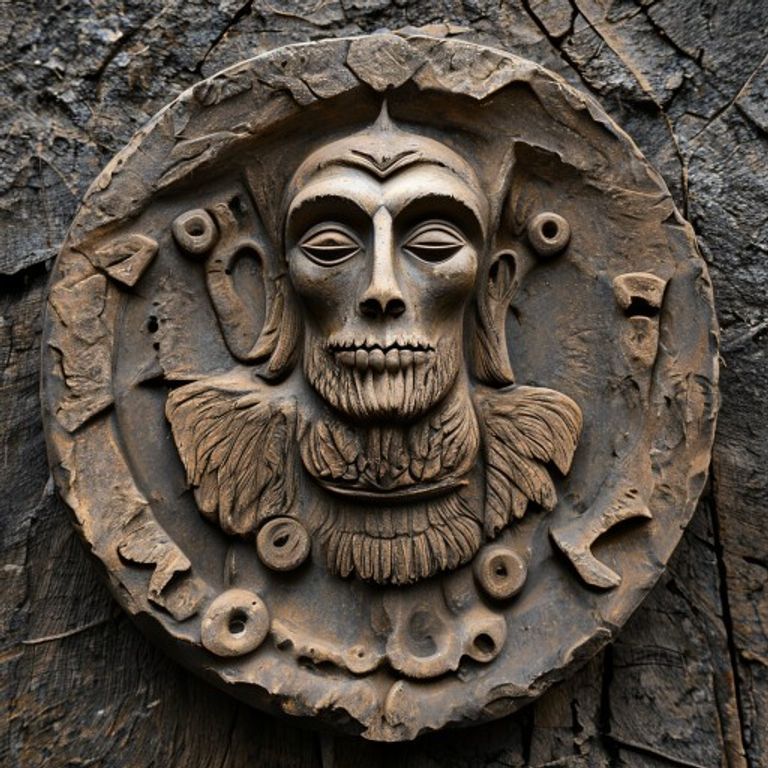
A complex and advanced stone temple, erected thousands of years before the invention of the wheel, was mysteriously and intentionally buried in Turkey.
⚠️ Research elaborated with the aid of Deep Research is subject to referential ambiguity.
🖥️Clean HTML code using a proprietary tool.
👥 Research by Guilherme Felipe, Curation by Sílvio Lôbo
Göbekli Tepe: The Prehistoric Sanctuary That Challenges History
Amidst the vast and arid plains of Eastern Anatolia, in Turkey, lies a monumental enigma that has rewritten history books and opened an abyss of questions about the dawn of human civilization. Göbekli Tepe, which means "Round Hill" in Turkish, is not just an archaeological site; it is a portal to a past so remote that it challenges our understanding of the origins of religion, art, and society itself. The mystery lies not in a crime or a sudden disappearance, but in the very existence and purpose of this colossal structure, erected by unknown hands, at a time when we believed humanity was still crawling in its evolutionary journey.
The Context and the Incident: The Discovery That Opened Pandora's Box
The "incident" at Göbekli Tepe was not a single event, but the discovery itself and the subsequent incomprehension of its magnitude. For millennia, the hill lay dormant under layers of earth, a silent witness to a forgotten past. Its existence was known locally, but only in 1963, a superficial archaeological survey led by the University of Chicago suggested the presence of Byzantine ruins. However, the true potential of the site remained hidden until the early 1990s, when German archaeologist Klaus Schmidt, after consulting previous research and the suggestion of a local shepherd, began deeper excavations.
What Schmidt and his team unearthed starting in 1994 shocked the academic world. T-shaped stone pillars, some weighing over 20 tons and standing up to 5.5 meters high, adorned with intricate reliefs of animals such as lions, bulls, boars, foxes, and birds, emerged from the ground. Radiocarbon dating placed these impressive structures in the Pre-Pottery Neolithic period, between 10,000 and 8,000 BC. This meant that Göbekli Tepe was significantly older than Stonehenge or the pyramids of Egypt, and it was built by nomadic hunter-gatherers, a group of people who, according to prevailing theories at the time, would not possess the social organization, technology, and motivation to achieve such monumental feats.
Timeline of Key Events
- 1960s: First superficial archaeological survey by the University of Chicago suggests the presence of Byzantine ruins.
- 1994: Systematic excavations begin under the leadership of German archaeologist Klaus Schmidt.
- From 1995: Discovery of the first T-shaped pillars and zoomorphic reliefs.
- Late 1990s / Early 2000s: Radiocarbon dating indicates a surprising age for the structures, between 10,000 and 8,000 BC.
- 2010: Klaus Schmidt passes away, leaving the continuation of research to other teams.
- 2011: Göbekli Tepe is declared a UNESCO World Heritage Site.
- 2015: New discoveries reveal the total size of the complex, which may cover an area of up to 900 square meters.
- 2018: The site is classified as the "World's Oldest Point" on a UNESCO World Heritage Atlas list.
Main Theories: Deciphering the Purpose of an Enigma
The magnitude and antiquity of Göbekli Tepe challenge conventional historical narratives, giving rise to various theories, ranging from the scientific to the speculative.
Scientific and Archaeological Theories
- Religious Temple or Ceremonial Center: This is the most widely accepted hypothesis by the archaeological community. The presence of monumental pillars, arranged in circles, with reliefs of possibly totemic animals or associated with spiritual beliefs, suggests a place dedicated to rituals, religious ceremonies, or ancestral cults. The complexity of the construction would indicate a high degree of social organization and a developed belief system, even among hunter-gatherers. The theory suggests that religion preceded agriculture and sedentarization, driving the development of these societies.
- Astronomical Observatory: Some researchers propose that the stone circles and the orientation of certain pillars may have been used for astronomical observations, marking solstices, equinoxes, or other celestial conjunctions important to the cosmology and calendar of ancient peoples. The representation of animals, in this view, could be linked to constellations.
- Social and Gathering Center: Although the religious nature is strong, Göbekli Tepe may also have served as a meeting point for various nomadic tribes, facilitating the exchange of goods, information, and the consolidation of alliances in a time of scarce resources. Rituals could have been a unifying element for these gatherings.
Alternative and Speculative Theories
- Elite Hunter-Gatherer Culture: A more elaborate view suggests that Göbekli Tepe was built by an organized elite within a hunter-gatherer society, which possessed the knowledge and resources necessary to mobilize labor and achieve such feats. This challenges the idea that such complexity would only be achieved with sedentarism and agriculture.
- Origin of Civilization: Some theorists argue that Göbekli Tepe represents a turning point in human history, being the "mother cell" of civilization. The need to organize the construction and maintenance of the site would have driven the development of agriculture and large-scale social organization.
Conspiracy or Paranormal Theories
- Extraterrestrial Intervention: As is common with ancient archaeological mysteries, the theory of alien intervention is often invoked. The technological sophistication for the time and the magnitude of the constructions lead some to believe that beings from other planets would have assisted or taught ancient humans to erect such monuments. There is, however, no concrete evidence to support this hypothesis.
- Lost/Advanced Civilizations: Another speculative line points to the existence of lost civilizations with knowledge and technology superior to what was believed to exist in antiquity. Göbekli Tepe would be a remnant of these civilizations.
Controversies and Blind Spots: The Gaps in Historical Reasoning
Despite significant advances in research, Göbekli Tepe is still shrouded in mysteries and blind spots that fuel debate:
- Creative Disorder: One of the biggest enigmas is the purpose and the way the site was intentionally buried. Excavations reveal that, after hundreds of years of use, the monumental circles were systematically filled with earth and debris. The motivation behind this "burial" is unknown. Was it a ritualistic act? An attempt at preservation? Or the end of a religious cycle?
- Lack of Settlement Evidence: Unlike other Neolithic sites, Göbekli Tepe lacks clear traces of permanent settlement. There are no signs of dwellings, ovens, or domestic tools in large quantities. This reinforces the idea that it was a site of specific purpose, perhaps seasonal or ceremonial, frequented by nomadic groups.
- Interpretation of Reliefs: The interpretation of the animal reliefs is largely speculative. Although they are associated with mythologies and cosmologies of later cultures, their exact meaning in such an archaic context remains obscure. Some of the animals represented, such as the scorpion or the serpent, may have ritualistic significance, but their reading is open to various interpretations.
- Professor Schmidt's Passing: The premature death of Klaus Schmidt in 2010 left a gap in leadership and continuity of interpretation. Although his work has been continued by others, the vision and deep familiarity he developed with the site are irreplaceable.
- The Extent of the Site: Although part of the complex has been excavated, the total extent of Göbekli Tepe is estimated to be hundreds of hectares. It is believed that more than 20 monumental circles remain buried, holding even greater secrets. Excavations are slow and costly, which limits the complete revelation of the site.
Curiosities and Legacy: A Legacy That Continues to Challenge
The legacy of Göbekli Tepe is profound and transformative. Its discovery forced archaeologists to rethink the chronology of human development and the idea that agriculture was the driving force behind social complexity.
- The "Revolution" of Religion: The dominant theory now is that the need to build and maintain Göbekli Tepe may have been the catalyst for the domestication of plants and animals, and for the development of permanent settlements. In other words, religion may have preceded agriculture, not the other way around.
- A Prototype for Future Monuments: The complexity of construction and the symbolism present in Göbekli Tepe may have served as inspiration or a model for future megalithic monuments worldwide, although a direct connection is difficult to prove.
- Cultural and Tourist Impact: Göbekli Tepe has become one of the most important archaeological sites in the world, attracting thousands of visitors and researchers annually. Its inclusion on the UNESCO World Heritage list has solidified its global importance.
- Current Status: The Göbekli Tepe case is far from being "reopened" or "closed." It is in a constant process of investigation and discovery. New excavations, DNA analyses, and 3D mapping technologies promise to unveil even more of its secrets in the coming decades. The mystery of Göbekli Tepe has not been solved; it has been expanded, broadening our horizons about humanity's past.
The hill of Göbekli Tepe remains a silent testament to an era before writing, before cities, before all that we know as civilization. It is a call to humility in the face of the vastness of time and an invitation to question established narratives, because, as this ancient sanctuary reveals to us, the past is a book with many pages yet to be turned.



