


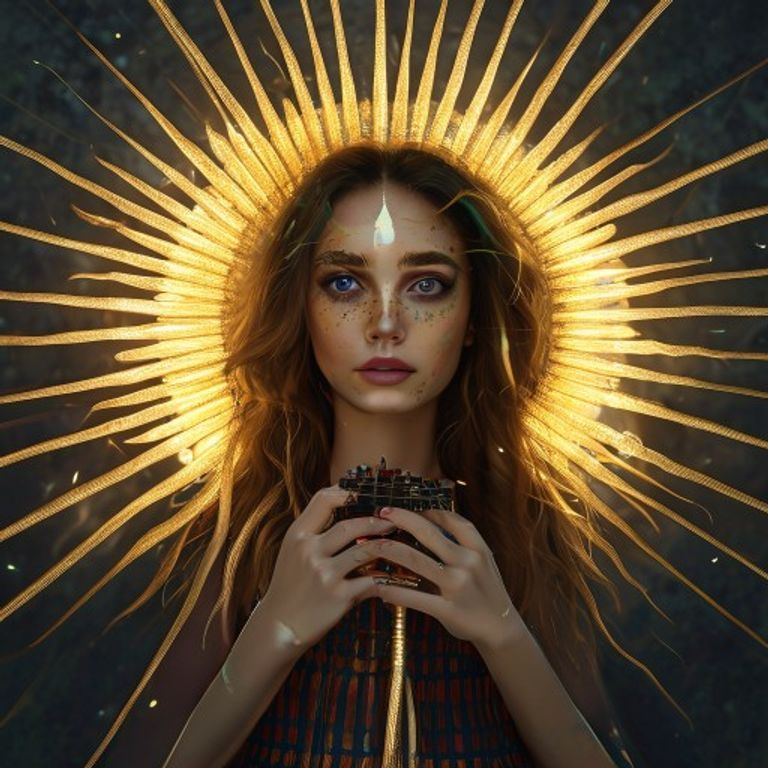
Tens of thousands of faithful and skeptics gathered in Fátima reported seeing the sun spin in the sky, change color, and plummet towards Earth in 1917.
⚠️ Research elaborated with the assistance of Deep Research is subject to referential ambiguity.
🖥️Clean HTML code using a proprietary tool.
👥 Research by Guilherme Felipe, Curation by Sílvio Lôbo
The Incident of the Miracle of the Sun: An Enigma Under a Burning Sky
On a day that became synonymous with mass hysteria and intransigent debate, the sun danced. Or so claim hundreds, if not thousands, of eyewitnesses. What happened on October 13, 1917, in a small, dusty field on the outskirts of Fátima, Portugal, transcends mere meteorological observation. It is an event that has become a religious landmark, a case study in mass psychology, and, for some, one of the greatest unsolved mysteries of the 20th century.
1. The Context and the Incident: Where, When, and How the Mystery Began
Portugal, in 1917, was mired in turbulent years of secularization, with a strong anti-clerical campaign underway. In this scenario, three humble children – Lúcia Santos, Francisco Marto, and Jacinta Marto – claimed to have had visions of a celestial figure, who identified herself as the Lady of the Rosary. These apparitions, which began in May 1917 and occurred monthly, culminated in a promise of an extraordinary event at their final meeting, scheduled for October 13, so that everyone could believe their words.
The location was Cova da Iria, a wasteland a few kilometers from the village of Fátima. On the appointed day, the weather forecast indicated persistent rain. However, the anticipation created by the children's prophecies attracted a crowd estimated at 70,000 people, including skeptics, the curious, and the faithful. What unfolded from midday that day defies conventional explanation.
2. Timeline of Events (October 13, 1917)
- Noon: The rain stops abruptly. The crowd gathered at Cova da Iria witnesses an unusual silence.
- Around 1:30 PM: The children, in ecstasy, announce the arrival of the Lady of the Rosary. Lúcia reports having dialogued with the apparition.
- After the messages: Witnesses report that the sun, previously obscured by clouds, breaks through the celestial cover.
- Dance of the Sun: Hundreds, possibly thousands, of witnesses claim to have seen the solar disk spin, shrink, and emit various colors, as if "dancing" in the sky. The phenomenon reportedly lasted between 10 and 15 minutes.
- Return to Normal: The sun returns to its normal position and appearance, leaving no visible traces of damage. The clothes and the ground, wet from the previous rain, appear dry.
3. Main Theories: Deciphering the Enigma
The magnitude and diversity of the accounts of the "Miracle of the Sun" have given rise to a range of interpretations, each with its own logic and appeal.
3.1. Scientific and Rational Hypotheses
- Optical Atmospheric Phenomenon (Mirage/Solar Halo): This is the most common explanation among skeptics and scientists. The theory suggests that the event could have been a complex atmospheric mirage, possibly amplified by specific humidity and light conditions. The refraction of sunlight in thin layers of ice or water droplets at high altitudes could have created illusions of movement and distortion of the solar disk. Reports of similar phenomena, such as sun dogs and solar halos, are frequently cited. However, the consistency of the accounts of the "dance" and the color changes in a repetitive pattern, and the absence of other contemporary optical phenomena, raise questions.
- Mass Hysteria and Psychological Suggestion: Given the strong religious expectation and the narrative previously established by the children's apparitions, mass hysteria is a robust hypothesis. Belief in the event, combined with group pressure and suggestion, may have led people to "see" what they expected to see. Mass psychology explains how emotions and perceptions can spread in large groups. The effect of "seeing" the sun dance could have been a collective projection of a deeply ingrained belief.
- Individual and Collective Optical Illusion: Similar to hysteria, but focusing more on individual perception, it is argued that the intense sunlight, especially at a moment of expectation, could have caused temporary fluctuations in vision, leading to anomalous perceptions of the solar disk. The convergence of reports from many people could have been the result of shared perceptual failures.
- Combination of Factors: Some scholars propose that the event may have been a combination of a real, albeit not extraordinary in itself, atmospheric phenomenon that was amplified and interpreted in light of mass hysteria and prophecies.
3.2. Alternative, Conspiracy, and Paranormal Theories
- Divine Intervention (The Religious Miracle): This is the official and predominant interpretation among devotees. According to this view, the "Miracle of the Sun" was a supernatural act orchestrated by God, as a sign to confirm the apparitions of the Virgin Mary and draw the world's attention to her message. The inability to explain the phenomenon by natural means is seen as proof of its divine nature.
- UFO and Extraterrestrial Phenomenon: A minority suggests that the event could have been the manifestation of advanced extraterrestrial technology. The description of a luminous object and its "unnatural" movement could fit a scenario of alien visitation. This theory, however, lacks concrete evidence and is based primarily on the interpretation of the accounts in a UFO context.
- Mass Psychic Experiment: Some speculations involve the idea that the event could have been the result of a large-scale psychic experiment, either intentional or spontaneous, where the collective psychic energy of tens of thousands of people manifested a shared illusion.
- Collective Depersonalization/Derealization Experience: On a more psychological level, but still considered "alternative" by some, it is argued that the stress and intensity of the moment could have induced a state of collective depersonalization or derealization, where the perception of reality becomes distorted.
4. Controversies and Blind Spots
The official investigation of the case, conducted by the Catholic Church, focused on validating the apparitions and the miracle as proof of faith. However, even within this perspective, there are points that generate debate:
- The Absence of Concrete Physical Evidence: Despite the vivid description of the events, there are no clear photographic or cinematographic records of the "miracle." The few photographs taken on that date in Fátima show the crowd, but not the solar phenomenon itself. The claim that the sun was "dry" is also contested, as the rain's humidity is a fact proven by witnesses who remained wet during and after the event.
- Conflicts in Testimonies: Although most accounts describe the sun dancing, the exact description of the phenomenon varies among testimonies. Some people saw nothing extraordinary, while others described an even more vivid spectacle. This variation raises questions about the objectivity of perceptions.
- The Ecclesiastical Investigation: The ecclesiastical commission that investigated the events, led by the bishop of Leiria, focused on the theological veracity of the apparitions and the miracle. The investigation did not seek alternative scientific explanations but rather the confirmation of faith. The declassification of ecclesiastical archives has not brought new evidence that unravels the physical mystery.
- The Silence of Some Key Witnesses: Lúcia Santos herself, the main confidante of the apparitions, described the event in detail, but her ability to describe the phenomenon in more scientific terms is limited. Her writings, throughout her life, maintained the supernatural narrative.
- Lack of Contemporary Scientific Reports: No astronomical observatory or meteorological station at the time registered solar or atmospheric anomalies that corresponded to the description of the "Miracle of the Sun." Although Portugal was not a cutting-edge research center in 1917, the complete absence of records is notable.
5. Curiosities and Legacy
The "Incident of the Miracle of the Sun" transcended Fátima and Portugal, becoming a global phenomenon. Its cultural influence is vast:
- Church Recognition: The Catholic Church declared the events of Fátima as Marian apparitions worthy of belief in 1930, after a canonical investigation. The "Miracle of the Sun" is considered the divine validation of these apparitions.
- Religious Tourism: Fátima has become one of the largest centers of Catholic pilgrimage in the world, attracting millions of visitors annually, many of whom come in search of a glimpse of the "miracle" or its spiritual consequences.
- Ongoing Debate: The case continues to be a point of contention between believers and skeptics. It is frequently cited in discussions about faith, science, psychology, and the nature of human perception.
- Current Status: The case has not been reopened in terms of formal scientific investigation. The Catholic Church considers it a sealed event and part of the faith. However, debate and speculation about the nature of the "Miracle of the Sun" remain alive in popular culture and in academic circles that study unexplained phenomena.
The sky of Fátima, on that October of 1917, held a luminous secret. An event that, depending on the lens through which one looks, can be a testament to faith, an anthropological curiosity, or simply one of those rare moments when the line between what is real and what is perceived becomes dangerously thin. The "Miracle of the Sun" remains, to this day, one of the most captivating and persistent enigmas of modern history.



