


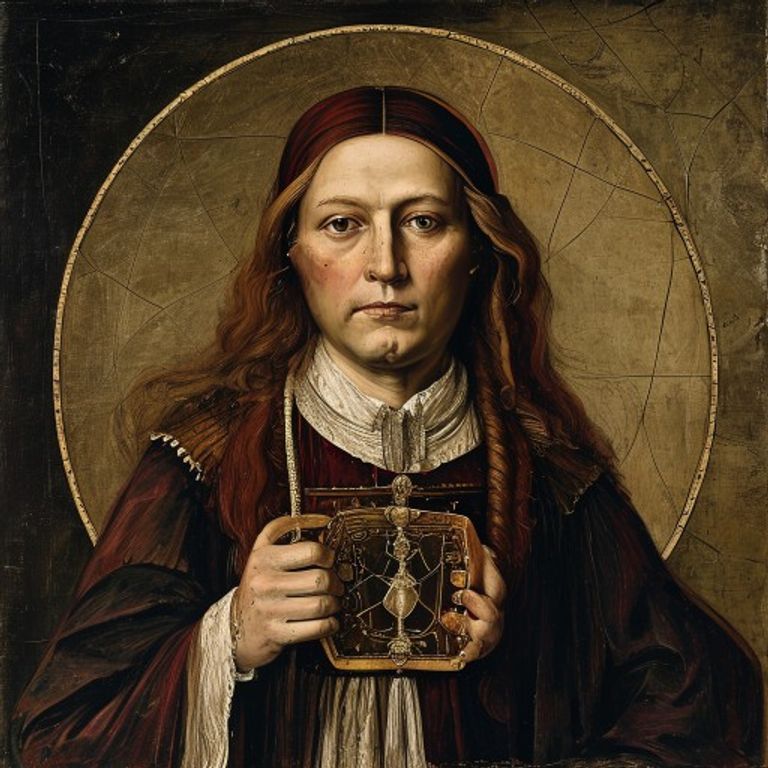
A medieval manuscript famous for containing marginal illustrations of strange creatures, including a figure that bears a near-perfect resemblance to the character Yoda.
⚠️ Research conducted with the aid of Deep Research is subject to referential ambiguity.
🖥️ Clean HTML code using a proprietary tool.
👥 Research by Guilherme Felipe, Curation by Sílvio Lôbo
The Enigma of the Smithfield Decretals: A Mystery Etched in Time
In a world saturated with instant information and quick resolutions, some enigmas insist on defying time, weaving a veil of mystery that has endured for decades. The "Smithfield Decretals Case" is one such enigma, an incident that, while not classified as a violent crime per se, has generated a trail of unanswered questions and speculations that echo to this day. It is a case that transcends mere police investigation, entering the realm of unresolved history, lost art, and potential conspiracies.
1. The Context and the Incident: Where, When, and How the Mystery Began
The focal point of this mystery lies in the Smithfield Abbey, a historic site with deep religious and cultural roots, located in London, England. The incident that gave rise to the enigma occurred in the 1920s, although the exact date of the disappearance of crucial objects is difficult to pinpoint with precision, which was one of the first signs that this case would be full of gaps.
At the heart of the mystery are the so-called "Smithfield Decretals" – a collection of documents and artifacts of inestimable value, supposedly containing writings and artistic representations of great historical and religious importance. The exact nature of the content of these decretals is, in itself, a point of debate, as very few concrete details about them have survived the passage of time and the frustrated investigations.
What is known is that, at some point in the 1920s, these valuable items began to disappear. It was not an audacious and sudden theft, but rather a gradual, almost imperceptible emptying. The discovery of the loss only became more pronounced when efforts were made to catalog or exhibit the items, highlighting the fragility of the custody and the subtlety of whoever was behind the subtraction.
2. Timeline of Events
Reconstructing a precise timeline for the Smithfield Decretals Case is a challenging exercise, marked by the scarcity of official records and the insidious nature of the disappearance:
- Early 20th Century (imprecise dates): The existence of the "Smithfield Decretals" is known within ecclesiastical and academic circles. There are indications that the artifacts were under the custody of Smithfield Abbey.
- 1920s (estimated period): The beginning of the gradual disappearance of the items. The lack of detailed inventory records makes it difficult to determine exactly when the first items went missing.
- Mid-1920s (approximate date): Some sources suggest that a partial record or inventory may have been carried out, and it was at this moment that the first realization of "something missing" began to emerge.
- Late 1920s / Early 1930s: The extent of the loss becomes clearer. Preliminary investigations are initiated by the abbey's administration and, possibly, by local authorities.
- Subsequent Decades: The case falls into relative oblivion, with few mentions in public archives. The lack of a direct violent crime may have contributed to it not being prioritized by broader police forces.
- Late 20th Century / Early 21st Century: The resurgence of interest in the case, driven by historians, mystery researchers, and conspiracy enthusiasts, who seek to uncover what really happened.
3. The Main Theories
The absence of concrete answers has given rise to a myriad of theories, ranging from mundane explanations to extraordinary hypotheses:
Conventional and Police Theories:
- Inside Job: This is perhaps the most plausible and widely considered theory. An individual or a group within Smithfield Abbey itself, with privileged access to the artifacts, would have appropriated them. The motivation could be financial (sale on the black market for antiquities) or personal (desire for possession).
- Opportunistic Outside Theft: Although less likely due to the apparent discretion of the disappearance, one cannot rule out the possibility of a theft orchestrated by experienced thieves who somehow obtained information about the existence and value of the items and exploited security flaws.
- Accidental Loss or Deterioration: In an era with less rigor in collection conservation, it is possible that some items were misplaced during renovations, relocations, or simply deteriorated to the point of being discarded without proper record. However, the "gradual" nature of the disappearance suggests something more deliberate.
Alternative, Conspiracy, or Paranormal Theories:
- Church or Specific Circles Conspiracy: One theory suggests that the decretals contained sensitive information, possibly heretical or controversial for the time, and that an influential group within the church itself or in circles of power decided to remove them from circulation to protect dogmas or reputations. The discreet subtraction would be a way to "hide the truth" without causing a stir.
- Secret Societies: Similar to the previous theory, but with a focus on more obscure groups, such as secret societies (Freemasons, Rosicrucians, etc.). The idea would be that these societies would have an interest in acquiring artifacts with occult or symbolic knowledge, and that Smithfield Abbey would be an access point for such items.
- Artifacts with Forbidden Power or Knowledge: Some speculations, more inclined toward the mystical, suggest that the Smithfield Decretals contained knowledge that could be dangerous if disclosed, or even possessed some form of energy or power that attracted the attention of individuals with unknown intentions. This aligns with narratives about ancient artifacts.
- Extraterrestrial Intervention or Unexplained Phenomena: At one end of the spectrum, the absence of logical explanations leads some to consider paranormal scenarios. The idea that the artifacts were "taken" by unknown forces, without leaving conventional physical traces, is a hypothesis that, although without solid empirical basis, fuels the mystery.
4. Controversies and Blind Spots
The Smithfield Decretals Case is full of inconsistencies and blind spots that hinder its resolution:
- Lack of Detailed Inventory: The biggest controversy lies in the absence, or loss, of meticulous records of the Smithfield Abbey collection before and during the period of the disappearance. Without a precise inventory, it is impossible to determine exactly what was lost and when.
- Superficial Official Investigations: Reports indicate that the initial investigations, if they were truly thorough, were poorly documented. The lack of declassified or easily accessible official reports contributes to the opacity.
- Conflicting or Silent Testimonies: Key witnesses, such as monks, abbey employees, or members of the local community at the time, either no longer exist, or their testimonies are scarce, vague, or even contradictory when memory fails or there are hidden interests.
- Missing or Never-Found Evidence: Clues that could have been crucial, such as surveillance cameras (practically non-existent at the time, but the lack of detailed physical surveillance is notable), or more concrete reports of suspicious activities, were never clearly identified or were lost over time.
- Exact Nature of the Decretals: The mystery about the exact content of the Smithfield Decretals is, in itself, a gap. If the content were known, perhaps there would be more clues about who would have an interest in removing them from circulation.
5. Curiosities and Legacy
Despite the lack of resolution, the Smithfield Decretals Case has left a peculiar cultural legacy:
- Inspiration for Narratives: The mystery has served as inspiration for short stories, novels, and documentaries that explore the themes of lost art, historical secrets, and the persistence of the inexplicable. The enigmatic aura attracts the popular imagination.
- Focus on Collection Recovery: To some extent, the lack of control over the Smithfield Abbey collection may have served as a warning to other institutions about the importance of rigorous cataloging and the security of their cultural heritage.
- A Symbol of Untold History: The case represents a fascinating facet of history – that which is not written in textbooks, but which resides in unanswered questions, documentary gaps, and the persistence of mysteries that remind us that not everything in the past has been fully uncovered.
- Current Status: Officially, the case has not been reopened in a criminal sense, as the exact nature of the "crime" (if there was one) was never established with certainty and the suspects, if they existed, were not formally identified. However, it remains alive in the archives of historical mysteries and in the independent research of historians and enthusiasts, waiting at any moment for the emergence of a new clue, a forgotten document, or a testimony that may, finally, shed light on the enigma of the Smithfield Decretals.



