


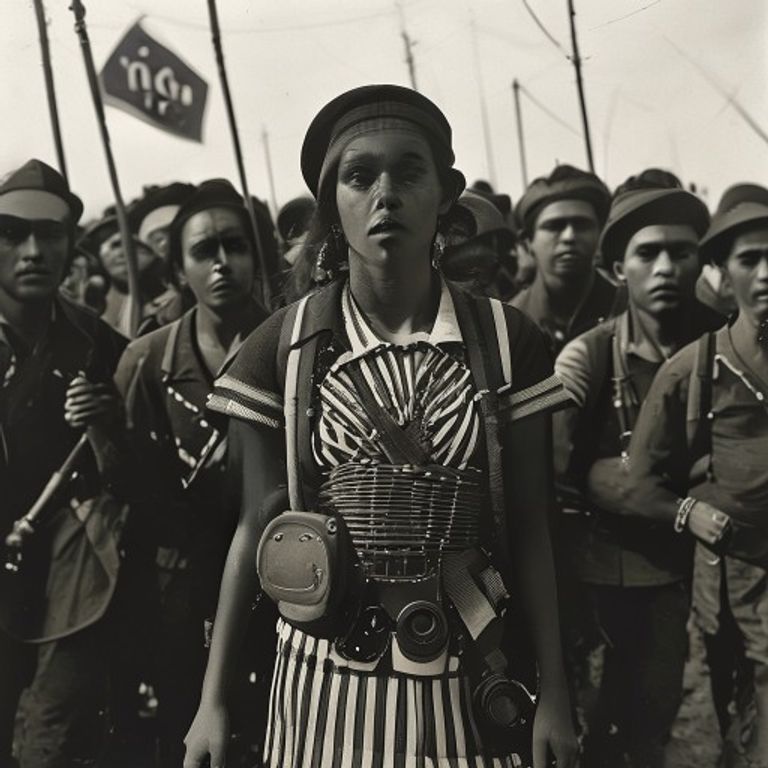
The armed uprising of settlers and squatters against land companies in southwestern Paraná, resulting in a popular victory and the creation of GETSOP.
⚠️ Research prepared with the aid of Deep Research is subject to referential ambiguity.
🖥️ Clean HTML code using a proprietary tool.
👥 Research by Guilherme Felipe, Curation by Sílvio Lôbo
The Silent Echo of the 1957 Revolt in Paraná: A Mystery That Resists Time
In 1957, the serene landscapes of Paraná were shaken by an event whose contours faded amidst mist and controversy. What has come to be called the "1957 Revolt" transcends the mere chronology of events. It is an intricate mosaic of misinformation, official silence, and a longing for answers that, decades later, still echoes in the minds of those who delve into the annals of Brazil's unsolved mysteries.
1. The Context and the Incident: The Whispered Cry in the Mountains
The epicenter of this enigma lies in a rural area of the state, near cities such as Lapa and Palmeira. Initial reports, fragmented and often contradictory, point to a popular uprising of unexpected proportions, involving groups of peasants and rural workers dissatisfied with the socioeconomic conditions of the time. The exact nature of the "revolt" is the first veil covering the case: was it an armed mutiny, a radicalized demonstration, or something more subtle, yet equally impactful?
The newspapers of the time, despite covering the event, did so with a tone of urgency and, at times, sensationalism, but without the investigative depth one would expect from an uprising with the characteristics of a "revolt." The scarcity of detailed official records and the reluctance to provide clear information on the part of the authorities created fertile ground for speculation.
2. Timeline of Events: Fragments of a Puzzle
Reconstructing the timeline of the "1957 Revolt Case" is an exercise in patience and meticulousness, given the inconsistency of reports and the lack of robust documents. However, some milestones can be outlined:
- Early 1957: Growing social and economic tension in rural areas of Paraná, marked by land disputes and dissatisfaction with government policies.
- Mid-1957: The first reports of gatherings and localized clashes emerge. The official narrative, when it exists, tends to minimize the dimension of these events as mere "disturbances."
- August 1957: The most critical point. Unconfirmed reports speak of coordinated actions by armed groups, road blockades, and direct clashes with police and military forces. Were there deaths? Injuries? Captures? Information is scarce and biased.
- September 1957: The official narrative attempts to restore order. Post-event reports describe the "pacification" of the area but do not explain the origin of the mass mobilization or the motives that drove it.
3. The Main Theories: Between the Grounded and the Supernatural
The ambiguity of the "1957 Revolt Case" has allowed for the flourishing of various theories, each attempting to fill the gaps left by the lack of clarity:
-
Socioeconomic Theories (Most Likely):
This hypothesis, supported by more recent historical analyses, points to a genuine uprising of peasants and rural workers. The causes would be linked to land concentration, labor exploitation, lack of access to basic resources, and dissatisfaction with non-existent or ineffective agrarian reform policies. The "revolt" would be a direct response to decades of neglect and social oppression. The lack of detailed documentation would be the result of state repression and the interest in silencing popular mobilization.
-
Political Conspiracy Theories:
Another line of investigation suggests that the event was not spontaneous, but orchestrated by political groups with specific interests. It could have been an attempt to destabilize the local or federal government, or a guerrilla movement with ideological goals. The lack of clear leadership identified in official reports would fuel this thesis, indicating possible control "behind the curtains."
-
External or Ideological Influence Theories:
In a period of Cold War and ideological polarization, the possibility of external influences cannot be ruled out. The dissemination of radical leftist ideologies among rural workers, or even the veiled support of foreign countries or groups, could have catalyzed the events. The difficulty in identifying a unified and coherent movement could be a reflection of this external influence.
-
Alternative and Paranormal Theories (Least Provable):
Although unsupported by concrete evidence, some peripheral narratives mention inexplicable events that allegedly occurred during the period. Reports of unusual luminous phenomena in the sky, animals behaving strangely, or even the suggestion that the land itself "reacted" to injustices, fuel a subgroup of speculations more focused on the esoteric or paranormal. These theories, however, lack any factual basis and tend to be rejected by serious investigators.
4. Controversies and Blind Spots: What the Archives Do Not Tell
The "1957 Revolt Case" is full of controversies and gaps that fuel the mystery:
-
Inconsistencies in Official Investigations:
The few official reports available are generic and focus on the "restoration of order," without delving into the human causes and consequences of the event. There are no clear records of legal proceedings against leaders or participants, which is unusual for an uprising of such magnitude. The absence of official lists of the dead and missing is particularly alarming.
-
Ignored Clues and Conflicting Testimonies:
Eyewitness accounts, collected informally over the years, frequently contradict the official version. Some point to violent and disproportionate repression, while others describe the participation of individuals in peaceful actions that were interpreted as a "revolt." The suppression of witnesses or intimidation to keep them from speaking are plausible hypotheses.
-
Disappeared Evidence:
Relevant historical documents, such as complete police inquiries, lists of detainees, or detailed military records from the time, seem to have disappeared or become inaccessible. This "loss" of evidence adds a layer of suspicion regarding the intention to cover up the truth.
-
The Silence of Victims and Relatives:
Many relatives of people who might have been involved in the 1957 events are reluctant to speak. Fear of reprisals, shame, or the pain of an unresolved past may have created a "historical silence" that prevents the full elucidation of the case.
5. Curiosities and Legacy: The Shadow of History
The "1957 Revolt Case" in Paraná remains a grim reminder of how history can be written (or erased) and how the truth can become a persistent ghost. Although it did not reach the status of cases with national repercussions like the Canudos Massacre or the Contestado War, it fits into a historical context of social conflicts in the Brazilian countryside that, for many decades, were silenced or minimized.
Currently, the case is not officially reopened by the authorities. However, it has been the subject of academic studies and independent research, driven by the interest of historians and journalists in unraveling its mysteries. The legacy of the "1957 Revolt Case" lies in the need to rescue silenced voices, to question official narratives, and to seek, with every fragment of evidence, the reconstruction of a history that, for obscure reasons, seems to have been intentionally left incomplete.
The silent echo of 1957 still resonates in the mountains of Paraná, a perennial invitation to reflect on the injustices of the past and the importance of never letting history be completely forgotten.



