


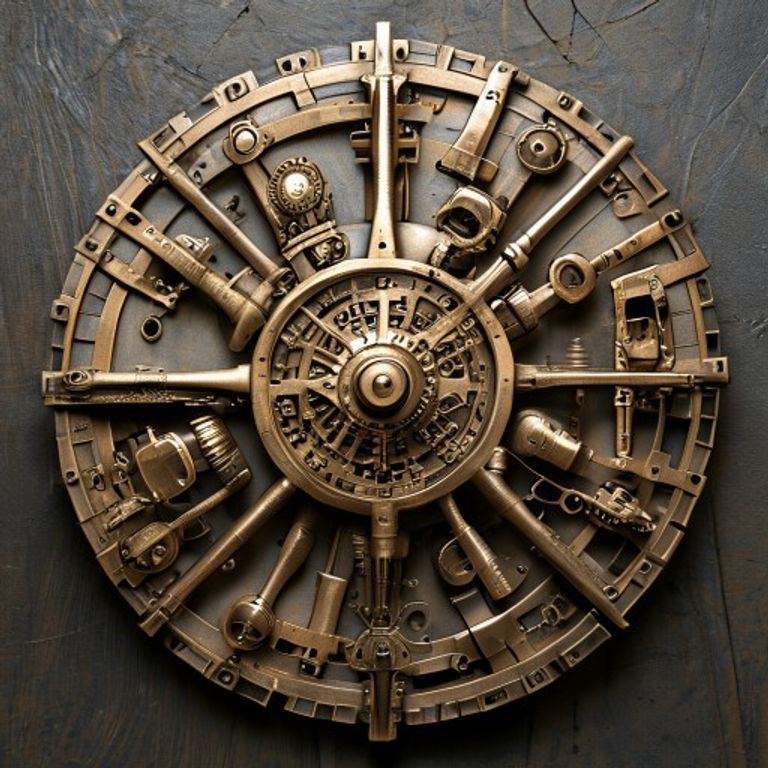
A complex bronze device recovered from a shipwreck in Greece is considered the first analog computer in history, capable of predicting eclipses and astronomical cycles with millennial precision.
⚠️ Research elaborated with the aid of Deep Research is subject to referential ambiguity.
🖥️Clean HTML code with the use of proprietary tools.
👥Research by Guilherme Felipe, Curation by Sílvio Lôbo
The Whispering Enigma of the Depths: Unraveling the Antikythera Mechanism Case
For decades, the Aegean Sea held a secret that defied imagination and the very chronology of technological history. An ancient shipwreck, dating back over two millennia, brought to light an artifact that would become the core of a mystery yet to be fully solved: the Antikythera Mechanism. This investigative article delves into the depths of time and speculation to illuminate one of the most fascinating and perplexing enigmas of modern archaeology.
1. The Context and the Incident: The Sunken Treasure and the Beginning of the Mystery
The stage for this underwater drama is the Greek island of Antikythera, located between Crete and the Peloponnese. In 1900, a group of Greek sponge divers, led by Elias Stadiatis, was caught in a storm that forced them to seek shelter near the island's coast. It was during this forced stop that they spotted the wreckage of an ancient Roman ship at a depth of approximately 45 meters. What followed was a monumental salvage operation, a race against time and currents to recover what was believed to be a treasure of marble and bronze statues.
The shipwreck, initially dated to the 1st century BC, revealed an extraordinary cargo. Among the stunning art pieces, a corroded and fragmented bronze object, initially misunderstood, caught attention. It was the Antikythera Mechanism, a complex tangle of bronze gears that seemed to belong to a technological era far more advanced than previously thought possible for Ancient Greece.
2. Timeline of Events: Discovery and the Struggle for Understanding
- 1900: Sponge divers discover the Roman shipwreck near Antikythera.
- 1901: The first major archaeological salvage expedition begins, led by Valerios Stais, who identifies the first fragments of the Mechanism.
- 1902: Valerios Stais recognizes the mechanical nature of the artifact, suggesting it contains gears.
- 1951-1976: Researchers like Derek J. de Solla Price, a historian of science, conduct more in-depth analyses, using X-ray techniques and culminating in his seminal publication "Gears from the Greeks," which describes the Mechanism as an astronomical computer.
- 2005: The "Antikythera Mechanism Research Project" is formed, bringing together experts from various fields to study the artifact with cutting-edge technology, including computed tomography and high-resolution imaging.
- 2007-2010: A new diving campaign at the shipwreck site discovers more related fragments and artifacts.
- 2012: The project publishes a detailed study revealing the Mechanism's complexity, indicating it could predict eclipses and planetary movements with remarkable accuracy.
- Present: The Antikythera Mechanism is exhibited at the National Archaeological Museum of Athens, continuing to inspire debates and research.
3. Main Theories: Seeking Logic in Unexpected Complexity
What exactly is the Antikythera Mechanism? The answer, far from being unequivocal, has generated a range of hypotheses, from the most scientific to the most speculative.
Scientific and Archaeological Theories (Proven Facts and Strong Hypotheses):
- Greco-Roman Astronomical Computer: This is the dominant theory, widely supported by physical evidence and scientific analysis. The Mechanism is considered a complex analog computer capable of predicting astronomical positions, solar and lunar eclipses, and calendar cycles. It is believed to have modeled the movements of the Sun, Moon, and possibly the five planets known in antiquity. The Greek inscription found on the fragments corroborates this interpretation, detailing functions and names of celestial bodies.
- Navigation Instrument: Although less emphasized, some speculate that the device could have had functions to aid navigation, using astronomical information for orientation.
- Educational or Demonstrative Tool: One hypothesis is that the Mechanism served as a tool for teaching astronomy or as a demonstration of advanced scientific knowledge.
Alternative, Conspiracy, and Paranormal Theories (Speculation):
- Alien Technology: One of the most extreme theories suggests that the Mechanism was not created by human hands of that era, but rather by an advanced extraterrestrial civilization that visited Earth. The complexity of the gears and the sophistication of the design, according to this view, would surpass the technological knowledge of antiquity.
- Advanced Lost Civilization: Similar to the previous one, this theory posits the existence of an unknown and much more advanced terrestrial civilization than Ancient Greece, whose knowledge would have been lost over time. The Mechanism would be proof of this forgotten civilization.
- Time Travel: An even more fantastical strand speculates that the Mechanism could be an artifact from time travelers, brought from the future to the past.
- Mysterious and Unknown Origin: Some prefer to maintain the possibility that the Mechanism's exact origin and purpose are radically different from what current theories suggest, and that new discoveries may revolutionize our understanding.
It is crucial to note that alternative and conspiracy theories lack concrete evidence and are widely rejected by the scientific and archaeological community, which relies on tangible proof and rigorous analysis methods.
4. Controversies and Blind Spots: The Shadows of Investigation
Despite monumental efforts, the Antikythera Mechanism case presents gaps and points that continue to fuel debate.
- Extreme Fragmentation: The state in which the Mechanism was recovered – in hundreds of corroded fragments – represents a colossal challenge for reconstruction and complete understanding. Many gears and inscriptions are still missing or illegible.
- Unknown Origin Location: Although the shipwreck occurred near Antikythera, the exact origin of the ship and its cargo remains a mystery. It is believed that the ship might have been traveling from Rhodes or another Greek city to Rome, but the exact route and the reason for the voyage are unclear.
- Final Purpose and Manufacturer: While the astronomical function is widely accepted, the ultimate purpose (scientific, educational, religious?) and the individual or workshop responsible for its creation are still subject to speculation.
- "Out of Place" Technology: The main controversy lies in the very existence of the Mechanism. Its technical sophistication, particularly the quality of the gear cutting, seemed to be centuries ahead of other known technologies of the time. This "out of place" technology led to questions about the speed of technological development in antiquity and whether there were gaps in our knowledge.
- Lost Clues: The initial exploration of the shipwreck in 1901, while heroic for its time, may have missed potential evidence due to the technological limitations and the nature of the era. The amount of material recovered was impressive, but it is possible that artifacts crucial for a complete understanding of the Mechanism were lost forever in the depths.
5. Curiosities and Legacy: A Beacon of Unexpected Knowledge
The Antikythera Mechanism has transcended the field of archaeology to become a cultural icon, redefining our perception of antiquity and inspiring new generations.
- The First Analog "Computer": Its discovery rewrote the history of computing, demonstrating that mechanical devices of extraordinary complexity already existed over two millennia ago.
- Inspiration for Fiction: The artifact's enigmatic nature has made it a recurring element in science fiction and conspiracy theories, fueling narratives about lost civilizations and forgotten technologies.
- A Symbol of Human Curiosity: The Mechanism is a testament to human ingenuity and the relentless pursuit of understanding the universe. It reminds us that knowledge and technology can emerge in unexpected times and places.
- Current Status: The Antikythera Mechanism case has not been shelved; on the contrary, it remains one of the most active areas of archaeological and historical research. The "Antikythera Mechanism Research Project" continues with new expeditions and analyses, seeking to fill the remaining gaps and fully unravel the secrets of this extraordinary device.
- Impact on Historical Perception: Its existence has forced historians and scientists to re-evaluate the technological capabilities of ancient civilizations, suggesting that we may have underestimated the depth of their knowledge.
The Antikythera Mechanism remains a beacon of unexpected knowledge, whispering stories of a distant and complex past. Each deciphered fragment, each analyzed gear, brings us a little closer to the truth, but the underlying mystery, like the depths of the sea that guarded it, still holds secrets that challenge our understanding.



