


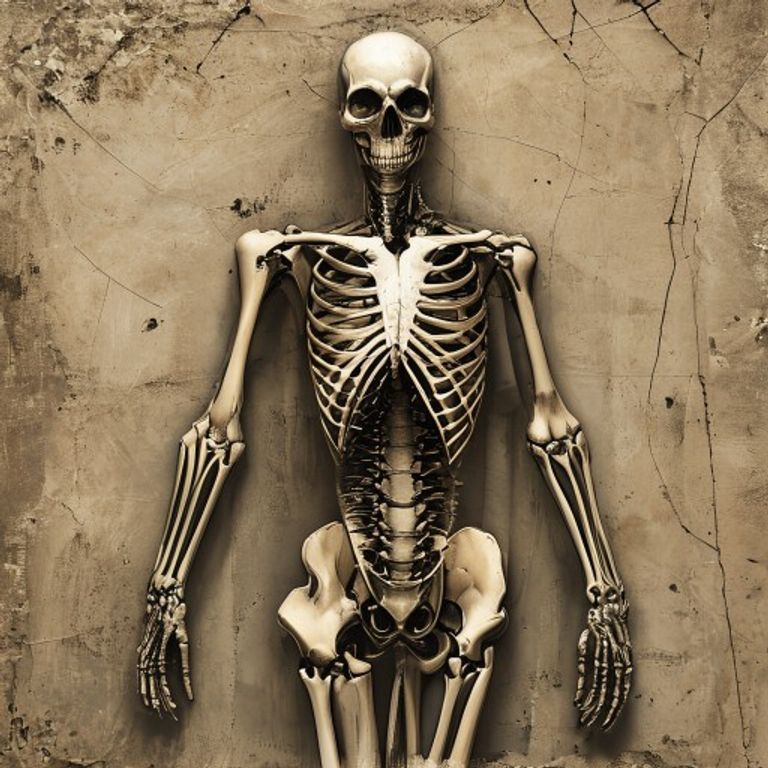
A tiny skeleton with the bone density of a child, but the size of a fetus and an extremely elongated skull, was found in the Chilean desert, defying initial explanations.
⚠️ Research conducted with the aid of Deep Research is subject to referential ambiguity.
🖥️Clean HTML code using a proprietary tool.
👥 Research by Guilherme Felipe, Curation by Sílvio Lôbo
The Atacama Skeleton: An Enigma Frozen in the Desert
In 2003, the arid vastness of the Atacama Desert in Chile held a secret that would challenge science and popular imagination. What appeared to be just another anonymous skeleton in a remote region quickly transformed into one of the most intriguing mysteries of the 21st century: the Atacama Skeleton Case, also known as Ata 00033.
1. The Context and the Incident: A Silent Discovery in Solitude
The incident began on October 17, 2003, when a group of explorers, led by Oskar Muñiz, were searching for remnants of an abandoned mine near the small and isolated town of San Pedro de Atacama. It was in a desolate location, about 75 kilometers from the town, that they stumbled upon the remains of a small human being, dressed in faded fabric clothes and a blanket. The discovery, initially met with some skepticism due to the nature of the site, soon attracted the attention of authorities and, subsequently, the world.
2. Timeline of Events: From Discovery to Global Debate
- October 17, 2003: The skeleton is discovered by explorers in a remote region near San Pedro de Atacama.
- 2003-2004: The remains are taken for analysis. The individual's small stature and anomalous characteristics generate initial speculation.
- 2013: A team of researchers from Stanford University, led by geneticist Dr. Garry Nolan, publishes a study suggesting that the skeleton could belong to a fetus or a very young child with genetic anomalies.
- 2018: The documentary "Sirius" revives public interest in the case, presenting new analyses and raising the possibility of a non-human origin.
- 2018 onwards: The case becomes a boiling point for debates, with the scientific community divided between conventional explanations and alternative theories.
3. The Main Theories: From Biological to Extraterrestrial
The enigmatic nature of the skeleton has given rise to a myriad of theories, each seeking to unravel the mystery:
3.1. Scientific and Police Hypotheses
- Fetus or Premature Baby with Genetic Anomalies: This is the most widely accepted explanation by the scientific community. DNA analyses, although with limitations on old samples, pointed to a human genome, suggesting that the individual was a fetus or a newborn child, possibly with rare genetic syndromes (such as microcephaly or other dysplasias) that resulted in its unusual physical characteristics. The context of the find, in a hard-to-reach location, could indicate a complicated birth or abandonment.
- Child with a Degenerative Genetic Disease: A variation of the previous theory, proposing that the individual was an older child who suffered from a genetic condition that affected their growth and bone development, resulting in their reduced stature and anomalous skull.
3.2. Alternative, Conspiracy, and Paranormal Theories
- Extraterrestrial Origin: This theory gained traction mainly after the release of the documentary "Sirius." It is argued that the skeleton's characteristics (small size, disproportionate skull, among others) do not fit any known human condition and would point to a being from another galaxy. The lack of complete and conclusive genetic data is often cited as support for this hypothesis.
- Genetic Experiments or Modified Creatures: A branch of the extraterrestrial theory, suggesting that the skeleton could be the result of secret genetic experiments, possibly involving the hybridization of human DNA with material from other species, or even aliens.
- Mythology or Ancient Beings: From a more mystical perspective, some speculate that the skeleton could belong to a legendary creature or a being from an ancient civilization, whose characteristics have been distorted over time into myths and folklore.
4. Controversies and Blind Spots: The Gaps in the Investigation
The Atacama skeleton case is permeated by controversies and blind spots that hinder a definitive resolution:
- Quality and Access to Genetic Data: Although DNA analyses have been performed, the quality of the samples and the interpretation of the results have been debated. The difficulty in obtaining a complete and contamination-free genome, given the age and preservation of the skeleton, leaves room for questioning. Unrestricted access to all original reports and samples by the global scientific community is also a point of contention.
- Disappearance of Evidence/Custody of Remains: There are reports and speculations that some evidence or parts of the skeleton may have been lost or that its custody, especially in the early stages of the investigation, was not fully documented.
- Pressure and Motivations: The involvement of researchers with declared interests in ufology has raised questions about the objectivity of the conclusions presented, creating a bias that the more skeptical scientific community has sought to discredit.
- Little-Explored Archaeological Context: The region where the skeleton was found is vast and little explored archaeologically. The lack of similar findings could either corroborate the individual's uniqueness or hinder contextualization.
5. Curiosities and Legacy: A Mystery That Persists
The "Atacama Skeleton" has transcended the scientific and police spheres to become an icon of popular culture related to mysteries and extraterrestrial life. Its widely disseminated image evokes imagination and fuels debate about the limits of what we know:
- Cultural Impact: The case has inspired countless articles, documentaries, online forum discussions, and is frequently cited in debates about ufology and biological anomalies.
- Current Status: Officially, the case remains within the realm of scientific investigation, with most scientists inclined to accept the explanation of a human fetus or child with genetic anomalies. However, the lack of definitive conclusions and the persistence of alternative theories keep the mystery alive. The remains are currently in the possession of the Stanford University Genetics Laboratory, awaiting further analyses that may, perhaps, one day shed light on this enigma frozen in the desert.



