


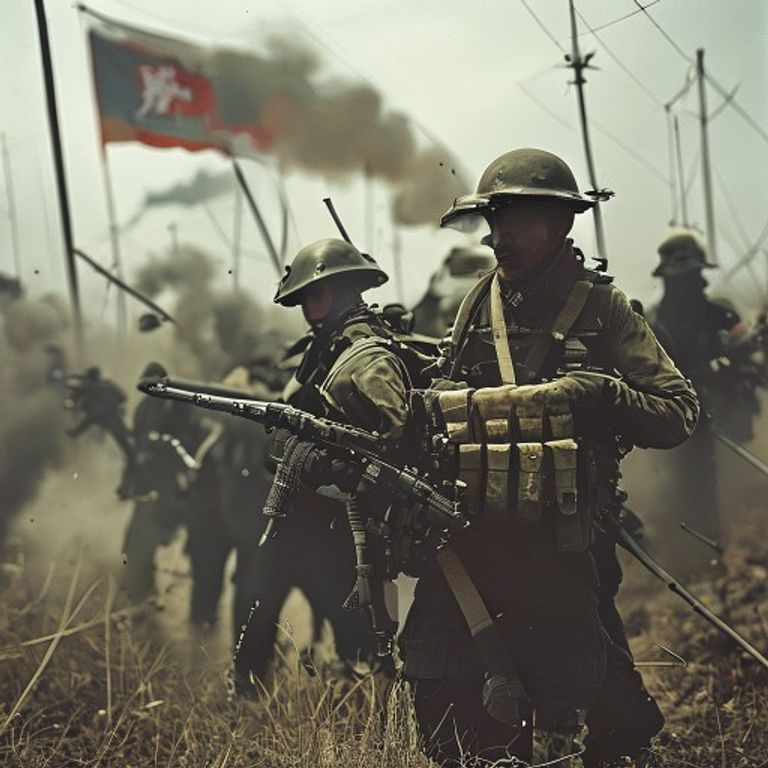
Anti-aircraft batteries fired thousands of rounds at an unidentified flying object over California months after Pearl Harbor, but no enemy aircraft were shot down.
⚠️ Research conducted with the aid of Deep Research may be subject to referential ambiguity.
🖥️Clean HTML code using a proprietary tool.
👥 Research by Guilherme Felipe, Curation by Sílvio Lôbo
The Battle of Los Angeles Incident: An Aerospace Enigma Haunting Southern California
In the early hours of February 25, 1942, amidst the fervor and fear of World War II, the sky over Los Angeles became the stage for an event that would defy explanation and fuel theories for decades: what became known as the "Battle of Los Angeles Incident." An alarm sounded, sirens wailed, and panic gripped the city as a tense darkness was broken by flashes of light and the deafening roar of anti-aircraft artillery.
The Context and the Incident: Where, When, and How the Mystery Began
Less than three months after the attack on Pearl Harbor, the West Coast of the United States lived under the imminence of a Japanese attack. The city of Los Angeles, an important industrial and military center, was on high alert. Around 2:00 AM, an unidentified object was spotted flying over the Santa Monica area. From there, chaos ensued.
The city's defense system was activated. Anti-aircraft artillery opened fire, unleashing thousands of projectiles at what was believed to be an enemy aerial attack. The Los Angeles sky was illuminated by explosions, creating a terrifying spectacle that lasted approximately one hour. The battle, however, did not result in any enemy planes shot down, nor in significant casualties caused by bombings, which only deepened the mystery of what truly happened.
Timeline of Events: A Chronological Reconstruction
- February 25, 1942, approx. 2:00 AM: Initial sighting of an unidentified object over Santa Monica.
- February 25, 1942, approx. 2:15 AM: Air raid sirens sound throughout Los Angeles.
- February 25, 1942, approx. 2:25 AM: Anti-aircraft artillery begins firing at the object(s) in the sky.
- February 25, 1942, approx. 3:00 AM: The frenzy of firing gradually subsides.
- February 25, 1942, approx. 3:45 AM: Calm returns to the city, but uncertainty remains.
The Main Theories: Deciphering the Enigma
Over the years, various theories have emerged to try and explain what the "Battle of Los Angeles Incident" was. They range from mundane explanations to hypotheses that challenge conventional understanding.
Scientific and Official Hypotheses:
- Confusion and War Stress: The most widespread theory, accepted by the authorities at the time. It was believed that the initial sighting was caused by weather balloons or even a lone reconnaissance plane. The fear of an imminent attack led to an exaggerated and disorganized reaction from the defense, resulting in indiscriminate firing at nothing. General George C. Marshall, in a later report, pointed to "nervousness" as the main factor.
- Friendly Fire or Misidentification: It is possible that some of the anti-aircraft artillery fire caused damage and even some of the few reported fatalities (attributed to heart attacks or falls during the panic), and that confusion prevented the correct identification of exploding projectiles.
Alternative and Conspiracy Theories:
- "Blackout" Operation and Defense Test: One theory suggests that the event was partly orchestrated to test the city's response capability to an air attack, as well as to serve as a blackout exercise. However, the intensity and duration of the anti-aircraft response seem to go beyond a simple test.
- Secret or Experimental Technology: It is speculated that the object sighted could be a prototype of a secret aircraft, either American or Japanese, undergoing testing. The Soviet Union was also considered by some.
- Unusual Meteorological or Luminous Phenomenon: Some suggest that what was seen and fired upon could have been a rare natural phenomenon, such as unusual lightning, high-altitude weather balloons, or even large-scale ball lightning, which would have been misinterpreted as enemy aircraft.
Paranormal and Ufological Theories:
- Unidentified Flying Object (UFO): This is the theory that most captivates the popular imagination. The inability to identify the object, reports of anomalous movements, and resistance to gunfire fueled the belief that what flew over Los Angeles was an artifact of extraterrestrial origin. The lack of debris or physical evidence of a destroyed object, coupled with the elusive nature of the target, reinforces this hypothesis for its adherents.
Controversies and Blind Spots: The Cracks in the Official Narrative
Despite the official explanations, the incident is rife with inconsistencies and blind spots that fuel doubts to this day.
- Conflicting Reports: Initial reports from the Army and Navy presented contradictory descriptions of the number, size, and behavior of the sighted object(s).
- Missing or Ignored Evidence: Claims that pieces of a supposed object that had crashed in Santa Monica were collected by the military but never presented to the public have circulated for decades.
- Ignored Testimonies: Many testimonies from civilians and military personnel describing objects with unconventional characteristics were downplayed or discredited in favor of the explanation of simple war panic. A notable example is the testimony of civilians who reported seeing the object "suddenly change direction" and "stop in mid-air."
- The Delayed Official Report: The War Department's final report on the incident was only released months later, and its official conclusion that it was a "false alarm" caused by general nervousness did not satisfy everyone. The Secretary of the Navy himself, James Forrestal, reportedly expressed personal doubts about this explanation.
Curiosities and Legacy: The Enduring Echo of a Mystery
The Battle of Los Angeles Incident transcended the event itself, becoming a landmark in popular culture and the UFO imagination.
- Cultural Impact: The event inspired countless books, films (such as Steven Spielberg's "1941"), and documentaries, solidifying itself as one of the most intriguing mysteries of the 20th century.
- "Battle of Los Angeles" as an Icon: The name "Battle of Los Angeles" is often used to refer to significant UFO sightings or unexplained aerospace incidents.
- Current Status: The case remains officially classified as a false alarm. However, with the declassification of military documents over the years, interest in reopening or re-evaluating the incident periodically resurfaces, especially among enthusiasts and independent researchers seeking definitive answers to what really happened that tense night in Los Angeles. The truth, like many unsolved cases, may have been obscured by time and circumstances, but the mystery of the "Battle of Los Angeles" continues to hover in the sky of our imagination.



