


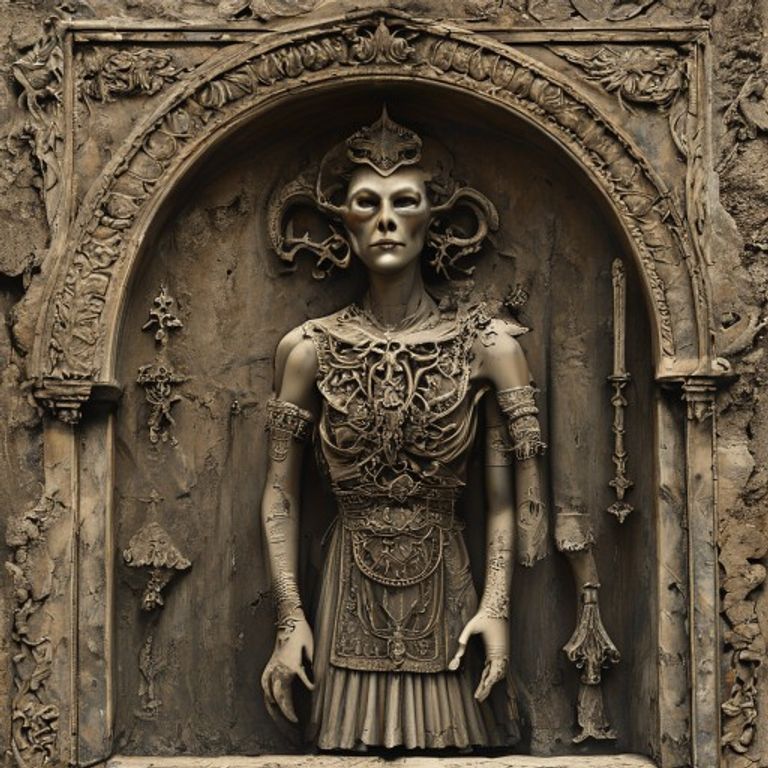
The legendary Visigoth king was buried in a riverbed in Italy in 410 along with the plundered treasure of Rome; the slaves who diverted the water were executed so that the secret of the location would never be revealed.
⚠️ Research elaborated with the aid of Deep Research is subject to referential ambiguity.
🖥️Clean HTML code using a proprietary tool.
👥 Research by Guilherme Felipe, Curation by Sílvio Lôbo
The Case of Alaric's Tomb: A Legend Buried in the Shadows of History
History often presents us with enigmas that challenge reason and the passage of time. Among these, the Case of Alaric's Tomb stands out as one of antiquity's most persistent and fascinating mysteries, a legend that spans centuries, fueled by very few concrete facts and a vast web of speculation. What happened to the mortal remains of the Visigoth king and the treasure that, according to legend, accompanied him in his final resting place? The search for an answer has become an obsession for historians, archaeologists, and treasure hunters, unearthing more questions than answers.
1. The Context and the Incident: Where, When, and How the Mystery Began
The mystery begins in 410 AD, following the shocking Sack of Rome by the Visigoths, led by the legendary king Alaric I. After plundering the Eternal City, Alaric led his troops to southern Italy with the aim of crossing into Africa and consolidating his power. However, fate had other plans. Alaric died suddenly, under circumstances not yet fully elucidated, in Cosenza, Calabria. Germanic tradition demanded a grand funeral, but the need to keep Roman enemies ignorant of the exact location of his grave led to a ritual that would become the seed of one of history's greatest mysteries.
The most widespread legend, narrated by the Byzantine historian Jordanes in his work Getica, describes a macabre and monumental feat: Alaric's tomb was allegedly built by temporarily diverting the course of the Busento River. The king's body, accompanied by an immeasurable amount of treasure plundered from Rome – gold, silver, jewels, and precious relics – was placed in the dry riverbed. Then, the course of the Busento was restored, forever submerging the royal burial site and the vast wealth that surrounded it. And to ensure absolute silence, all the slaves who participated in the work were allegedly executed.
2. Timeline of Events: A Chronological Reconstruction
- 410 AD: Sack of Rome by the Visigoths under the command of Alaric I.
- 410 AD: Death of Alaric I in Cosenza, Calabria, Italy.
- 410 AD (approximately): Secret funeral of Alaric, involving the diversion of the Busento River, according to tradition.
- 6th Century AD: Jordanes, a Byzantine historian, narrates the episode of Alaric's funeral in his work Getica, perpetuating the legend.
- Following Centuries: The legend of Alaric's Tomb and its treasure spreads, inspiring countless expeditions and speculations.
- Modern Periods: Various excavations and searches, especially around the Busento River in Cosenza, in an attempt to locate the tomb.
3. The Main Theories: Possible Explanations
Over the centuries, various theories have emerged to explain the fate of Alaric's tomb. They range from rational explanations, based on funerary practices and military logic, to more fantastic and paranormal hypotheses.
3.1. Scientific and Archaeological Hypotheses
- The Reality of the Legend: The most direct theory posits that Jordanes' narrative is essentially true. The diversion of the river and the secret burial with treasures would have been an effective method to protect the grave and its wealth from later looting and desecration. The difficulty in finding the tomb would be proof of its remote and protected location.
- The Lost Treasure, But Not Buried with the King: Some historians suggest that the focus on the treasure may have been exaggerated by the legend. The main objective was the secret burial of the king, and any wealth deposited would have been more symbolic than a real treasure. The dispersion of the Visigoths after Alaric's death could have led the royal treasure to other locations.
- Alternative Location: There are speculations that the tomb is not necessarily in the Busento River, but in another area near Cosenza, where the Visigoths might have camped. The description of the river diversion could be a metaphor or a simplification of historical reality.
3.2. Alternative, Conspiracy, or Paranormal Theories
- The Treasure as a Magnet for Myths: The conspiracy theory suggests that the legend was deliberately created or exaggerated by factions interested in diverting attention from other historical events or hiding the true destination of the treasure. It could have been taken by other Visigoth leaders or even hidden elsewhere without relation to the tomb.
- Curses and Supernatural Protections: More folkloric and paranormal narratives speak of curses cast upon those who dared to disturb Alaric's rest and his treasure. This perspective, while lacking scientific basis, adds an element of suspense and mystery to the story.
- Natural Phenomena and the Wear of Time: A more earthly, but no less mysterious, explanation is that natural events, such as floods or changes in the river's course over seventeen centuries, may have completely obliterated any trace of the tomb, making its discovery impossible.
4. Controversies and Blind Spots
The main blind spot of the Case of Alaric's Tomb lies in the scarcity of concrete evidence and the nature of the historical narrative itself.
- Jordanes' Sole Source: Much of what we know about Alaric's funeral comes from Jordanes' work, who wrote more than a century after the events. The accuracy of his information is debated, and it is possible that he incorporated legendary elements to glorify the Visigoth past.
- Absence of Definitive Archaeological Finds: Despite numerous expeditions and archaeological investigations carried out in Cosenza and its surroundings, no conclusive traces of Alaric's tomb or his fabulous treasure have ever been found. Excavation reports, when they exist, generally point to the difficulty in distinguishing historical strata due to the region's geology and the river's action.
- Lack of Contemporary Visigoth Records: There are no contemporary Visigoth accounts that corroborate Jordanes' version, leaving an informational vacuum regarding funerary rituals and the transfer of Alaric's body.
- The Enigma of "Alaric's Treasure": The nature and exact quantity of the treasure are purely speculative. The idea of a colossal treasure plundered from Rome is, in itself, a powerful narrative driver, but it lacks objective proof.
5. Curiosities and Legacy
The Case of Alaric's Tomb has transcended the field of history to become an icon of popular culture, inspiring books, films, and countless treasure hunts.
- The Fascination of Lost Treasure: The image of unimaginable treasure, submerged by the waters of a river, evokes a romanticism and adventure that captivate the human imagination. The case has become synonymous with "the greatest lost treasure of antiquity."
- Modern Expeditions and Technology: Throughout the 20th and early 21st centuries, various expeditions, often using cutting-edge technology such as ground-penetrating radar and underwater drones, have attempted to unravel the mystery. However, the geological complexity of the area and the sheer force of nature have been formidable obstacles.
- Current Status: The case remains officially unresolved. Alaric's tomb and its treasure continue to be a myth, a legend buried in the shadows of history. The lack of concrete evidence has led to the shelving of many official investigations, but the fascination with the story persists, fueling the hope that one day, perhaps, the waters of the Busento will reveal their secrets. The case serves as a reminder of the fragility of historical knowledge and the persistence of enigmas that humanity is unable to fully solve.



