


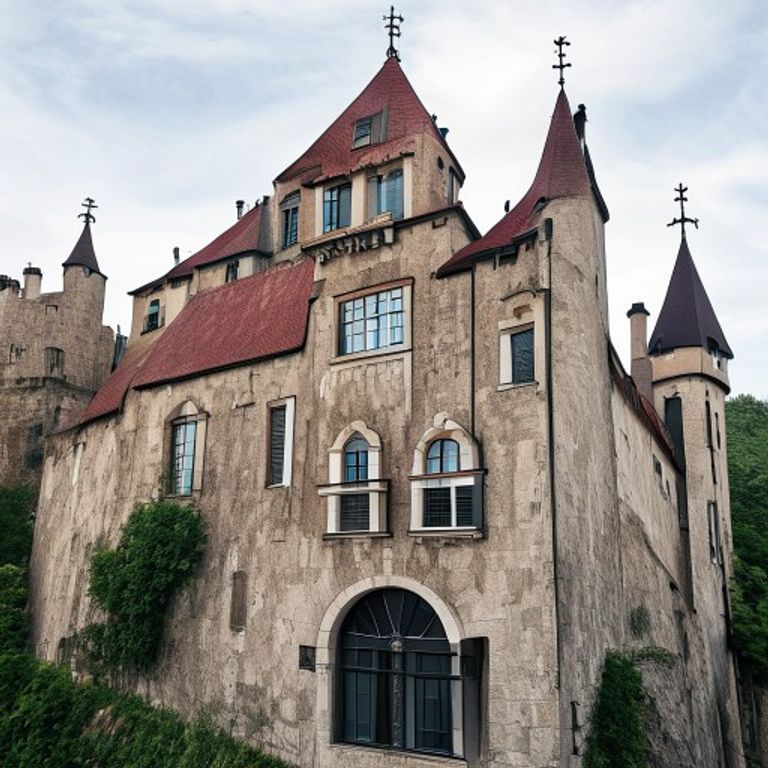
An imposing fortress in the Czech Republic was built without access to water or trade routes, supposedly only to seal a bottomless well leading to hell.
⚠️ Research conducted with the assistance of Deep Research is subject to referential ambiguity.
🖥️Clean HTML code using a proprietary tool.
👥 Research by Guilherme Felipe, Curation by Sílvio Lôbo
The Chilling Enigma of Houska Castle: An Unfinished Portal to the Unknown
In the heart of Bohemia, in the Czech Republic, stands Houska Castle, a medieval fortress shrouded in mists of mystery. More than its imposing walls and Gothic architecture, what captivates and frightens is the legend of a deep, unfathomable hole within its grounds, considered by many to be a portal to hell. This article delves into what we know, what we speculate, and what remains undecipherable about The Case of Houska Castle.
1. The Context and the Incident: A Bottomless Pit
The origin of the mystery dates back to the castle's construction, possibly in the 13th century, under the reign of Boleslaus I or Boleslaus II. The peculiarity lies in its location: not on a strategic hill for defense, but in a relatively flat area, far from important trade routes. The true anomaly, however, is what is narrated about a fissure, a natural abyss, that was located in the center of the courtyard. Historical accounts, though scarce and often legendary, describe this hole as unfathomable, with polished stone walls that seemed to swallow the light.
The narrative that underpins the castle's central mystery is that the hole was a portal to hell. Legend has it that, in ancient times, the king ordered a prisoner to be tied to a rope and thrown into the abyss. It was believed that the man would scream for hours, but soon after, his voice would transform into a chorus of demons, confirming suspicions that the passage led to a realm of torment.
2. Timeline of Events: Between Legends and Records
The chronological reconstruction of The Case of Houska Castle is intrinsically linked to the evolution of legends and the preservation (or neglect) of historical records.
- 13th Century: Construction of Houska Castle begins. It is believed that the natural fissure already existed at the site and was incorporated (or surrounded) by the architecture. The first legends about the "portal" begin to circulate, fueled by the unknown and the fear of the abyss.
- Medieval Period: The castle's reputation as a place of demonic activities or passages to the underworld solidifies among the local population. The absence of clear official records about the exact nature of the hole contributes to the proliferation of stories.
- 16th Century: The castle undergoes renovations and is rebuilt in the Renaissance style, with the chapel being erected over the supposed hole. This architectural intervention is seen by some as an attempt to "seal" or neutralize the alleged passage.
- 20th and 21st Centuries: Interest in Houska Castle is revived with the emergence of reports of paranormal phenomena. Tourists and paranormal researchers visit the site, attracted by the legends and the dark atmosphere. The original abyss, if it still exists, would be completely covered by the chapel's structure.
3. Main Theories: From Scientific to Supernatural
Houska's enigma has generated a myriad of theories, ranging from pragmatic explanations to conjectures that defy conventional logic.
3.1. Scientific and Geological Hypotheses (the most probable)
- Geological Formation: The most accepted theory by geology is that the "hole" was simply a natural fissure in a rock formation, possibly a cave or a deep cavity. The lack of deep exploration and the atmosphere of fear would have amplified its dimension in the popular imagination. The rock in the area is of a calcareous nature, which can form caves and sinkholes.
- Water Well or Cistern: Another possibility is that what is described as a "portal" was, in fact, a water well or a cistern for the castle's supply. The depth could have been significant, but not supernatural. The difficulty in exploring it could be due to geological instability or the presence of water.
3.2. Historical and Archaeological Theories
- Site of Pagan Rituals: The area where the castle was built may have been a sacred site for pre-Christian pagan cults. It is believed that Christians, in their expansion, often built churches and castles over pagan worship sites to convert and subjugate ancient beliefs. The "hole" could have been a ritualistic element in these cults.
- Foundation Legends: The story of the prisoner thrown into the abyss may be a distorted or dramatized version of a foundation legend, common in many cultures, to explain the origin of a place or to warn against disrespecting certain sites.
3.3. Paranormal and Supernatural Theories (the most popular in pop culture)
- Portal to Hell/Underworld: This is the central theory of the mystery. It is believed that the hole is a weak point in reality, allowing the passage of demonic entities or spirits from the underworld. Reports of strange sounds, apparitions, and intense cold sensations in the chapel area are often cited as "evidence."
- Gateway to Other Dimensions: A variation of the previous theory suggests that the hole would not necessarily lead to the Christian "hell," but rather to other dimensions or parallel realities.
- Geopathic Energy Point: Some esoteric theories associate the site with terrestrial energy lines or "dragon points," where paranormal activity would be intensified.
4. Controversies and Blind Spots: The Void in the Evidence
The greatest controversy surrounding The Case of Houska Castle lies in the glaring lack of concrete evidence and the fragmented nature of historical accounts.
- Lack of Official Exploration Reports: There are no official records of a thorough exploration of the original hole. The difficulty in accessing what is believed to be the exact location, under the chapel, prevents any conclusive geological or archaeological investigation.
- Contradictory Testimonies: Legends are passed down orally and, over time, undergo alterations. Testimonies from people who claim to have experienced paranormal phenomena are often subjective and difficult to corroborate.
- Missing or Non-existent Evidence: The absence of artifacts, archaeological discoveries, or even detailed records proving the existence of a "portal" is a significant blind spot. If the hole was so prominent, it is surprising that there are no more concrete traces of its original nature beyond the legends.
- Selective Interpretation: The fascination with the paranormal leads to a selective interpretation of any anomaly. An unusual cold in an ancient stone fortress, or a sound amplified by the site's acoustics, can easily be labeled as supernatural evidence.
5. Curiosities and Legacy: An Icon of Mystery
Houska Castle has transcended its medieval origins to become an icon of popular culture, especially in the niche of mysteries and the paranormal.
- Cultural Impact: The castle is a popular tourist destination for those interested in legends and the occult. Its story has inspired books, documentaries, and conspiracy theories. The image of the castle as a portal to hell is powerful and evocative.
- Current Status: The castle has been restored and is open for visits. The area where the "portal" is believed to be is a point of great interest. There is no official reopening of police or scientific investigations into a specific incident, as the mystery is more of a legendary and paranormal nature than a crime or isolated event with defined suspects. Investigations into the site are limited to academic research on folklore and architecture, or incursions by ghost hunters and paranormal researchers.
- The Legend Continues: Despite the lack of concrete proof, the legend of the portal at Houska Castle persists, fueled by human imagination and the eternal fascination with the unknown that lies beneath the surface of our reality.



