


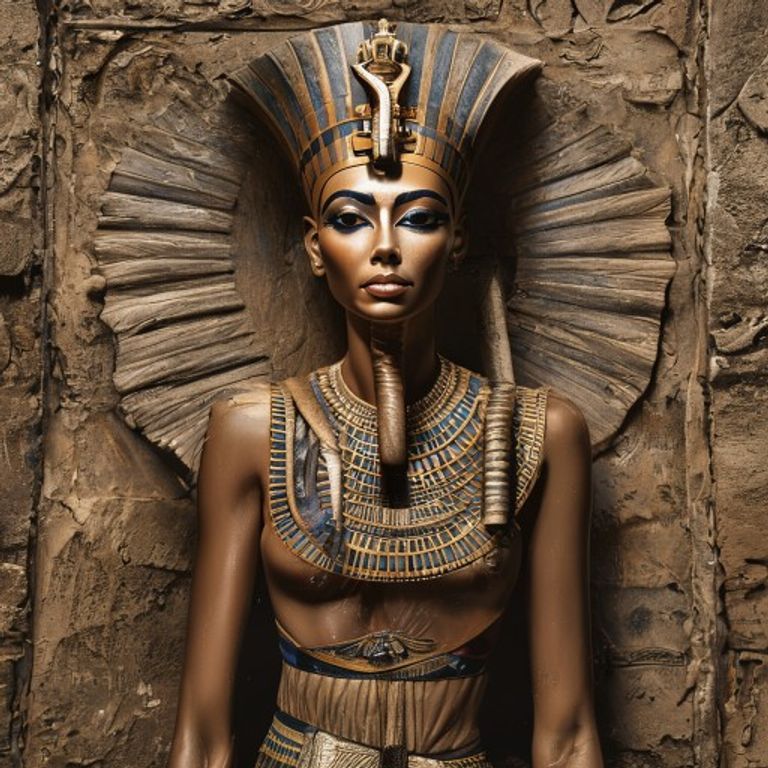
The embalmed body and tomb of the famous and powerful Egyptian queen have never been found, frustrating Egyptologists and generating intense archaeological debates.
⚠️ Research elaborated with the aid of Deep Research is subject to referential ambiguity.
🖥️Clean HTML code using proprietary tools.
👥 Research by Guilherme Felipe, Curation by Sílvio Lôbo
The Enigma of the Missing Mummy: Investigating the Nefertiti Case
Ancient Egypt evokes images of pharaohs, pyramids, and ancestral mysteries. Among these enigmas, few capture the imagination as much as the disappearance of the mummy attributed to Queen Nefertiti. A case that has challenged archaeologists, historians, and detectives for decades, blending proven facts with seductive speculation, and which, for many, represents one of the greatest lapses in the history of Egyptology.
1. The Context and the Incident: A Hidden Treasure Revealed and Lost
The mystery of "Nefertiti's Mummy" does not refer to the queen herself, but to a discovery made in 1898 in the necropolis of Deir el-Bahari, in the Valley of the Kings, Egypt. A group of tomb robbers, operating in secret, unearthed a tomb (later identified as TT 320) that housed a treasure of royal mummies. Among them, one in particular caught the attention of those involved: a female mummy, wrapped in linen, which exhibited distinctive characteristics that led to its attribution to the iconic Queen Nefertiti, wife of Akhenaten.
The incident that initiated the mystery, however, was not the discovery itself, but rather the subsequent dissemination and eventual disappearance of part of the material. Reports from the time indicate that the robbers, after removing the most valuable artifacts, left behind a significant number of items, including the mummy in question. What happened next, and why this mummy, which could revolutionize our understanding of the Amarna dynasty, disappeared without clear traces, is the core of the enigma.
2. Timeline of Events: A Chronology of Shadows
An accurate reconstruction of events is hindered by the clandestine nature of the initial discoveries and the lack of rigorous official records in its early stages. However, the main milestones can be traced:
- 1898: Egyptian tomb robbers discover tomb TT 320 in Deir el-Bahari. Reports indicate the presence of royal mummies, including one attributed to Nefertiti.
- Early 20th Century: Fragments of information about the discovery begin to circulate, fueling the interest of Egyptologists and collectors. The identity of the mummy begins to be speculated upon.
- 1920s-1930s: The search for concrete evidence and the attempt to authenticate the mummy intensify. However, the lack of a clear record of the mummy in question in the archives of official excavations begins to raise suspicions.
- Mid-20th Century: The hypothesis that the mummy attributed to Nefertiti might have been secretly transferred or looted before an official discovery gains traction.
- Late 20th and Early 21st Centuries: Academic research and the re-evaluation of previous findings attempt to locate the mummy, often focusing on private collections or other royal tombs. The lack of scientific consensus on the identity of other mummies found in nearby locations adds complexity to the case.
3. The Main Theories: Deciphering the Enigma
Explanations for the disappearance of Nefertiti's mummy range from plausible scientific hypotheses to conspiracy narratives and supernatural speculations. Each attempts to fill the gaps left by investigations and incomplete records.
Scientific and Archaeological Theories
- Looting and Dispersion: This is the most widely accepted theory. It argues that, after its discovery by tomb robbers, the mummy was stolen and sold on the black market for antiquities. The lack of a formal record at the time, due to the illegality of the discovery, facilitated its dispersion and concealment. Reports from contemporary archaeologists, such as Howard Carter, who excavated Tutankhamun's tomb nearby, mention the existence of looting in the area.
- Identity or Location Confusion: Another hypothesis suggests that the mummy may have been confused with another, or that it was moved to an undocumented location after being recovered by Egyptian authorities or archaeologists. The difficulty in identifying ancient mummies with 100% certainty, even with modern technology, makes this possibility relevant. Recent research attempts to identify the "Young Woman" found in Tutankhamun's tomb as a possible candidate, but without definitive conclusions.
- Loss During Transport or Storage: It is possible that the mummy was damaged or lost during the rigorous processes of excavation, transport to museums, or storage in insecure depots during the early decades of Egyptology, a period marked by less control and more negligence.
Alternative and Conspiracy Theories
- Secret Transfer for Protection: One theory speculates that, due to the mummy's historical importance and value, Egyptian authorities or involved archaeologists may have decided to secretly transfer it to a safer location, out of reach of looters and political chaos, and that this transfer was never properly documented.
- Concealment for Political or Religious Reasons: In a context of political instability or religious upheaval in Ancient Egypt, it is possible that the mummy was deliberately hidden or relocated to prevent its desecration by rival factions. This theory, while more speculative, fits periods of intense turmoil like the Amarna dynasty.
- Paranormal or Esoteric Theories: Although without scientific basis, more fanciful narratives suggest that the mummy may have been a victim of curses, or that its whereabouts are linked to occult or mystical knowledge. These theories, while popular in mystery circles, lack any empirical evidence and are widely dismissed by the scientific community.
4. Controversies and Blind Spots: The Cracks in the Investigation
The case of Nefertiti's mummy is dotted with inconsistencies and gaps that fuel researchers' mystery and frustration:
- Lack of Initial Official Record: The original discovery in 1898 by tomb robbers prevents a formal police or archaeological investigation from the outset. Initial reports are fragmented and often second-hand, making fact-checking difficult.
- Fragmented Material Evidence: Unlike many archaeological discoveries that result in detailed and cataloged findings, the mummy in question was not formally identified and documented by competent authorities in its original context. This means there is no central "object" to investigate.
- Conflicting or Absent Testimonies: The illegal nature of the discovery means that the primary "witnesses" are tomb robbers, whose accounts may be inaccurate, exaggerated, or simply intended to mislead. The absence of reliable witnesses and official records is a crucial blind spot.
- Blind Museums and Private Collections: The possibility that the mummy was sold and is in private collections, or even in museums without due recognition, is a constant source of speculation. The difficulty in tracing antiquities on the black market is legendary.
- Controversial Scientific Re-evaluations: Attempts to identify other mummies as Nefertiti's, such as the so-called "Young Woman," have been met with skepticism from the scientific community due to the lack of conclusive DNA evidence or correspondence with known artifacts of the queen.
5. Curiosities and Legacy: An Immortal Enigma
The case of Nefertiti's mummy has transcended the field of archaeology to become a pop culture icon:
- Inspiration for Fiction and Documentaries: The mystery has inspired countless books, documentaries, films, and conspiracy theories, exploring the possibilities of its whereabouts and what its discovery could reveal about Egyptian history.
- Symbol of the Search for the Unknown: The case represents humanity's eternal quest for answers, for unraveling the secrets of the past, and for filling the gaps in knowledge. The figure of Nefertiti, known for her beauty and influence, adds a special fascination.
- Legacy in Egyptology: Despite its disappearance, the search for the mummy has driven research into the Amarna dynasty and mummification techniques. The story serves as a grim reminder of the dangers of looting and the importance of archaeological preservation.
- Current Status: The case of Nefertiti's mummy has not been officially reopened by any authority, as technically, the mummy was never "documented" as missing from an official record. However, academic research and speculation continue, with archaeologists and historians constantly reviewing old findings and new technologies to try to unravel this persistent mystery of Ancient Egypt. The enigma remains, fueling the imagination and curiosity of generations.



