


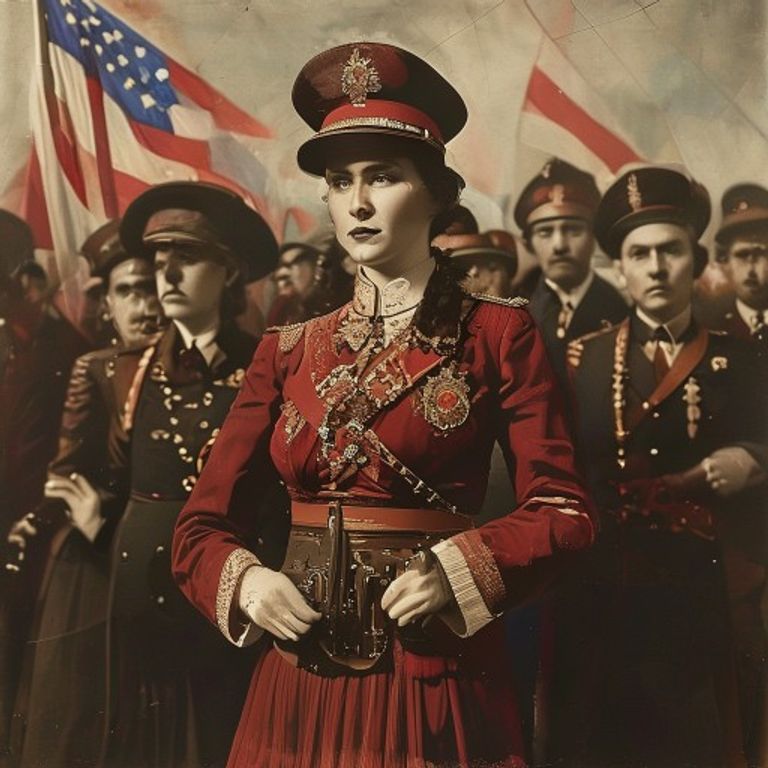
The popular and military uprising against Tsardom, marked by 'Bloody Sunday' and the mutiny on the Battleship Potemkin, serving as the dress rehearsal for the 1917 Revolution.
⚠️ Research prepared with the aid of Deep Research is subject to referential ambiguity.
🖥️ Clean HTML code using a proprietary tool.
👥 Research by Guilherme Felipe, Curation by Sílvio Lôbo
The Fire That Does Not Go Out: Unraveling the Enigma of the 1905 Russian Revolution
The annals of history are filled with inflection points, turning points that redefined the course of nations. The 1905 Russian Revolution is, without a doubt, one of these milestones. However, as with many great social upheavals, the veil of complex and often chaotic events hides layers of mystery and speculation. This article aims to dive into the depths of this historical whirlwind, separating the factual from the conjectural, and unveiling a case that, decades later, still intrigues and challenges.
1. The Context and the Incident: The Cry in the Streets of Saint Petersburg
The stage for the unfolding mystery of the 1905 Revolution was set in a weakened Russian Empire, on the brink of collapse. Socioeconomic conditions were deplorable for the vast majority of the population. The Tsarist autocracy, led by Tsar Nicholas II, showed an increasing inability to deal with demands for political reform and social justice. The humiliating defeat in the Russo-Japanese War (1904-1905) further exacerbated popular discontent, exposing the regime's incompetence and corruption.
The ignition point, the incident that would become the epicenter of the mystery, occurred on a frigid Sunday, January 22, 1905 (January 9 in the Julian calendar, then in use in Russia), in Saint Petersburg. What began as a peaceful demonstration, organized by Father Georgy Gapon, with the goal of presenting a petition to the Tsar requesting better working conditions, rights, and an end to the war, turned into a bloody massacre. Imperial troops opened fire on the unarmed crowd approaching the Winter Palace, resulting in the deaths of hundreds and the wounding of thousands. This event, known as "Bloody Sunday", dispelled the belief in the Tsar's benevolence and ignited the flame of revolt throughout the empire.
2. Timeline of Key Events
The 1905 Revolution was a complex and multifaceted process, the main events of which unfolded as follows:
- January 22, 1905: "Bloody Sunday" in Saint Petersburg. The peaceful march of workers and their families is met with gunfire by imperial troops.
- January-February 1905: Strikes and protests spread throughout the empire, reaching major industrial centers. Strike movements gain strength in Warsaw, Lodz, and other cities.
- May-June 1905: Formation of soviets (workers' councils) in various cities, such as the Ivanovo-Voznesensk Soviet. These emerging organs of workers' self-management become a new center of power and organization.
- June 14, 1905: The mutiny on the battleship Potemkin, one of the most iconic episodes of the revolution, where sailors rebel against officers.
- September-October 1905: A massive general strike paralyzes the country, culminating in petitions and demands for radical political reforms.
- October 17, 1905: Under intense pressure, Tsar Nicholas II issues the October Manifesto, promising civil liberties and the creation of a Duma (elected parliament).
- October-December 1905: The October Manifesto creates divisions among revolutionary forces. Some groups accept the reforms, while others continue the fight for a deeper revolution. Armed uprisings erupt in Moscow and other cities but are brutally repressed.
- 1906: The First Duma is convened but is dissolved by the Tsar a few months later, evidencing the fragility of the concessions made.
3. The Main Theories: Weaving the Possibilities
The complex nature and multiple facets of the 1905 Revolution opened space for diverse interpretations and theories, some more grounded in evidence than others:
3.1. Theories Based on Evidence and Historical Analysis (Probable Theories)
- Theory of Socioeconomic and Political Pressure: This is the most consensual explanation among historians. The revolution was the inevitable consequence of decades of Tsarist oppression, glaring social inequality, inhumane working conditions, and the growing political consciousness of the masses, exacerbated by the regime's failures and the defeat in the war. "Bloody Sunday" was the spark that lit the powder keg. Analysis of official reports from the time, such as police reports on strikes and social unrest, and documentation of workers' movements, reinforce this thesis.
- Theory of the Role of Intellectuals and Revolutionary Groups: Groups such as the Social Democrats (Bolsheviks and Mensheviks), the Socialist-Revolutionaries, and liberals played a crucial role in the organization, agitation, and dissemination of revolutionary ideas. Documents from these parties and the testimonies of their leaders provide evidence of their influence on popular mobilization.
- Theory of the Influence of the Russo-Japanese War: The defeat in the war discredited the Tsarist regime, undermined confidence in the army, and exposed governmental incompetence, serving as a catalyst for increased internal discontent. Military reports and strategic analyses of the time corroborate the negative impact of the war on the morale and legitimacy of the government.
3.2. Alternative, Conspiracy, or Paranormal Theories (Speculative Theories)
Although the weight of evidence points to socioeconomic and political causes, the context of mystery and the breadth of the events allowed for the emergence of other hypotheses:
- Theory of an Internal Conspiracy to Destabilize Tsardom: Some speculate that elements within the power circle itself, perhaps dissatisfied with the Tsar's ineffectiveness or the influence of figures like Grigori Rasputin (although Rasputin became prominent after 1905, his later influence is seen as part of a pattern of instability at court), could have orchestrated or exacerbated certain events to force changes or to benefit from the chaos. However, the absence of concrete evidence in declassified archives to corroborate such a conspiracy makes this hypothesis highly speculative.
- Theory of External Influence (Foreign Agitation): In some accounts, speculations arose about the interference of foreign powers interested in weakening Russia. This theory, while not entirely dismissed in geopolitical analyses, lacks direct and robust proof in documents from the time, often being relegated to the field of unfounded conspiracy.
- Theory of the Hidden Role of Agents Provocateurs: The idea that government agents infiltrated revolutionary movements to incite violence and justify brutal repression is a recurring line of thought in times of revolt. There are reports, and testimonies from participants, that suggest the presence of individuals who seemed to incite unnecessary violence during protests, but the extent and official nature of this practice remain difficult to prove conclusively in the archives. Father Gapon himself, a central figure of "Bloody Sunday," had his loyalty questioned at times.
- Paranormal or Mystical Theories: In a context where mysticism and religion played an important role in the lives of many Russians, theories emerged (and persist in some circles) that seek explanations in hidden forces or divine/demonic interventions. These theories, naturally, fall outside the scope of journalistic investigation based on facts and concrete evidence.
4. Controversies and Blind Spots: The Shadows of the Investigation
The 1905 Revolution, as an event of such overwhelming and chaotic proportions, inevitably left behind a trail of controversies and blind spots in official investigations and collective memory:
- The Victim Count of "Bloody Sunday": The exact number of dead and wounded on "Bloody Sunday" was never established with precision. Official government reports tended to minimize the number, while revolutionaries and eyewitnesses spoke of thousands. This intentional discrepancy in statistics makes it difficult to fully understand the magnitude of the repression.
- The Exact Role of Father Gapon: The figure of Georgy Gapon is central and controversial. Was he a genuine workers' leader, an undercover agent provocateur, or both? His subsequent flight abroad and his contacts with different political factions fuel the mystery surrounding his true motivations and loyalties. Intelligence reports from the time, fragmented and often biased, offer glimpses of his activities but not a definitive answer.
- Destroyed or Hidden Evidence: In periods of revolution and counter-revolution, it is common for crucial documents to be destroyed or hidden for political reasons. The lack of full access to certain imperial archives, especially those related to intelligence and direct orders for repression, prevents an exhaustive analysis.
- Conflicting Witness Testimonies: Amidst the chaos, different witnesses reported the events of "Bloody Sunday" in distinct ways, influenced by their own experiences, political positions, and emotional impact. The validation of testimonies becomes a significant challenge for any rigorous historical analysis.
- The Nature of the "General Strike": Although the general strike of October is a proven fact, the extent of its organization and the degree of coordination between different revolutionary groups are subjects of ongoing debate. The rapid rise of the soviets as organs of parallel power raises questions about the level of planning and the emergence of new political structures in real-time.
5. Curiosities and Legacy: The Flame That Does Not Yield
The 1905 Russian Revolution, despite not having overthrown the autocracy immediately, left an indelible legacy and inspired several curiosities:
- The "Dress Rehearsal" for 1917: It is widely considered by historiography as a "dress rehearsal" for the October Revolution of 1917. Many of the actors, tactics, and power structures that emerged in 1917 had their roots and development during the events of 1905.
- The Rise of the Soviets: The formation of workers' soviets was an unprecedented revolutionary phenomenon, which demonstrated the ability of the masses to self-organize outside of state structures. This model of council organization would be crucial in 1917.
- The October Manifesto and the Duma: The concessions made by the Tsar, although limited, represented a significant step in the direction of a constitutional monarchy and introduced the concept of parliament in Russia. The brief life of the First Duma, however, demonstrated the regime's reluctance to cede real power.
- Inspiration for Global Revolutionary Movements: The 1905 Revolution inspired workers' and revolutionary movements around the world, serving as an example of resistance against authoritarian regimes.
- Current Status of the Case: The "Case of the 1905 Russian Revolution" is not a criminal case to be reopened or shelved in a literal sense. However, as a historical enigma, it continues to be the subject of academic study and debate. New discoveries in archives, reinterpretations of sources, and the application of new historical research methodologies can, at any moment, shed new light on its mysteries. The legacy of the revolution, and the not fully answered questions about its origins and development, remain alive in the understanding of the 20th century and the formation of the Soviet Union.
The 1905 Russian Revolution is, therefore, a complex mosaic of events, motivations, and consequences. While the basic facts are clear – an empire in crisis, a people in search of change, an act of brutal repression, and a wave of revolt – the deeper details, hidden intentions, and exact connections between the various actors still offer fertile ground for investigation and reflection. The fire that ignited in 1905 may have been contained, but its embers continue to illuminate the shadows of history, reminding us that, behind the great cataclysms, there always reside layers of mystery to be unraveled.



