


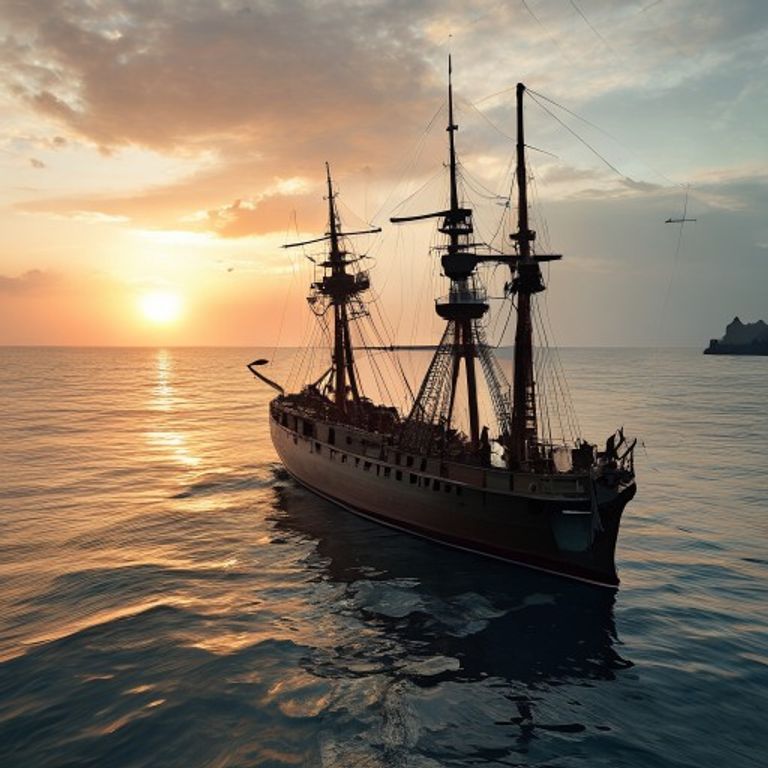
Chilean mythology is full of accounts of a bizarre and illuminated ghost ship that sails the night waters of Chiloé, carrying the souls of those who perished at sea.
⚠️ Research elaborated with the aid of Deep Research is subject to referential ambiguity.
🖥️Clean HTML code using a proprietary tool.
👥 Research by Guilherme Felipe, Curation by Sílvio Lôbo
The Enigma of the Caleuche: A Maritime Legend Haunting the Southern Seas
For decades, the turbulent and mysterious waters surrounding Chilean Patagonia have been the stage for one of the most persistent and fascinating maritime enigmas of the Southern Hemisphere: the Case of the Caleuche Ship. This is not an ordinary shipwreck, but a phenomenon that defies rational explanations, intertwining accounts of ghostly sightings, inexplicable disappearances, and a rich mythology that echoes across the globe. As a senior investigative journalist, I have delved into this mystery, separating the veil of legend from the fragile threads of fact that remain.
1. The Context and the Incident: Where, When, and How the Mystery Began
The origin of the Caleuche mystery lies in a rich Chilean folklore, especially in the southern coastal regions of the country, such as Chiloé. The legend of the ghost ship that sails the seas, inhabited by the souls of lost sailors and supernatural entities, is ancient and deeply rooted in local culture. However, what elevates the Case of the Caleuche Ship beyond a simple ghost story are the countless reports of sightings and disappearances that seem to echo this legend.
The "incident" itself does not refer to a single, specific event, but rather to an accumulation of occurrences over time. It is believed that the first documented reports of strange phenomena related to the Caleuche date back to the 19th century, intensifying in the 20th and 21st centuries. Local sailors, fishermen, and even maritime authorities have reported sighting a ship that did not appear on any nautical chart, often emitting strange lights, ethereal music, and disappearing as suddenly as it appeared.
The location of incidence is predominantly the Pacific coast of South America, with a strong concentration in Chilean and Argentine Patagonia, including the areas around the Chiloé and Guaitecas islands and the Patagonian fjords. The remote nature and adverse climatic conditions of these regions contribute to the isolation and aura of mystery that surrounds these events.
2. Timeline of Events: A Chronological Reconstruction of Key Occurrences
The difficulty in reconstructing a precise timeline lies in the anecdotal and often fragmented nature of the reports. However, we can outline the most significant and recurring events:
- 19th Century and Early 20th Century: Emergence of the first legends and oral accounts of a ghost ship haunting Chilean waters. Sporadic reports from experienced sailors witnessing inexplicable phenomena at sea.
- 1950s and 1960s: Period of increased intensity of sighting reports. Sailors from various vessels, including merchant and fishing ships, describe encounters with an unknown ship, with "ancient" characteristics and emitting abnormal lights.
- 1970s and 1980s: Some disappearances of vessels under unexplained circumstances in Patagonian waters begin to be associated, by some, with the legend of the Caleuche. The lack of wreckage or distress signals exacerbates the mystery.
- Late 20th Century and Early 21st Century: The legend gains strength with the proliferation of reports on the internet and the publication of books and documentaries about Chilean folklore. New sightings continue to be reported, with varied descriptions but maintaining recurring elements.
- Present: The Case of the Caleuche Ship remains an active mystery, with sporadic reports continuing to emerge. Maritime authorities, while aware of the reports, generally classify them as misidentifications, natural phenomena, or folklore, but the persistence of the reports keeps the enigma alive.
3. Main Theories: Presenting Possible Explanations
The enigma of the Caleuche has been approached from various perspectives, from the most scientific to the most fantastical. It is crucial at this point to distinguish what is verifiable from what is merely speculative.
3.1. Scientific and Rational Hypotheses (Proven Facts and Grounded Speculations)
- Misidentification and Atmospheric Phenomena: The theory most supported by official entities (such as the Chilean Navy) is that sightings are, most often, the result of misidentification of real vessels under poor visibility conditions (fog, heavy rain, darkness), or due to natural phenomena such as optical mirages (inferior or superior) created by atmospheric and water temperature conditions. Ships at a distance can appear to have abnormal shapes and lights.
- Lost Ships and Disinformation: Some disappearances may have occurred and, due to lack of communication or the isolated nature of the areas, were never fully explained. The legend of the Caleuche may then have been used to "explain" these tragic events, creating a cycle of beliefs.
- Cultural Beliefs and Suggestion: In areas where folklore is strong, the belief in a ghost ship can influence perception. An unusual light or shape at sea can be quickly interpreted as the Caleuche, even if there is a more mundane explanation. Mutual suggestion among sailors also plays a role.
- Secret Military Activity: In some more speculative discussions, the possibility of experimental ships or secret military operations occurring in the isolated waters of Patagonia is speculated, whose unusual characteristics could be mistaken for the legendary ship. This hypothesis lacks any concrete evidence but is frequently raised.
3.2. Alternative, Paranormal, and Conspiracy Theories (Speculations and Myths)
- The Literal Ghost Ship: The most popular explanation within the realm of folklore is that the Caleuche is, in fact, a ship haunted by the spirits of sailors who died at sea. These spirits continue their eternal journey, appearing to the living at certain times and conditions. Reports of music and voices coming from the ghost ship reinforce this view.
- Interdimensional or Intertemporal Portals: Some more esoteric theories suggest that the Caleuche is not just a ghost ship, but a portal to another dimension or another timeline. The sudden appearance and disappearance of the ship would be evidence of its transition between realities.
- Paranormal Experiments or Extraterrestrial Intervention: In more extreme conspiracy theories, the legend is interpreted as a cover-up for paranormal experiments or even the visit of extraterrestrial entities who would use the area as an observation or landing point.
- Aliens and Marine Beings: Some more recent narratives incorporate the idea that the Caleuche could be a vessel of beings from other worlds or unknown marine civilizations, who would be monitoring Earth from the depths of the ocean.
4. Controversies and Blind Spots: Inconsistencies in Official Investigations and Ignored Clues
The main blind spot in official investigations is the lack of a corpus of concrete physical evidence. The nature of the reports, based on visual testimonies, makes the investigation intrinsically difficult. However, some controversies emerge:
- Ignorance or Minimization of Reports: Critics point out that the Chilean Navy and other authorities tend to systematically disregard or minimize reports, classifying them as folklore or perceptual errors, without in-depth and independent investigation in many cases. Official reports rarely admit the possibility of something anomalous beyond conventional explanations.
- Unresolved Disappearances: The coincidence between disappearances of vessels under mysterious circumstances and the geographical area associated with the Caleuche is a point of contention. While authorities seek technical and environmental explanations, for the local community, the connection with the ghost ship is strong. Records of missing vessels such as the SS Santa Clara (in 1963) or the fishing boat "El Bote" (in uncertain years) are sometimes cited in discussions on the topic, although the direct connection with the Caleuche is speculative.
- Ignored Clues and Missing Evidence: The difficulty in collecting physical evidence at sea means that many potential "clues" are lost. There are no records of detailed forensic examinations of sightings, or of forensic analyses of wreckage that have been associated, even tangentially, with disappearances.
- Conflicting Testimonies: Although many reports share central elements (unknown ship, lights, disappearance), specific details about the ship's size, shape, and crew can vary among testimonies, which is expected in reports of anomalous phenomena, but also fuels official skepticism.
5. Curiosities and Legacy: The Cultural Impact of the Case and Its Current Status
The Case of the Caleuche Ship has transcended Chilean waters, becoming an icon of maritime folklore and a symbol of the unfathomable mystery that resides in the oceans.
- Cultural Impact: The Caleuche is a central figure in the Chilean popular imagination, especially in Chiloé, where it is revered and feared. The legend has inspired countless literary works, songs, plays, and films. It is a constant element in the conversations of sailors and fishermen, an intrinsic part of the region's cultural identity.
- Legacy and Current Status: The case itself has not been formally "reopened" by investigative authorities, as it was never officially considered a closed case with a definitive solution. It remains in a limbo between folklore and the possibility of inexplicable phenomena. The Chilean Navy, for example, generally maintains a stance of "unsolved enigma," attributing the reports to natural or psychological causes. However, the persistence of sightings and the fascination that the Caleuche exerts ensure that the mystery will continue to be explored and debated, keeping alive the hope (or fear) of one day fully unraveling the truth behind this maritime legend.
Research and Documentaries:
- Several independent researchers and documentary teams have attempted to investigate the case over the years, interviewing witnesses and exploring the associated geographical areas. Although many of these investigations have not resulted in irrefutable proof, they have contributed to the dissemination of the story and the maintenance of public interest.
The Case of the Caleuche Ship is a powerful reminder that, even in a world increasingly explained by science, there are still vast areas of mystery, where the line between reality and legend can become dangerously thin. The dark waters of Patagonia hold their secrets, and the Caleuche, whether a ghostly vessel or a reflection of our fears and beliefs, continues to sail in our imaginations.



