


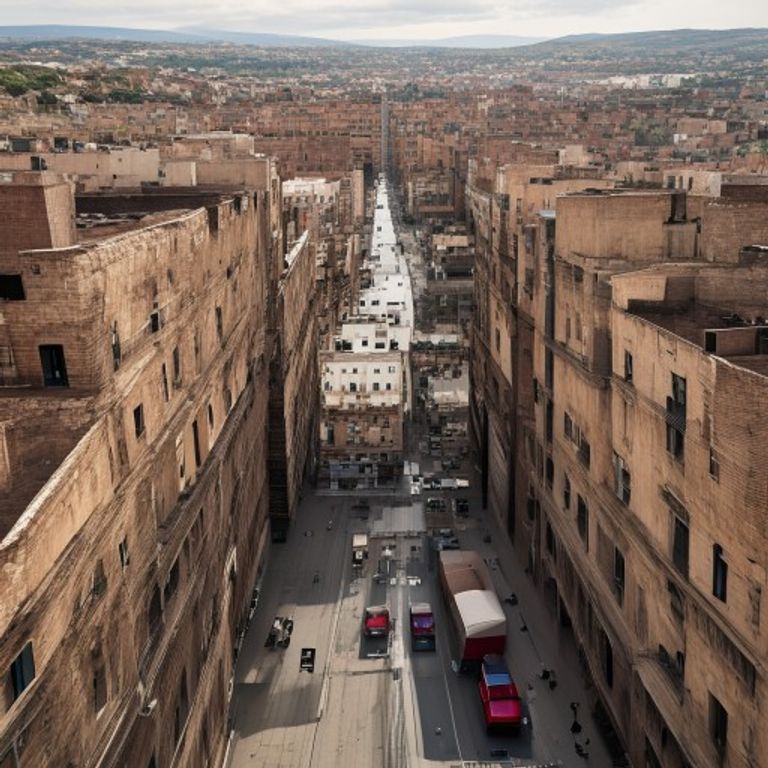
A resident in Turkey accidentally discovered, behind a wall in his basement, an immense eighteen-level underground metropolis capable of housing twenty thousand people in total isolation.
⚠️ Research conducted with the aid of Deep Research may be subject to referential ambiguity.
🖥️Clean HTML code using a proprietary tool.
👥 Research by Guilherme Felipe, Curation by Sílvio Lôbo
The Abyss of Derinkuyu: A Buried Mystery in Cappadocia
Amidst the surreal rock formations of Cappadocia, Turkey, lies an enigma that defies logic and human comprehension: the underground city of Derinkuyu. Far from being a mere archaeological site, Derinkuyu hides a nebulous past and questions that echo through the centuries, fueling a mystery that, for many, remains profoundly unsolved.
This article delves into the "Case of the City of Derinkuyu," not as a crime in the conventional sense, but as an intricate historical and archaeological puzzle, where the absence of definitive answers has given rise to endless speculation, conspiracy theories, and a perennial cultural legacy.
1. The Context and the Incident: Where, When, and How the Mystery Began
The mystery of Derinkuyu does not have a singular "incident" at its beginning, like a criminal event. Its genesis is intrinsically linked to its very existence and the purpose for which it was built and later abandoned. The underground city of Derinkuyu, located in the Nevşehir Province of Turkey, is one of the largest and most impressive underground structures known in the world. It is estimated to have been excavated and used between the 8th and 7th centuries BC, with later expansions and improvements.
The "mystery" lies not in a specific event of disappearance or crime, but rather in the magnitude of the construction, its functionalities, and, most importantly, its eventual and almost complete abandonment. Why was such a complex and elaborate structure, capable of housing thousands of people with their livestock and supplies, abandoned? What was the exact purpose of so many rooms, tunnels, ventilation shafts, and secret passages? The absence of clear and detailed records about its construction and use, coupled with archaeological discoveries that reveal a surprising level of engineering for the time, fuels the enigma.
2. Timeline of Events (Facts and Speculations)
Reconstructing an accurate timeline for Derinkuyu is a challenge. The dates are based on archaeological dating and scattered historical references.
- 8th - 7th Century BC: Beginning of the excavation and construction of the first layers of the underground city. It is believed that the Hittite people were the first to explore the potential of Cappadocia's rock formations.
- Later Periods (Byzantine Empire): Derinkuyu was expanded and extensively used as a refuge during periods of invasion and persecution, especially during the wars between the Byzantine Empire and the Arabs. It is believed that the city could house up to 20,000 people, along with livestock and supplies, for extended periods.
- 15th - 16th Century AD: It is believed that Derinkuyu was gradually abandoned with the rise of the Ottoman Empire and the decrease in the threats that had previously justified its use.
- 20th Century: The underground city was rediscovered by a local resident in 1963, who found a secret passage in his house leading to one of the tunnels. The discovery attracted the attention of archaeologists and historians.
- From 1963 onwards: Commencement of formal archaeological excavations and research. Much of the city was unearthed, revealing its complexity and scale.
It is important to note that the timeline focuses more on the occupation and abandonment of the city than on a specific "incident." The mystery lies in the knowledge gap regarding the precise reasons and details of life within its confines.
3. Main Theories
Theories about Derinkuyu range from scientific and logical explanations to more fantastical speculations.
3.1. Scientific and Historical Theories
- Refuge Against Invasions: This is the most accepted theory by the archaeological and historical community. Cappadocia, over the centuries, was the scene of numerous invasions and conflicts. Derinkuyu would have served as a complex system of defense and shelter for civilian populations against invading armies, allowing them to hide, resupply, and wait for hostilities to end. The deep ventilation shafts, the massive stone gates to block tunnels, and the storage spaces corroborate this hypothesis.
- Permanent Residence and Daily Routine: Although its use as a refuge is prominent, the magnitude of Derinkuyu suggests that parts of it could have been inhabited more continuously, with spaces dedicated to agriculture (on internal terraces or with access to protected outdoor areas), livestock raising, and artisanal activities. The complexity of the structure, with churches, schools, and even cemeteries, suggests a society functioning within its limits.
- Tourist and Commercial Attraction (Speculative): During periods of relative peace, some areas might have served as trading posts or protected meeting points. However, this theory is less supported by direct evidence.
3.2. Alternative and Conspiracy Theories
- Dwelling of Advanced Ancient Civilizations: Some theories speculate that Derinkuyu could be the work of pre-Hittite civilizations, possibly with technological knowledge superior to that attributed to the era. The precision of the excavation and the complexity of the engineering lead some to question the authorship purely by humans of that time.
- Base for Aliens or Extraterrestrial Beings: This theory, although without any scientific basis, arises from the fascination with the grandeur of the structure and the lack of fully satisfactory explanations for some. The idea is that Derinkuyu would be an underground base created by beings from another world.
- Shelter in Scenarios of Global Cataclysms: Another speculative line suggests that the city was built to shelter humanity in case of large-scale natural cataclysms, such as meteor showers or drastic climate changes.
3.3. Paranormal Theories
Although less common and without a basis in concrete evidence, the mysterious nature of Derinkuyu opens space for theories of paranormal phenomena, such as:
- Presence of Entities or Spirits: The idea that the underground city houses energies or spirits from past civilizations, or that inexplicable phenomena related to them occur. These theories are based on anecdotal reports and subjective interpretations of experiences within the city.
4. Controversies and Blind Spots
The investigation and study of Derinkuyu are not without controversies and significant gaps:
- Lack of Detailed Records: The biggest controversy is the scarcity of contemporary historical records describing the construction, exact purpose, and daily life in Derinkuyu. Much of what we know is inferred from archaeology.
- Precise Dating of Original Construction: While it is estimated that excavation began around the 8th-7th century BC, the precise dating of the different phases of construction and expansion is still a subject of debate among archaeologists.
- Identity of the Original Builders: The attribution to the Hittites is a strong hypothesis, but the absence of inscriptions or artifacts that unequivocally confirm this authorship in all phases is a blind spot.
- Actual Occupation Capacity: Estimates of up to 20,000 people are based on the explored area and space calculations. The actual capacity and how long the city could sustain that population in case of a prolonged siege are still points of speculation.
- Purpose of Certain Structures: Although most rooms have clear functions (housing, storage, churches, etc.), the purpose of some specific tunnels or chambers remains a mystery, fueling alternative theories.
- Ignored Clues or Disappeared Evidence: As with many ancient archaeological sites, it is possible that crucial clues have been lost over time due to erosion, neglect, or incomplete discoveries in the initial phases. There are no official reports specifically pointing to "ignored clues" in a criminal sense, but the fragmented nature of the discoveries is an inherent "blind spot."
5. Curiosities and Legacy
Derinkuyu has transcended its historical role to become a cultural icon and a symbol of mystery:
- Surprising Engineering: The complexity of the engineering, with multiple levels, interconnected tunnels, ventilation systems reaching hundreds of meters deep, and the ability to seal entrances with enormous circular stones (similar to steganes), is impressive even today.
- Inspiration for Fiction: The underground city has inspired countless books, films, and documentaries, fueling the popular imagination and solidifying its status as a place of mystery.
- UNESCO World Heritage Site: The Cappadocia region, including the sites of underground cities like Derinkuyu, is recognized as a UNESCO World Heritage Site, highlighting its historical and cultural importance.
- Current Status: Derinkuyu is an active tourist site, with a large part of the city open for visitation. Archaeological research continues, albeit at a slower pace, seeking to uncover more secrets. The case has not been "reopened" in the sense of a police investigation, but academic and public interest in unraveling its mysteries remains alive.
- The Mystery Persists: Despite decades of research, many aspects of life and construction in Derinkuyu remain shrouded in uncertainty. The grandeur of the site and the absence of definitive answers ensure that the "Case of the City of Derinkuyu" continues to be one of the most fascinating and intriguing historical enigmas in the world.



