


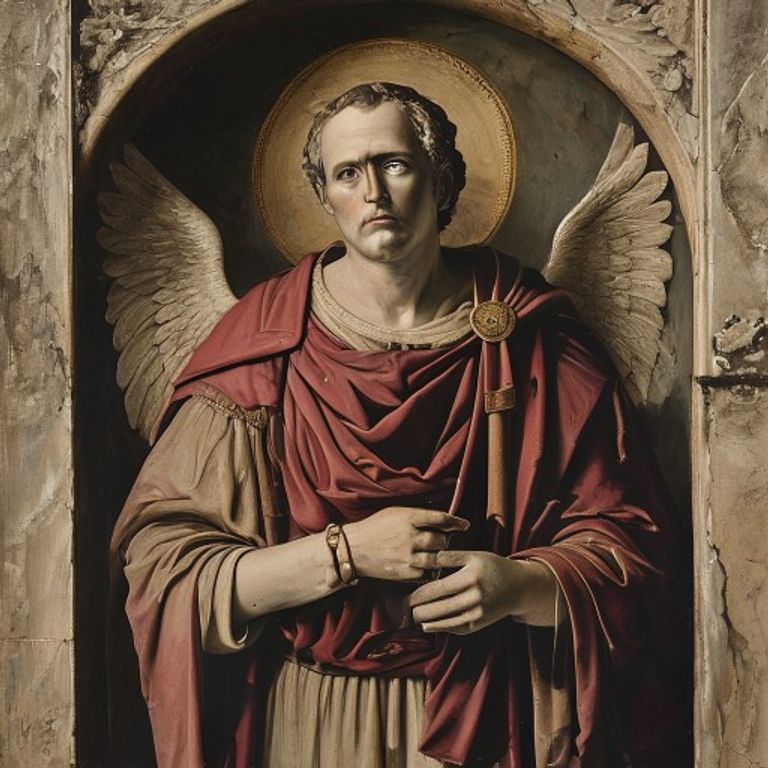
The assassination of the Roman dictator in 44 B.C. by a group of senators who feared his absolute power, an event that marked the transition from the Roman Republic to the Roman Empire.
⚠️ Research prepared with the aid of Deep Research is subject to referential ambiguity.
🖥️ Clean HTML code using a proprietary tool.
👥 Research by Guilherme Felipe, Curation by Sílvio Lôbo
The Assassination of Caesar: A Mystery that Bleeds Through History
On March 15, 44 B.C., the Roman world watched, stunned, at the fall of Julius Caesar. The man who proclaimed himself dictator in perpetuity of the Roman Republic, culminating a meteoric trajectory of military conquests and political ascent, was brutally murdered in the very Curia of Pompey. What was intended to be an act of republican restoration by his executioners, the senators, turned into one of the most enduring and controversial enigmas of antiquity. The exact circumstances, the underlying motivations, and the true extent of the conspiracy remain, in many respects, shrouded in historical mist.
The Context and the Incident: The Day that Shook Rome
The context was one of deep political instability. Caesar, after decades of civil wars, had consolidated unprecedented power, concentrating the highest magistracies in his hands and at times ignoring republican traditions. This concentration of power generated resentment and fear among the senatorial elite, who saw their own prerogatives and influence being eroded. The Curia of Pompey, an annex to the Senate, became the bloody stage for this power conflict. The incident itself was abrupt and violent: Caesar was stabbed repeatedly by a group of senators, culminating in his final words, supposedly directed at Marcus Junius Brutus, his protégé and one of the main conspirators: "Et tu, Brute?"
Timeline of Events: The Dark Ides of March
- 44 B.C. (early March): Rumors about plans to assassinate Caesar circulate among the senators. Calpurnia, Caesar's wife, has nightmares and begs him not to go to the Senate.
- March 15, 44 B.C. (morning): Caesar, despite omens and warnings, decides to attend the Senate meeting at the Curia of Pompey.
- March 15, 44 B.C. (approx. 11:00 AM): Upon entering the Curia, Caesar is surrounded by a group of senators. Tillius Cimber, acting as a pretext, pulls his toga.
- March 15, 44 B.C. (approx. 11:05 AM): The first blow is struck by Casca. Other blows from dozens of senators follow.
- March 15, 44 B.C. (approx. 11:10 AM): Caesar falls dead at the foot of the statue of Pompey.
- After the assassination: The conspirators announce the restoration of the Republic, but the people and the army react with shock and indignation. Mark Antony, an ally of Caesar, emerges as a central figure.
- March 18, 44 B.C.: Caesar's funeral, with the reading of his will by Mark Antony, inflames the crowd against the assassins, forcing them to flee Rome.
The Main Theories: Unraveling the Labyrinth of Truth
The complexity of the case allows for diverse interpretations, from the most factual to the most speculative:
- Classical Republican Theory (Proven Fact, with Debated Motivations): The most widely accepted theory, supported by historians such as Suetonius and Plutarch, posits that the assassination was an act of "tyrannicide" motivated by the need to "save" the Republic from Caesar's autocratic ambitions. The conspirators, led by Brutus and Cassius, acted in the name of republican ideals. However, the efficacy and legitimacy of this act, as well as the popular support they expected, are questionable.
- Internal Conspiracy Theory (Speculation Based on Circumstantial Evidence): Some hypotheses suggest that the conspiracy may have been broader than thought, involving political figures who, although not directly involved in the stabbings, benefited from Caesar's death or maintained strategic silence. The silence of certain influential senators after the event fuels this speculation.
- Miscalculation Theory (Behavioral Analysis): A line of thought points to a profound miscalculation on the part of the conspirators. They underestimated the popular attachment to Caesar and the ability of his allies, such as Mark Antony, to mobilize support. They believed their action would be seen as liberating, but the reality was one of destabilization and prolonged civil war.
- Possible External Manipulation Theory (Highly Speculative): In more conspiratorial circles, there is speculation about the influence of foreign powers or interest groups that could have encouraged or manipulated the senators against Caesar. However, concrete evidence to support such claims is lacking.
- Paranormal or Supernatural Theories (Folklore and Mythology): Although devoid of scientific or forensic basis, folklore and mythological interpretations attribute a fateful character to Caesar's death. The omens, Calpurnia's dreams, and the "curses" that supposedly befell the conspirators fuel a mystical imagery around the event, but they do not qualify as explanations for the assassination itself.
Controversies and Blind Spots: The Gaps in Historical Investigation
The nature of the "inquiry" into Caesar's death was inherently flawed, given the origin and consequences of the event:
- Absence of Traditional Official Investigation: There was no "police inquiry" in the modern sense. Those responsible were the political leaders themselves, and the "judgment" took place in the streets, in the Senate, and in the subsequent civil wars.
- Subjective and Propagandistic Accounts: The main sources, such as Plutarch and Suetonius, wrote decades after the event, compiling reports from various sources, some of them with clear political leanings for or against Caesar. The work of Cicero, a contemporary, offers valuable fragments, but it is also biased.
- Physical Evidence: The "crime scene" was quickly cleaned by the assassins themselves. There are no forensic reports or detailed physical evidence regarding the exact number of stab wounds, the order of the blows, or the weapon used, beyond generic mentions in historical accounts.
- Conflicting Testimonies: Although many witnessed the violence, the motives and intentions of the conspirators are interpreted in diverse ways by the accounts. The famous phrase "Et tu, Brute?" is an example of a detail that may have been dramatized or even fabricated later.
- The Silence of Key Figures: The absence of detailed statements from some of the conspirators, such as Cassius, after the event (before his death in combat) leaves gaps regarding the internal dynamics of the conspiracy.
Curiosities and Legacy: The Eternal Echo of Tragedy
The legacy of the assassination of Julius Caesar transcends mere political history:
- Cultural Impact: The event became an archetype of political assassination and betrayal. The phrase "Et tu, Brute?" is one of the most cited in Western literature, and the image of Caesar falling in a pool of blood at the Curia of Pompey is a cultural icon, portrayed in countless works of art, plays, and films.
- End of the Republic: Paradoxically, the assassination of Caesar, which aimed to restore the Republic, accelerated its end. The instability generated led to the rise of Octavian (future emperor Augustus), who established the Principate, the beginning of the Roman Empire.
- Current Status: The "Case of the Death of Julius Caesar" has not been reopened in legal or investigative terms. It remains under constant analysis by historians, political scientists, and scholars, who continue to debate the nuances and motivations behind this defining event of Western history. There are no modern declassified files to be revealed, only the reinterpretation and critique of ancient sources. The mystery, therefore, is not "shelved," but rather in perpetual academic dissection, keeping alive the flame of investigation into one of the most important and intriguing crimes in human history.



