


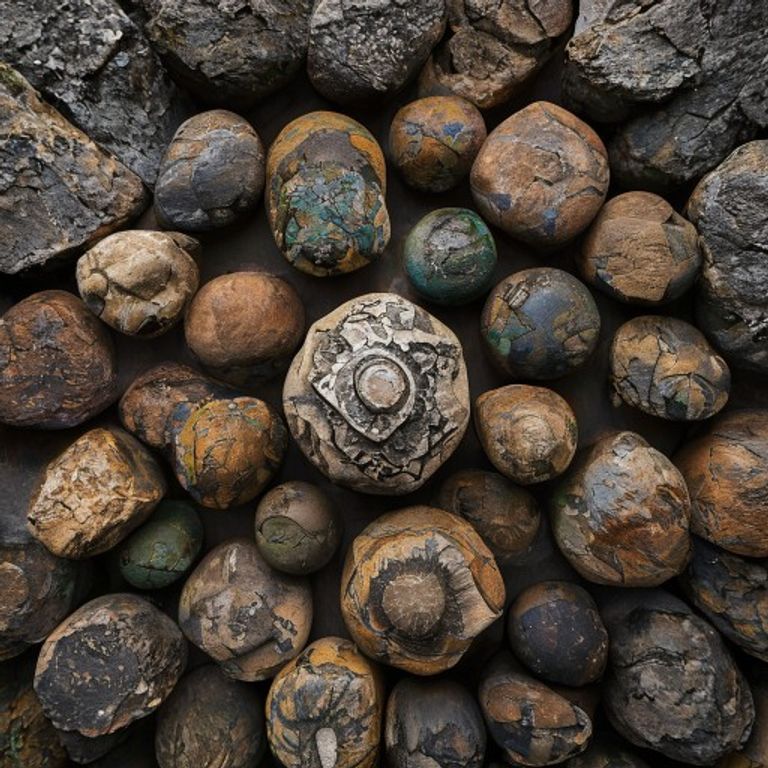
Hundreds of perfectly spherical stones of various sizes have been found in Costa Rica, carved by an ancient civilization without the apparent use of metal tools or modern measuring instruments.
⚠️ Research elaborated with the aid of Deep Research is subject to referential ambiguity.
🖥️Clean HTML code using a proprietary tool.
👥 Research by Guilherme Felipe, Curation by Sílvio Lôbo
The Enigma of the Diquís Stone Spheres: A Pre-Columbian Mystery That Defies Reason
In the heart of Costa Rica, amidst the dense tropical rainforest of the Diquís region, lies an enigma that has intrigued archaeologists, historians, and adventurers for decades: the monumental stone spheres. These geological formations, perfect in their geometry and impressive in their size, remain a silent testament to an ancient civilization whose skills and intentions are still shrouded in veils of mystery.
1. The Context and the Incident: Where, When, and How the Mystery Began
The discovery of the Diquís stone spheres was not an "incident" in the sense of a sudden event, but rather a gradual revelation of an exceptional archaeological heritage. The first written mentions date back to the early 20th century, when workers of a banana company, the United Fruit Company, while clearing the area for planting, stumbled upon these strange formations. Initially, some were damaged or removed, seen more as exotic curiosities than artifacts of historical value.
The Diquís region, specifically the areas near the Térraba and Sierpe rivers, became the epicenter of these discoveries. The spheres, some over 2 meters in diameter and weighing several tons, were scattered across archaeological sites, often grouped in alignments or in association with other remnants of pre-Columbian settlements. The mystery lies not in their existence, but in their origin and purpose. How were they created? By whom? And, crucially, for what?
2. Timeline of Events
- Late 19th / Early 20th Century: First documented discoveries of the spheres by workers of the United Fruit Company during deforestation activities in the Diquís region.
- 1930s-1940s: More systematic archaeological investigations begin in the region, led by researchers such as Samuel Lothrop. Lothrop documents the presence of hundreds of spheres, some in their original locations and others displaced.
- 1940s: Some spheres are removed from their original locations and distributed, some to the National Museum of Costa Rica, others to private collections, and even to the United States, increasing the dispersion of the find.
- 1960s: Archaeologist Gordon Willey and his team deepen their studies in the region, seeking to contextualize the spheres within the Diquís culture.
- 1980s onwards: Recognition of the spheres' importance grows significantly, leading to conservation and protection efforts for the remaining sites.
- 2014: The Ministry of Culture and Youth of Costa Rica declares the Diquís spheres and associated archaeological sites as a UNESCO World Heritage Site, consolidating their international status and the urgency of their preservation.
3. The Main Theories
The lack of written records left by the civilization that produced the spheres opens a vast field for speculation. Theories range from scientific and archaeological explanations to more audacious hypotheses.
3.1. Scientific and Archaeological Theories
- Theory of Sedimentary Rock Sculpture: This is the most accepted hypothesis by the archaeological community. It suggests that the spheres were created from soft sedimentary rocks, such as sandstone or limestone. It is believed that artisans used harder stone tools (like basalt or volcanic rock) to gradually sculpt the spherical shape. Perfection was achieved through an iterative process of roughing, polishing, and using alignment techniques with ropes and natural references. It is believed that some spheres were made in situ, in locations where the raw material was abundant.
- Theory of Transport and Positioning: Once shaped, the transport and positioning of these massive spheres represent a colossal challenge. Theories suggest the use of tree trunks as rollers, wooden levers, concentrated human force, and possibly the use of gravity on inclined terrain. The reason for such an effort is debated, but it is believed that the positioning had astronomical or ceremonial significance.
3.2. Alternative and Speculative Theories
- Alien Theory: One of the most popular hypotheses, although without any scientific evidence, suggests that the spheres were created or assisted by beings from other planets. The geometric perfection and the force required to move them are cited as arguments for this intervention.
- Theory of Lost Advanced Civilizations: Similar to the previous one, this theory postulates the existence of pre-diluvian civilizations with much more advanced technologies than those commonly attributed to ancient peoples. The spheres would be remnants of this lost technology.
- Theory of Natural Phenomena: Some have attempted to explain the spheres as a product of natural geological processes, such as concretion (formation of geological nodules in sedimentary rocks). However, the perfection of the shapes, the materials used, and their presence in specific locations make this hypothesis less likely for the vast majority of the spheres.
4. Controversies and Blind Spots
Despite research efforts, many aspects of the Diquís spheres remain obscure, generating controversies and gaps in knowledge.
- The Defined Purpose: The exact function of the spheres is the biggest blind spot. Were they land markers? Symbols of power? Astronomical tools? Ritual objects? The absence of inscriptions or clear cultural context prevents a definitive answer. Archaeological reports mention that some spheres were found in alignments that could indicate a calendrical or astronomical function, but the evidence is inconclusive.
- The Detailed Manufacturing Method: Although it is known that they were sculpted, the precise details of the techniques employed, the exact tools used, and the time invested in the production of each sphere are unknown.
- The Disappearance of the Civilization: The civilization that produced the spheres, often associated with the Diquís culture, disappeared without leaving detailed written records about its rise, daily life, or decline. The reasons for this disappearance are subject to debate, with theories ranging from internal conflicts, climate change, or pressure from other cultures.
- The Fate of Some Spheres: The indiscriminate removal of the spheres in the early 20th century led to the loss of valuable information about their places of origin and the context in which they were situated. Reports from the time indicate that many were "looted" or simply treated as curiosities.
5. Curiosities and Legacy
The Diquís spheres have transcended the field of archaeology to become a national icon of Costa Rica and a symbol of pre-Columbian mystery.
- National Symbol: The spheres are one of Costa Rica's most recognized symbols, appearing on coins, stamps, and being a tourist attraction of great importance.
- World Heritage Site: The UNESCO recognition in 2014 reinforced the need for conservation and in-depth study, attracting international attention to the site.
- Continued Research: Although the case has not been "reopened" in a police sense, archaeological and anthropological research in the Diquís region remains active. New technologies for soil analysis and aerial mapping are being used to try to uncover more secrets about the ancient inhabitants and their work.
- Cultural Inspiration: The mystery of the spheres has inspired countless stories, documentaries, and works of fiction, fueling popular fascination with the unknown and the wonders of the past.
The Diquís stone spheres remain an invitation to reflect on human capabilities in remote times and on the secrets that the earth still holds. Each sphere is a link to a distant past, an enigma to be unraveled, a silent testament that, even in geometric perfection, history still has much to teach us.



