


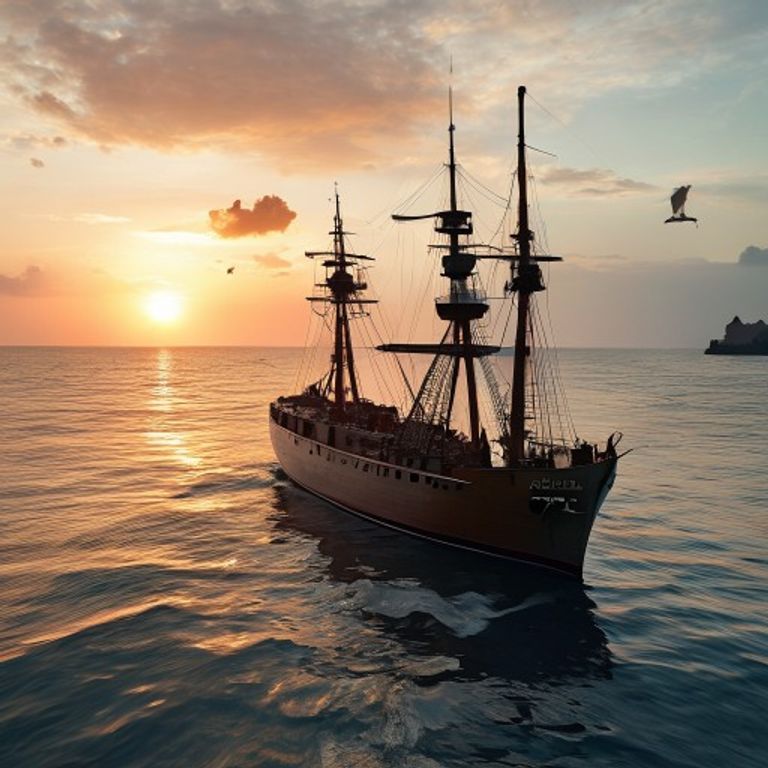
A yacht was found adrift in the South Pacific in 1955 with its radio tuned to a distress signal and bloody bandages on deck, but with the twenty-five people registered on board missing.
⚠️ Research conducted with the assistance of Deep Research may be subject to referential ambiguity.
🖥️Clean HTML code generated using a proprietary tool.
👥 Research by Guilherme Felipe, Curation by Sílvio Lôbo
The Ghost Ship of Fiji: The Enigmatic Tragedy of the Joyita
By [Your Name], Senior Investigative Journalist
An open-sea mystery that defies logic, the disappearance of the ship Joyita in 1955 continues to haunt the waters of the South Pacific, leaving a trail of unanswered questions and conflicting theories.
1. The Context and the Incident: Where, When, and How the Mystery Began
The SS Joyita, a 69-foot merchant vessel, was not a notorious ship before its final, fateful voyage. Built in 1931, the ship boasted a modest and functional past, operating mainly in the region of Fiji, an archipelago in the southwestern Pacific.
On October 3, 1955, the Joyita departed from Tavuki, in Vanua Balavu, Fiji Islands, bound for Apia, Western Samoa. On board were 25 people: Captain Ferninand M. Knight, nine crew members, and 15 passengers, including British government officials and their families. The main cargo consisted of medical supplies, beer, and various merchandise.
The journey, which was expected to last about 48 hours, turned into a disappearance. The Joyita never reached its destination. Its absence was only noted by the authorities days later, triggering a wide and desperate search that, initially, yielded no success. What followed was one of the most disturbing maritime mysteries of the 20th century.
2. Timeline of Events
- October 3, 1955: The SS Joyita departs from Tavuki, Fiji, with 25 people on board.
- October 4, 1955: The ship was scheduled to arrive in Apia, Western Samoa.
- October 5, 1955: The Apia port authority reports the delay of the Joyita.
- October 6, 1955: An official search is initiated. Several ships and aircraft are mobilized.
- October 10, 1955: Aboard a fishing vessel named Tufto, a group of fishermen finds the Joyita adrift about 600 nautical miles (approximately 1,100 km) northwest of Fiji, in an area known as the Great Astrolabe Reef. The ship was slightly listing and showed no signs of human presence.
- October 11, 1955: A rescue team, led by Lieutenant Commander M. R. F. Bayley, aboard the British survey ship HMS Loch Fada, boards the Joyita. They find the ship deserted, with signs of a struggle or hurried departure, but no bodies. The helm was jammed, and the engine was off.
- October 12, 1955: The Joyita is towed to Suva, the capital of Fiji, where the official investigation intensifies.
- November 1955: The official investigation concludes, declaring the ship no longer safe to navigate due to structural damage and a lack of clear criminal responsibility.
3. The Main Theories
The absence of bodies and the nature of the Joyita's discovery have given rise to a myriad of explanations, ranging from the prosaic to the paranormal.
3.1. Scientific and Police Theories (Most Probable)
- Piracy or Robbery: The theory suggests that modern pirates operating in the region boarded the ship. They took the crew and passengers hostage for ransom or eliminated them after stealing valuable cargo. However, the lack of signs of forced entry or violent struggle in the main compartments and the absence of ransom communications make this hypothesis less likely without additional evidence. Official reports found no concrete indications of piracy.
- Shipwreck and Mass Abandonment: A catastrophic failure at some point along the route, perhaps a sudden flooding due to a hole in the hull, would have led to a panicked evacuation. The theory posits that the crew and passengers abandoned the ship in lifeboats but unfortunately succumbed to the sea conditions or became lost. However, the general condition of the Joyita when found (with intact cargo and little water in the holds) and the absence of nearby debris make this hypothesis questionable.
- Maritime Accident and Storm: A sudden and violent storm, or a collision with an unidentified submerged object, could have caused severe damage to the ship, leading to flooding and forced abandonment. The South Pacific region is known for tropical storms. However, there are no records of significant storms during the exact period of the disappearance that would justify a mass abandonment.
- Mutiny or Crime Aboard: The possibility of a crime committed on board, such as a mutiny or mass murder, followed by the disposal of bodies at sea, is another explanation considered. Tension between the crew and passengers, or internal disputes, could have escalated into a tragic event. The lack of physical evidence of confrontation, however, makes confirmation difficult.
3.2. Alternative, Conspiracy, or Paranormal Theories
- Involvement of Government Agencies or Organized Crime: Rumors circulate about the involvement of powerful entities that would have silenced the crew and passengers for unknown reasons, perhaps related to sensitive cargo the ship was carrying, or because they witnessed something they shouldn't have. This theory, lacking concrete proof, fuels the mystery.
- Paranormal or Unknown Phenomena: Some theories, though speculative, suggest the intervention of inexplicable forces. Encounters with UFOs, teleportation phenomena, or even the intervention of supernatural entities have been proposed. These hypotheses are, by nature, difficult to investigate scientifically and are based on interpretations of anomalous events.
- Pacific Bermuda Triangle: A more fanciful theory is that the Joyita fell victim to a local "Bermuda Triangle," an area with a high incidence of unexplained disappearances. Although the original Bermuda Triangle is more well-known, the idea of maritime anomaly zones is recurrent in mystery stories.
4. Controversies and Blind Spots
The official investigation into the Joyita case, conducted by British authorities, was widely criticized for its gaps and inconsistencies.
- Questionable Physical Evidence: When found, the Joyita was in a peculiar state. The windows were boarded up, suggesting an attempt to prevent water entry, but the lifeboats were intact and had not been used. There was an open first-aid kit, but no signs of serious injuries that would justify its mass use. A sum of money was found in a cabin, which contradicts the theory of robbery as the primary motive.
- The Disappearance of the Logbook: Captain Knight's logbook, which could have contained crucial information about the events leading to the disaster, was never found. Its absence is one of the biggest controversies and fuels suspicions of a cover-up.
- Conflicting Testimonies: The crew of the fishing vessel Tufto, which discovered the Joyita, reported that the ship appeared to be heading towards the coast when they first saw it. However, when the rescue team aboard the HMS Loch Fada boarded it, it was adrift. This discrepancy, although it could be explained by the ship's drift, fueled speculation about what really happened after the abandonment.
- Insufficient Expertise: The official investigation was concluded relatively quickly, and some critics point out that a more in-depth analysis of the ship's structure, cargo, and navigation systems could have revealed clearer clues. The decision to declare the ship inoperable and sell it for scrap shortly after its discovery also prevented further forensic analysis.
- Pressure to Close the Case: There are unconfirmed reports that authorities were under pressure to close the case quickly, possibly to avoid panic or to avoid exposing flaws in maritime safety at the time.
5. Curiosities and Legacy
The case of the Joyita transcended maritime headlines to become an icon of inexplicable mystery, inspiring books, documentaries, and debates to this day.
- The "Ghost" Ship: The image of an intact, yet deserted, ship adrift in remote waters captured the public imagination, drawing comparisons to ghost ship legends.
- Cultural Influence: The story of the Joyita has been documented in several books, such as "The Mystery of the Joyita" by Craig N. O. Adams, and has served as inspiration for fictional works.
- The Legacy of Uncertainty: Despite the decades that have passed, the Joyita case remains largely unsolved. There has been no significant official reopening of the case, and the available archives continue to be analyzed by enthusiasts and researchers.
- The Persistent Mystery: The fundamental questions remain: What happened to the 25 souls on board the Joyita? Why was the ship found in such a state? The lack of definitive answers ensures that the enigma of the Joyita will continue to sail the murky waters of historical mystery.



