


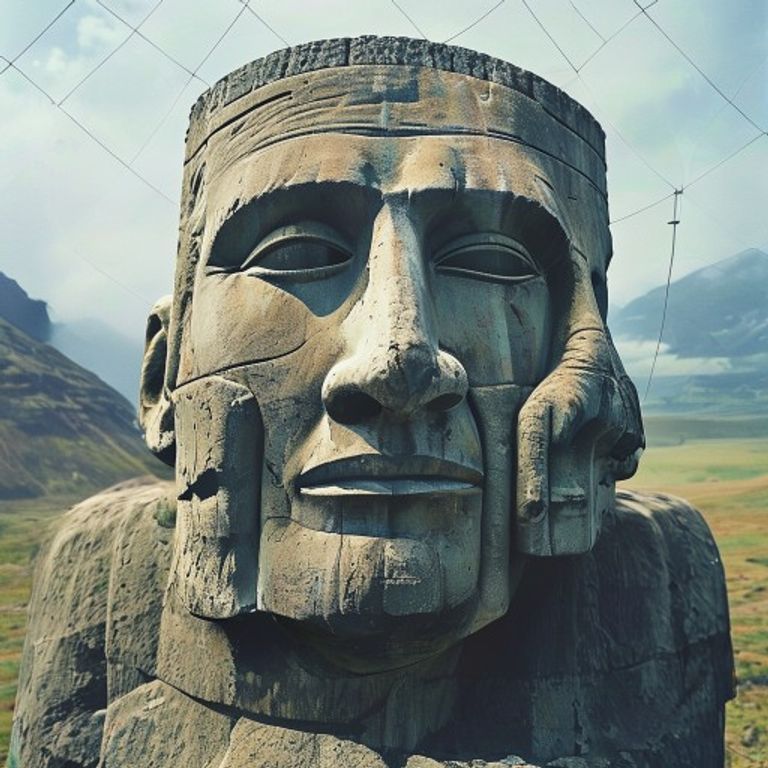
The precise logistical methods used by the natives of Easter Island to carve, move, and erect hundreds of colossal volcanic statues remain a remarkable challenge for archaeological engineering.
⚠️ Research elaborated with the aid of Deep Research is subject to referential ambiguity.
🖥️Clean HTML code using a proprietary tool.
👥 Research by Guilherme Felipe, Curation by Sílvio Lôbo
The Enigma of the Stone Giants: Unraveling the Case of the Moai Transport
For decades, the volcanic island of Rapa Nui, better known as Easter Island, has been the stage for one of the greatest enigmas of archaeology and ancient engineering: how did the Rapa Nui people, isolated in the South Pacific, manage to transport and erect the iconic and colossal Moai, monolithic stone statues that can weigh tens of tons? This is not a criminal case in the traditional sense, but a historical-anthropological mystery that defies conventional explanations and fuels global fascination, generating heated debates among scientists and enthusiasts of bolder theories.
The mystery does not lie in the creation of the statues themselves – the quarries, such as Rano Raraku, with its unfinished Moai and rudimentary tools, are concrete evidence of their fabrication. The enigma arises when trying to understand the logistics and workforce required to move these stone giants for kilometers over rugged terrain to their ceremonial platforms, the Ahu.
The Context and the Incident: Where, When, and How the Mystery Began
The history of the Moai dates back to a period between the 13th and 16th centuries. The Rapa Nui society, though isolated, prospered for centuries, developing a rich and complex culture, with the fabrication and transport of the Moai as its ultimate expression of power and spirituality. The "incident" that gave rise to the mystery is, in fact, the very existence and positioning of these monumental statues in often difficult-to-access locations, challenging modern understanding of the technological and organizational capabilities of ancient societies.
The lack of detailed written records about the transport process, combined with the passage of centuries and the eventual decline of Rapa Nui society, created a knowledge vacuum that allowed various speculations and theories to flourish. The monumental nature of the feat itself, requiring surprising coordination and engineering knowledge for its time, is at the heart of the enigma.
Timeline of Key Events
- Around 1250 AD: Beginning of the fabrication and transport of the first Moai on Rapa Nui.
- 13th to 16th Centuries: Peak period of Moai production and movement. It is estimated that over 900 statues were carved and spread across the island.
- 17th Century Onwards: Decline of Rapa Nui society, possibly due to internal conflicts, overpopulation, and environmental degradation, leading to the abandonment of Moai construction and transport.
- 18th Century: Arrival of the first European explorers, such as Jacob Roggeveen in 1722, who documented the statues in their current state and began to question how they were transported.
- 20th and 21st Centuries: Intensification of archaeological, anthropological, and engineering studies to decipher the transport methods, with various theories emerging and being tested.
The Main Theories: Scientific, Alternative, and Paranormal Hypotheses
The diversity of explanations reflects the complexity of the case and the absence of a definitive, universally accepted answer. The theories can be grouped as follows:
Scientific and Archaeological Theories (Most Probable)
- The "Walking" Theory: Proposed by archaeologist Terry Hunt and others, it suggests that the Moai were "walked" forward by rocking them on their feet and moving them slowly in small steps, using ropes and a reasonable number of people. Small-scale experiments have demonstrated the feasibility of this technique.
- The Log Roller Theory: An older hypothesis suggesting the use of tree trunks as rollers to slide the statues. However, the lack of wood on Rapa Nui during the periods of greatest transport activity and the difficulty of maneuvering heavy logs under a Moai raise doubts.
- The Stone "Road" Theory: Suggests the creation of paved or inclined paths to facilitate sliding. Evidence of rudimentary roads has been found, but their effectiveness for such heavy statues is debated.
- The "Front to Back" Theory (with Ropes and Levers): Similar to "walking," but with greater emphasis on using wooden levers to lift and move small sections of the Moai at a time, with the aid of ropes.
Alternative and Conspiracy Theories
- The Extraterrestrial Help Theory: Given the difficulty of the feat and the lack of satisfactory "conventional" explanations for some, the hypothesis of intervention by more advanced civilizations (extraterrestrials) is often raised. The logic here is to attribute the necessary technological capability to beings with superior knowledge.
- The Advanced Lost Civilization Theory: Similar to the previous one, but speculates about the existence of a pre-existing terrestrial civilization (like Atlantis or Mu) that possessed the technology to move these stones and whose knowledge was passed on to the Rapa Nui.
- The Levitation or Energy Manipulation Theory: Some less conventional theories suggest that the Rapa Nui may have mastered forms of energy manipulation or levitation, allowing the Moai to be moved without apparent physical effort.
Paranormal Theories
- Supernatural Theories: In some more esoteric narratives, it is believed that the Moai were moved by spiritual or magical forces, attributing it to a mystical power inherent in the Rapa Nui themselves or to higher entities.
Controversies and Blind Spots
Despite decades of research, the "Case of the Moai Transport" remains full of controversies and blind spots that fuel the mystery:
- Scarcity of Resources: Rapa Nui island suffered from large-scale deforestation, especially during the period of greatest construction activity. The amount of wood required for some theories (like log rollers) seems incompatible with available resources. Archaeological reports, such as those on the island's paleoecology, frequently point to this scarcity as a limiting factor.
- Resistance to the "Walking" Theory: Although recent research supports "walking," many skeptics argue that the stability of a moving Moai, with its high center of gravity, would be precarious, and the effort to maintain balance and movement on uneven terrain would be immense.
- Ancient Testimonies and Legends: The few Rapa Nui legends and oral traditions that mention the transport of the Moai are often interpreted in different ways, leading to conflicts of interpretation and hindering the extraction of concrete facts. Some legends speak of "paths that walk by themselves," fueling speculation.
- Lost or Destroyed Evidence: Over the years, erosion, vandalism, and the passage of time itself may have destroyed or obscured crucial evidence that could have elucidated the process. There is no fixed "crime scene" or clear "forensic artifacts" to analyze in a traditional sense.
- Lack of Contemporary Documentation: The Rapa Nui did not develop an alphabetic writing system, and the few artifacts with inscriptions (like Rongorongo, whose meaning is still largely unknown) do not detail construction or transport methods.
Curiosities and Legacy
The "Case of the Moai Transport" has transcended archaeology to become a pop culture icon and a symbol of human mystery in the face of extraordinary achievements.
- Cultural Impact: The Moai have inspired countless works of art, literature, films, and documentaries, solidifying Easter Island as a place of fascination and intrigue. They represent not only a physical achievement but also a testament to human ingenuity and organizational capacity in ancient times.
- Current Status: The case has not been "reopened" or "closed" in the sense of a legal proceeding. It remains an active field of scientific research, with new discoveries and experiments constantly being conducted. The "walking" theory is currently the most accepted by the scientific community, but the debate and the search for definitive answers continue.
- Ongoing Research: Archaeologists and engineers continue to conduct simulations and experiments, using modern technology to test different hypotheses. The analysis of 3D scanning data of the Moai and the island's topography also contributes to a deeper understanding.
- The Enigma of Decline: Alongside the mystery of transport, the history of the eventual decline of Rapa Nui society and the island's ecological collapse continue to be subjects of intense study, serving as a cautionary tale about sustainability and human impact on the environment.
As science seeks to decipher the secrets behind the transport of the stone giants, the mystery of the Case of the Moai Transport will continue to echo through time, challenging our conceptions of the past and inspiring generations to contemplate the limits of human capability.



