


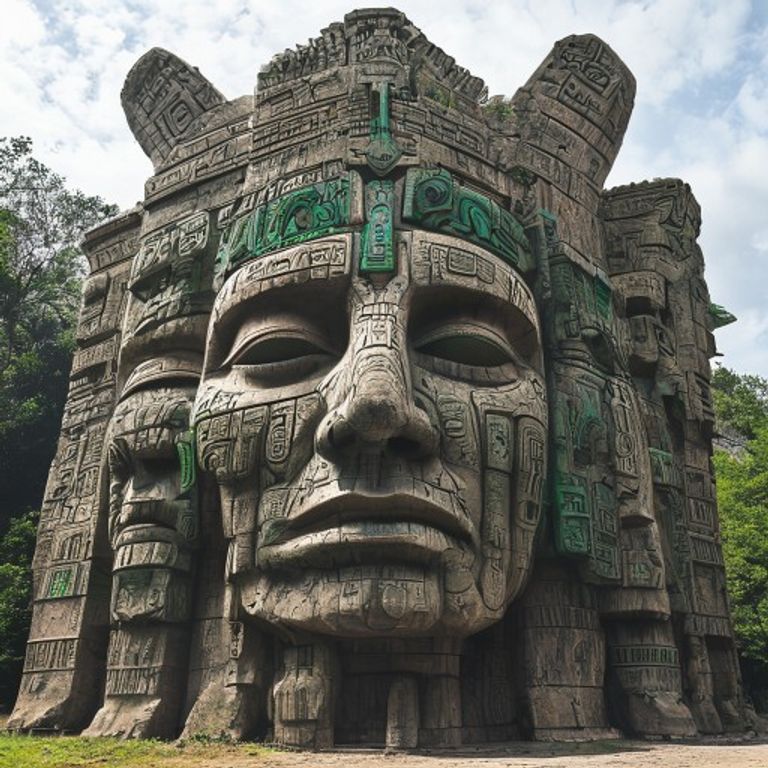
Enormous stone sculptures with distinct facial features and helmets have been found in Mexico, weighing tons and suggesting engineering knowledge and cultural contacts not yet explained by archaeology.
⚠️ Research elaborated with the aid of Deep Research is subject to referential ambiguity.
🖥️Clean HTML code using a proprietary tool.
👥 Research by Guilherme Felipe, Curation by Sílvio Lôbo
The Case of the Olmec Colossal Heads: The Stone Enigma That Defies History
As a senior investigative journalist, I have dedicated years to exploring mysteries that haunt human history. Few, however, echo with the silent gravity and persistent perplexity of the so-called "Case of the Olmec Colossal Heads." This is not a crime in the modern sense, but a crime against knowledge, a black hole in our understanding of one of the oldest and most enigmatic civilizations in the Americas.
1. The Context and the Incident: Where, When, and How the Mystery Began
The mystery of the Olmec colossal heads did not arise from a sudden event, but rather from archaeological discoveries that, from the outset, defied conventional explanations. The Olmec civilization, considered the "mother culture" of Mesoamerica, flourished between 1500 BC and 400 BC, primarily in the coastal region of the Gulf of Mexico, encompassing parts of the present-day Mexican states of Veracruz and Tabasco.
The first significant discoveries of these monumental stone heads occurred in the early 20th century. In 1862, explorer José María Melgar y Serrano reported the discovery of a colossal head in Tres Zapotes, Veracruz. However, it was from the 1920s and 1930s onwards that expeditions led by archaeologists such as Matthew Stirling, with support from the Smithsonian Institution, brought to light an impressive number of these artifacts at sites like San Lorenzo Tenochtitlán and La Venta.
The "incident," if we can call it that, lies in the very nature of these monuments: they are massive blocks of stone, some weighing over 40 tons, carved with distinct facial features – flattened noses, thick lips, and in some cases, characteristic helmets. The question that has haunted from the very beginning is: How and why did the Olmecs, without the benefit of advanced metal tools or the wheel for large-scale transport, manage to quarry, carve, and transport such heavy stones, and what was the purpose of these impressive representations?
2. Timeline of Events
- c. 1500 BC - 400 BC: Period of flourishing of the Olmec Civilization. Construction and creation of colossal heads in various ceremonial centers.
- 1862: José María Melgar y Serrano documents the discovery of the first colossal head in Tres Zapotes.
- 1925-1930s: Archaeological expeditions, notably led by Matthew Stirling and funded by the Smithsonian Institution, reveal the extent of the phenomenon in San Lorenzo, La Venta, and Tres Zapotes.
- 1940s-1960s: Intensified studies and large-scale excavations reveal more heads and help map the geographical distribution and cultural context of Olmec sites.
- 1970s onwards: Continuation of archaeological research, using more advanced techniques, but the mystery surrounding the origin and method of stone transport persists.
- Present: The colossal heads continue to be icons of Mesoamerican archaeology, objects of public fascination, and subjects of intense academic debate.
3. Main Theories
The enigma of the colossal heads has generated a myriad of theories, ranging from scientific rigor to the most audacious speculation.
3.1. Scientific and Archaeological Hypotheses
- Quarrying and Transport with Stone Tools and Ropes: This is the most widely accepted explanation by the scientific community. It is believed that the Olmecs used harder stones to carve the basalt heads (a volcanic rock relatively common in the region). For transport, the extensive use of rudimentary pulleys, logs as rollers for the monoliths, and the strength of hundreds of men pulling with ropes made from plant fibers is theorized. The proximity of quarries (like San Martín Pajapan) to construction sites is seen as a facilitating factor.
- Use of Water and Canals: Some hypotheses suggest that water could have been used to facilitate transport, either by flooding artificially created channels or by utilizing natural bodies of water.
- Ritualistic and Symbolic Purpose: Most archaeologists agree that the heads represented Olmec rulers, gods, or ancestors. It is believed they were erected in ceremonial sites, possibly to mark territories, commemorate victories, or honor leaders. The practice of intentionally "burying" some heads after a period suggests completion or deposition rituals.
3.2. Alternative, Conspiracy, or Paranormal Theories
- Extraterrestrial Visitors: A popular theory in ufology circles suggests that the sophistication and magnitude of the heads were beyond the technological capabilities of the time, implying the intervention of otherworldly beings who assisted the Olmecs with advanced technology.
- Lost Advanced Civilizations: Some theories postulate the existence of pre-Olmec or contemporary civilizations with superior technological knowledge, who would have left this legacy.
- Sonic or Psychic Technology: More esoteric hypotheses speculate about the use of sound vibrations or psychic powers to shape stone, although they lack any scientific basis or concrete evidence.
It is crucial to emphasize that scientific theories are based on material evidence, tool analysis, and archaeological context, while alternative theories often lack verifiable proof and are based on knowledge gaps and speculation.
4. Controversies and Blind Spots
The investigation into the case of the Olmec colossal heads is rife with controversies and blind spots that fuel the mystery:
- The Disappearance of Evidence: Early expedition reports often mention the destruction of some artifacts by local excavators in search of valuable materials. The lack of strict control over the sites in the early decades of exploration may have led to the irreparable loss of context and crucial information.
- Debates on Chronology: Although the general chronology of the Olmec culture is established, the exact dating of some heads and their association with specific rulers are still debated among archaeologists.
- Lack of Preserved Tools: The absence of perfectly preserved stone tools that explicitly demonstrate the technique for carving such massive blocks leaves room for speculation about the exact methods employed.
- Interpretations of Testimonies: Accounts from local natives to early explorers, sometimes filtered by linguistic and cultural barriers, may contain keys to the meaning of the heads that were lost or misinterpreted over time.
- The Nature of Early "Expeditions": Some of the early explorations may have been more extractive than investigative, focusing on the removal of artifacts for museums rather than on complete contextual research.
5. Curiosities and Legacy
The case of the Olmec colossal heads has transcended the field of archaeology to become a cultural icon and a symbol of the ancient mystery of the Americas.
- National Iconography: The colossal heads are one of the most recognizable symbols of Mexican culture and pre-Columbian history.
- Tourism and Research: Sites like San Lorenzo and La Venta are important tourist destinations and centers for ongoing research, attracting archaeologists and enthusiasts from around the world.
- Popular Adaptations: The mystery has inspired countless books, documentaries, and conspiracy theories, fueling popular imagination about what the Olmecs were capable of achieving.
- Current Status: The case is not "reopened" in the sense of a police investigation, as there is no crime to solve. However, archaeological research on the colossal heads is continuous and dynamic. New findings, dating analyses, and mapping technologies continue to refine our understanding, but the aura of mystery surrounding their creation and purpose remains a powerful invitation to investigation and reflection on the capabilities of ancient civilizations.
The enigma of the Olmec colossal heads serves as a poignant reminder that, even in our increasingly connected and informed world, history still holds profound secrets, etched in stone and whispering through the millennia.



