


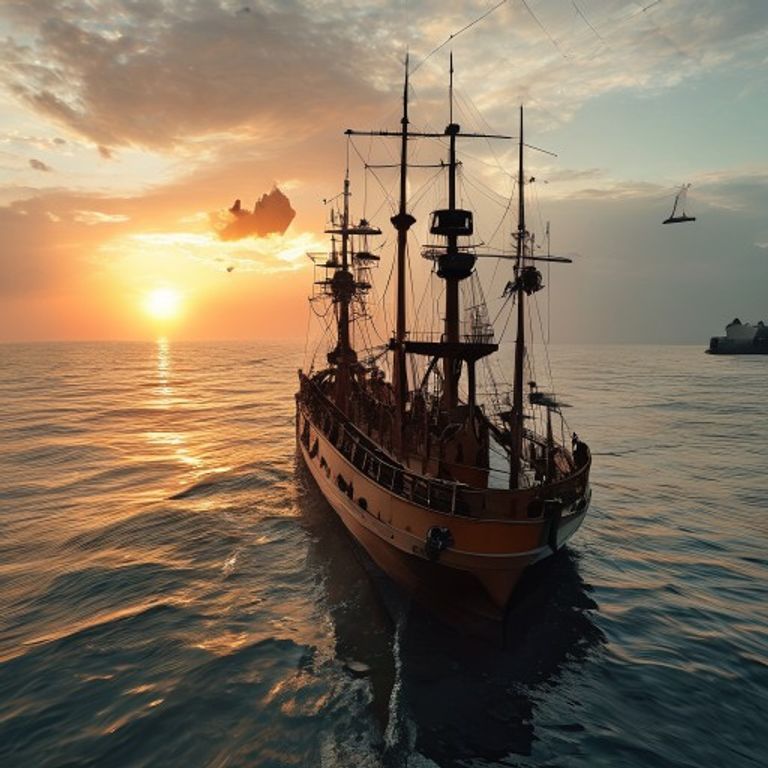
The account of a Dutch freighter found adrift with its entire crew dead, wearing expressions of terror, shortly before the vessel exploded and sank without a trace.
⚠️ Research conducted with the aid of Deep Research is subject to referential ambiguity.
🖥️ Clean HTML code using a proprietary tool.
👥 Research by Guilherme Felipe, Curation by Sílvio Lôbo
The Ghost Ship Case: Unraveling the Mystery of the Ourang Medan
The sea holds unfathomable secrets, and few are as disturbing as the story of the Ourang Medan. A ghost ship that emerged from the mists of the Strait of Malacca in 1947, carrying a crew dead under horrifying circumstances and a mystery that haunts navigation to this day. As a senior investigative journalist, I have delved into the few and fragmented reports, cross-referencing information and separating myth from reality in one of the most enigmatic unsolved cases in maritime history.
1. The Context and the Incident: A Silent Scream in the Waters
The narrative begins in the calm waters of the Strait of Malacca, one of the busiest shipping routes in the world, located between Malaysia and Indonesia. In February 1947 (the exact date is a subject of debate, ranging between February and June 1947 in different accounts), vessels navigating the region picked up a desperate distress signal. The message, transmitted in English, appeared to come from a Dutch ship named Ourang Medan. The content was alarming: "All officers, including the captain, are dead." Shortly after, an anguished scream echoed over the radio: "I... die..." The signal ceased abruptly, leaving behind a chilling silence.
Intrigued and concerned, nearby ships headed to the location to investigate. The Silver Star, an American freighter, was one of the first to arrive. Upon approaching, the crew spotted the Ourang Medan adrift, with no signs of smoke or apparent life. A rescue team was sent aboard.
2. Timeline of Events: A Countdown to Silence
- Indeterminate Date (Likely February/June 1947): The ship Ourang Medan, supposedly sailing from the port of Djakarta (now Jakarta) to Sumatra, departs on its voyage. Later reports suggest the cargo might have been unusual, possibly containing hazardous materials, although this has never been officially confirmed.
- Indeterminate Date (Months before the rescue): The first distress signal is picked up. The text message, which varies in detail depending on the source, indicates the death of the entire crew.
- Indeterminate Date (Shortly after the first signal): The second distress signal is picked up, with the terrified voice of a crew member reporting their own imminent death.
- Indeterminate Date (A few hours after the last signal): The American ship Silver Star arrives in the vicinity of the Ourang Medan and begins boarding.
- Boarding the Ourang Medan: The Silver Star rescue team finds the Ourang Medan crew dead. Their bodies are in bizarre positions, with arms outstretched and faces contorted in expressions of terror, turned toward the sun. Even the ship's dog was found dead, with a similar expression of agony. The temperature on board was abnormally cold.
- Discovery of the Bodies: There were no visible signs of injury on the bodies. The only physical evidence of "violence" was the expression of pure panic on their faces and the rigor mortis in unnatural poses.
- Fire and Sinking: As the rescue team prepared to tow the Ourang Medan, smoke began to pour from one of the hatches. The team rushed back to the Silver Star. Shortly after, an explosion was heard, and the Ourang Medan sank rapidly into the waters of the Strait of Malacca, taking all its secrets with it.
3. The Main Theories: Seeking Logic in the Madness
The lack of concrete evidence and the shocking nature of the discovery opened the door to a myriad of theories, some more plausible than others. Let's analyze the most prominent ones:
-
Scientific and Police Theories (Most Likely):
- Toxic Gas Leak: This is one of the most accepted and scientifically plausible explanations. The hypothesis is that the ship's cargo, possibly containing unstable chemicals such as nitroglycerin or phosphorus compounds, leaked. The inhalation of these gases would have caused the rapid and agonizing death of the crew. The rigidity in unnatural poses could be the result of extreme muscle spasms caused by intoxication. The cold on board could be a side effect of the evaporation of a solvent or refrigerant. The explosion and subsequent sinking would be the result of the ignition of these gases or a spontaneous fire. Reports of incidents with hazardous cargo on ships are recurring in maritime history.
- Carbon Dioxide (CO2) from Poorly Stored Cargo: Another scientific possibility is the accumulation of carbon dioxide from decomposing organic cargo, such as fertilizers or fuels. In a closed space without proper ventilation, CO2 can reach lethal levels, leading to asphyxiation. However, the expression of terror on the faces makes this explanation difficult to accept in isolation.
- Unknown Virus or Bacteria: Although less likely without concrete evidence, one cannot rule out the possibility of a highly contagious and fast-acting disease that could have decimated the crew. However, the absence of medical reports or any subsequent contagion on the Silver Star weakens this theory.
-
Alternative and Paranormal Theories:
- Pirate Attack or Sabotage Using Gas: A variation of the gas leak theory, where the intent would be criminal. Pirates could have used an incapacitating or lethal gas to neutralize the crew before stealing the cargo. Deliberate sabotage for unknown reasons also falls into this category. However, the absence of apparent theft and the silence after the attack are questionable.
- Encounter with a UFO or Extraterrestrial Phenomenon: The terror expressed on the faces and the inexplicable nature of the event fueled speculation about alien interference. The idea is that an unknown force attacked the crew, causing panic and death. This theory, while fascinating, lacks any physical or testimonial evidence to support it.
- Paranormal Activity or Curse: In a more mystical scenario, some suggest the ship was cursed or that supernatural forces were responsible. This theory is purely speculative and not based on observable facts.
- Secret Military Experiments: During the Cold War, many conspiracy theories involved secret military experiments. Could the Ourang Medan have been the site of a biological or chemical weapon test that went horribly wrong? The absence of any official confirmation or declassification of documents regarding such experiments makes this hypothesis difficult to prove.
4. Controversies and Blind Spots: The Gaps in the Puzzle
The Ourang Medan case is full of inconsistencies and gaps that hinder any definitive conclusion:
- Fragmented and Conflicting Reports: The greatest difficulty lies in the scarcity and fragmented nature of the reports. There are no detailed official reports on the investigation of the ship, nor forensic examinations of the bodies. Most information comes from second-hand accounts, from sailors on other ships who interacted with the Silver Star, or from newspaper articles of the time, which often exaggerated details to attract readers.
- The Logbook: There are reports that a logbook was found on board the Ourang Medan. However, its exact content, whether it really existed, and what it contained remains a mystery. Some suggest the logbook detailed the events leading to the tragedy but was lost or destroyed before being properly analyzed.
- The Identity of the Crew and the Ship: The exact origin of the Ourang Medan and its crew is also obscure. There are no clear records of a ship with that name and flag in 1947 that was involved in conventional trade routes. This raises the possibility that the ship was of unofficial registration or involved in illicit activities.
- The Speed of the Sinking: The fact that the ship sank so quickly after the fire started is noteworthy. This reinforces the theory of unstable cargo or a large-scale explosion.
- The Official Silence: The absence of an in-depth investigation and official statements by maritime authorities of the time is a significant blind spot. Why did such a serious incident not generate a formal inquiry?
5. Curiosities and Legacy: The Eternal Echo of a Mystery
The Ourang Medan case has transcended time, becoming a legend in maritime folklore. Its story has been told in books, articles, documentaries, and has inspired various works of fiction. The mystery lies in its ability to evoke the primal fear of the unknown, of the impalpable that can lead to death in a sudden and inexplicable way.
The ship, with its ghost cargo and terrified crew, has become a symbol of the latent danger of the oceans and the secrets they hold. The theories, however speculative they may be, demonstrate our incessant search for answers, even in the face of the inexplicable.
Currently, the Ourang Medan case remains officially unsolved. Without the discovery of wreckage, detailed reports, or new evidence, the ghost ship will continue to sail in the waters of speculation, a grim reminder that, no matter how much we unravel the mysteries of the world, some still remain in the depths, echoing like a silent scream in time.



