


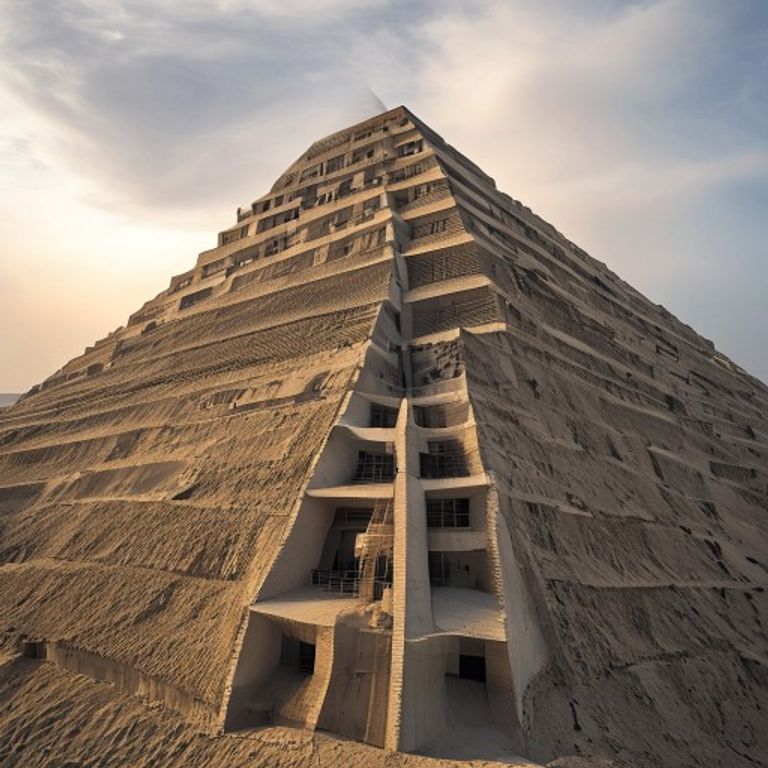
The exact methodology used to perfectly transport and erect millions of enormous stone blocks weighing tons in ancient Egypt continues to challenge engineers and historians.
⚠️ Research elaborated with the aid of Deep Research is subject to referential ambiguity.
🖥️Clean HTML code using a proprietary tool.
👥 Research by Guilherme Felipe, Curation by Sílvio Lôbo
The Case of the Pyramid Construction: An Ancient Mystery That Defies Reason
The history of humanity is punctuated by enigmas that, no matter how many centuries pass, resist definitive resolution. Among the most fascinating and persistent is the Case of the Pyramid Construction. This is not a murder case or a modern disappearance, but rather a colossal architectural feat that, to this day, generates a sea of doubts and theories about its origin and execution. The mystery did not begin with a specific event, but with the very existence of these monumental structures in Ancient Egypt, erected over four millennia ago.
The Context and the Incident: Where, When, and How the Mystery Began
The "incident" that gave rise to this case is the very construction of the Great Pyramids of Giza, particularly the Pyramid of Khufu. Built during the Fourth Dynasty of Ancient Egypt (approximately 2580-2560 BC), these monolithic structures represent an unprecedented technological and organizational leap for their time. The central question that fuels the mystery is: how was a civilization with tools considered primitive, and without advanced engineering knowledge as we know it, capable of transporting, carving, and positioning millions of massive stone blocks, some weighing tens of tons, with such geometric precision?
The mystery is not a sudden event, but the sum of questions that accumulate as archaeologists, historians, and engineers attempt to decipher the construction methods. The lack of detailed records on the specific processes of lifting and setting the blocks, and the monumental scale of the undertaking, leave a void that imagination and science attempt to fill.
Timeline of Key Events
- c. 2580-2560 BC: Construction of the Pyramid of Khufu in Giza begins, under the reign of Pharaoh Khufu.
- c. 2570-2544 BC: Construction of the Pyramid of Khafre and the Great Sphinx.
- c. 2532-2503 BC: Construction of the Pyramid of Menkaure.
- Ancient Egyptian Period: It is believed that the construction was carried out by a numerous workforce, composed of skilled artisans and seasonal laborers, using methods involving ramps, levers, and human and animal power.
- 18th-19th Centuries: Revival of scientific and exploratory interest in Ancient Egypt, with Napoleon Bonaparte's expeditions, which brought extensive knowledge about the pyramids to Europe, but also raised new questions.
- 20th Century Onwards: Intensification of archaeological and engineering research. Discoveries of partial ramps, copper and bronze tools, and evidence of complex planning. However, the magnitude of the achievement continues to generate debate.
The Main Theories
The case of the pyramid construction is a fertile ground for a wide range of theories, from the most scientifically grounded to those that flirt with the fantastic.
Scientific and Archaeological Theories (Probable Hypotheses):
- Ramp Theory: This is the dominant hypothesis among Egyptologists and engineers. It suggests that ramps were built around the developing pyramid.
- Straight Ramp: A long, inclined ramp. Disadvantage: would require a volume of material almost as large as the pyramid itself and would become excessively long and steep.
- Internal Spiral Ramp: A ramp that would encircle the pyramid from the inside, built as the walls rose. Advantage: less material volume and a more manageable incline.
- Zig-Zag Ramp: Ramps that would ascend in a zig-zag pattern up the pyramid's faces.
- Lifting and Sliding Techniques: Use of levers, rollers (although concrete evidence is scarce), and hydraulic force (possibly by dragging blocks on wet surfaces or with lubricants).
- Massive and Organized Workforce: It is believed that the construction involved tens of thousands of skilled and unskilled workers, organized into teams and supplied with provisions and housing. Evidence of worker villages has been found.
- Primitive Tools and Carving Techniques: Use of copper and bronze chisels, stone hammers, and sand abrasion techniques to shape and polish the stones.
Alternative and Speculative Theories:
- Lost Technology Theory: Suggests that the Egyptians possessed advanced technologies that were lost over time. This theory often relies on the precision of the stones and the absence of obvious "tool marks" on many blocks.
- Extraterrestrial Intervention Theory: Proposes that beings from other planets provided knowledge or direct assistance in the construction of the pyramids, given their dimensions and precision.
- Sonoluminescence or Sound Resonance Theory: Some theories speculate about the use of sound vibrations or energy fields to levitate or move the stone blocks.
- Construction by Advanced Previous Civilizations Theory: Hypotheses suggesting that the pyramids were built by a much older and technologically superior pre-Egyptian civilization.
The logic behind the scientific theories is based on archaeological evidence and the extrapolation of known engineering and logistical principles. Alternative theories, on the other hand, often arise from the difficulty in reconciling the magnitude of the work with the known tools, seeking explanations outside the scope of documented Egyptian technology and knowledge.
Controversies and Blind Spots
Despite decades of research, the case still presents blind spots and controversies:
- Lack of Detailed Records: There are no papyri or hieroglyphs that describe step-by-step the exact process of construction, lifting, and setting the blocks. The existing records focus more on the pharaohs and religious aspects.
- The Issue of Lifting the Blocks: The precision with which granite blocks, weighing over 50 tons, were raised to the internal chambers of the Pyramid of Khufu remains one of the greatest challenges to be fully explained by conventional methods.
- Geometric Precision: The near-perfect alignment of the pyramids with the cardinal points and the precision in their angles and dimensions suggest highly developed astronomical and engineering knowledge, whose practical application methods remain debated.
- Evidence of Primitive Tools vs. Final Result: The disparity between the simplicity of the copper and bronze tools found and the perfection of the cutting and fitting of some stones raises questions.
- Theories about the Sphinx: Although not directly part of the pyramid construction, the dating of the Great Sphinx is controversial. Some theories, based on erosion patterns, suggest it is much older than the Fourth Dynasty, implying a previous civilization with advanced architectural skills.
Curiosities and Legacy
The Case of the Pyramid Construction has transcended the field of archaeology to become a global cultural icon. It has inspired countless books, films, documentaries, and debates, fueling humanity's fascination with the unknown and the ingenuity of ancient civilizations.
Cultural Impact:
- Symbol of Ancient Egypt and its grandeur.
- Catalyst for the development of Egyptology and modern archaeology.
- An inexhaustible source of inspiration for conspiracy theories and paranormal speculations.
- One of the most visited tourist landmarks in the world, attracting millions of visitors annually.
Current Status:
The case has not been "reopened" in a criminal sense, as there is no crime to be solved. However, scientific and archaeological investigation into the construction methods is ongoing and evolving with new technologies and discoveries. With each new excavation, with each improved analysis, new pieces are added to the puzzle, but the full truth about how these wonders were built still lies, in large part, in the sands of time, fueling mystery and admiration.



