


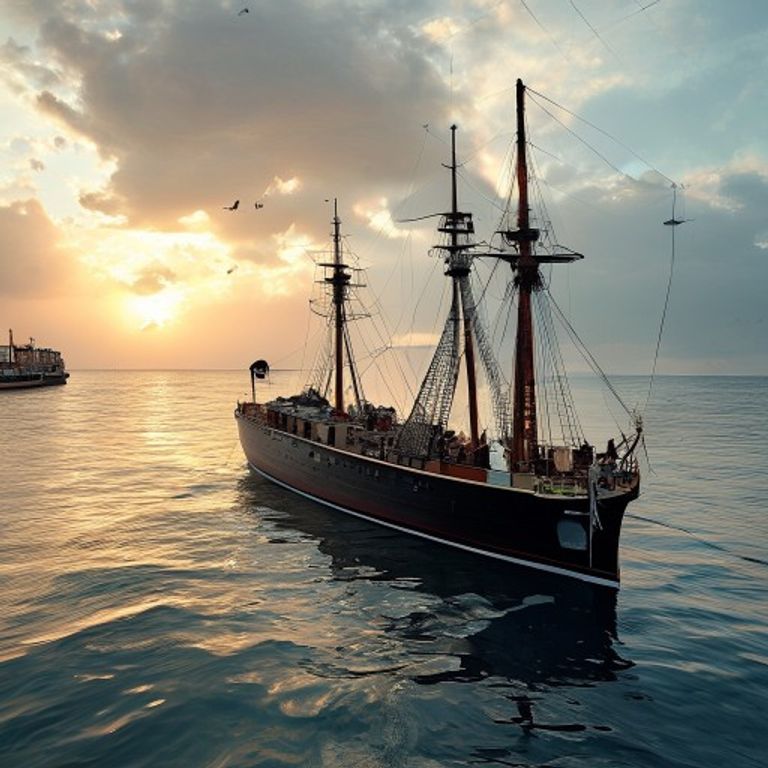
The sinking of the British ocean liner by a German submarine in 1915, an event that helped shift public opinion and drive American entry into the First World War.
⚠️ Research conducted with the aid of Deep Research is subject to referential ambiguity.
🖥️ Clean HTML code using proprietary tools.
👥 Research by Guilherme Felipe, Curation by Sílvio Lôbo
The Silent Cry of the Lusitania: A Dossier on the Sinking That Changed History
The North Atlantic, on May 7, 1915, witnessed an event that would echo for decades, turning a luxurious ocean liner into a submerged tomb and sparking the flames of a global conflict. The sinking of the RMS Lusitania, one of the fastest and most imposing passenger ships of its time, was not just a maritime tragedy; it was a catalyst that propelled the United States into World War I and left a trail of unanswered questions that persist to this day. As a senior investigative journalist, I have delved into the archives, testimonies, and whispers of time to unravel the layers of this historical mystery.
1. The Context and the Incident: Where, When, and How the Mystery Began
The scene unfolded in treacherous waters, just 18 kilometers off the coast of Old Head of Kinsale, in Ireland. The RMS Lusitania, a Cunard Line ship, was a symbol of British pride and cutting-edge naval engineering. On its 102nd transatlantic voyage, departing from New York on May 1, 1915, it carried 1,959 passengers and crew, a number that would become grim in a matter of hours.
The context was World War I. Germany, in response to the British naval blockade, had declared the area around the British Isles a war zone and introduced submarines (U-boats) as combat weapons. British and American propaganda portrayed U-boats as instruments of barbarism, and the Lusitania, despite being a passenger ship, was on a high-risk route.
The incident itself was shocking in its speed. Around 2:10 PM on May 7, while approaching the Irish coast in foggy conditions with reduced visibility, the Lusitania was struck by a single torpedo launched by the German U-boat U-20, commanded by Captain Walter Schwieger. The initial explosion was followed by a second, even more devastating one, which sealed the ship's fate. In a mere 18 minutes, the majestic ocean liner sank, taking 1,198 lives with it, including 128 American citizens.
2. Timeline of Events
To understand the complexity of the case, it is crucial to reconstruct the sequence of events:
- April 24, 1915: The German embassy in Washington D.C. publishes a notice in American newspapers warning about the dangers of traveling on British ships, including the Lusitania, in war waters.
- May 1, 1915: The RMS Lusitania sets sail from New York.
- May 6, 1915: The Lusitania enters the war zone declared by the Germans. Captain William Thomas Turner receives a telegram from the British Admiralty instructing him to navigate erratically to avoid torpedoes, an instruction that would become a point of contention.
- May 7, 1915, ~2:10 PM: The U-20 spots the Lusitania and fires a torpedo.
- May 7, 1915, ~2:12 PM: The torpedo hits the starboard side of the Lusitania, near the bow.
- May 7, 1915, ~2:14 PM: A second and massive explosion occurs inside the ship, causing catastrophic damage.
- May 7, 1915, ~2:28 PM: The Lusitania sinks completely into the Atlantic.
- May 7, 1915, following nights and days: Rescue operations save 761 survivors, many in serious condition.
- 1915-1918: Official investigations are conducted by the British Admiralty and the U.S. Court of Inquiry.
3. The Main Theories
The sinking of the Lusitania gave rise to a range of theories, some grounded in evidence, others lost in the fog of speculation.
3.1. The Official Theory: Unjustified Attack and German Guilt
This is the prevailing narrative and the official conclusion of British and American investigations. According to this theory, the U-20, acting under German orders, deliberately attacked an unarmed civilian ship with the goal of causing a massacre and inflaming public opinion against Germany. The second explosion, which accelerated the sinking, is attributed to the ignition of flammable materials on board, including coal and possibly poorly stored war explosives.
- Proven Facts: The torpedo was fired by the German U-20. The ship sank rapidly after the impact. There were passengers and crew on board. Germany admitted responsibility for the torpedo.
- Points of Doubt/Speculation: The exact nature of the second explosion and whether it was intentional or accidental, and the alleged deliberate intent to target a civilian ship with so many lives on board.
3.2. The Secret Cargo Theory: Was the Lusitania Carrying Weapons?
One of the most persistent and controversial theories suggests that the Lusitania, in addition to passengers, was secretly carrying a shipment of weapons and ammunition. It is argued that if the ship were loaded with war explosives, the second explosion, much more powerful than the initial torpedo strike, would be explained by the detonation of these materials. This would place the ship in a different category, perhaps justifying the attack as a military act against a disguised warship.
- Proven Facts: Reports after the sinking, including declassified documents, revealed that the Lusitania was indeed carrying a considerable cargo of military items, such as rifle cartridges and gunpowder, although the extent and exact nature of other possible shipments remain a subject of debate. The ship was not officially classified as armed.
- Points of Doubt/Speculation: The exact quantity and nature of the explosive materials. Whether the British Admiralty knew about the cargo and if this influenced the navigation orders. The intent to disguise the weapons cargo as civilian merchandise.
3.3. The Deliberately Provocative Navigation Theory: A Dangerous Game?
This theory raises the possibility that Captain Turner, under orders from the British Admiralty, navigated in a purposefully reckless and visible manner as a way to provoke the Germans and obtain a justification for the U.S. entry into the war. The instructions to "navigate erratically" are frequently cited as evidence, suggesting that the ship did not actively try to hide or avoid the danger zone effectively.
- Proven Facts: Captain Turner received the telegram from the British Admiralty with specific instructions regarding navigation. There are reports that the ship did not use all its spotlights, nor did it zigzag consistently.
- Points of Doubt/Speculation: Whether the instructions were a deliberate plan to sacrifice the ship, or just a standard tactic in wartime. The exact motivation behind the apparent inaction at certain critical moments.
3.4. Alternative and Paranormal Theories: The Internal Sabotage Hypothesis and Unknown Energy
In contrast to the more political and military theories, some hypotheses explore the realm of internal sabotage or even inexplicable forces.
- Internal Sabotage: Although difficult to prove, some speculate that an act of sabotage on board, perhaps orchestrated by spies, could have caused the second explosion. However, there is no concrete evidence to support this hypothesis.
- Unknown Energy or Natural Phenomenon: In cases of inexplicable mysteries, there is a temptation to attribute events to forces we do not fully understand. However, in the case of the Lusitania, the confirmed presence of the German U-boat and the torpedo significantly minimize the plausibility of paranormal or unknown natural explanations for the initial explosion. The second explosion, while intriguing, is more plausibly explained by material factors.
4. Controversies and Blind Spots
The investigation into the sinking of the Lusitania is full of controversies and gaps that fuel the mystery:
- The Second Explosion: The exact nature of the second explosion remains one of the biggest blind spots. The official version attributes it to the ignition of materials on board, but the intensity and speed with which it occurred led to speculation about the type of cargo and whether it was being transported improperly or purposefully. Later reports indicate the presence of ammunition on board, which reinforces this possibility, but the extent of the explosive cargo and its arrangement remain obscure.
- Captain Turner's Testimony: Captain William Thomas Turner, an experienced naval officer, spent the rest of his life haunted by the event. His testimonies regarding the orders received and his actions during the sinking presented some inconsistencies or, at least, an apparent reluctance to provide details that could further implicate the British Admiralty. Pressure and trauma certainly played a role in his memory and account.
- Lost or Ignored Evidence: As with many disasters of epic proportions, it is possible that some crucial evidence was lost in the chaos of the sinking or during rescue operations. Furthermore, the political urgency to blame Germany may have led to the disregard of certain lines of investigation.
- The Admiralty's "Secret": The exact nature of the orders given to Captain Turner and whether they were known to the public or if the Admiralty was aware of the extreme risk the Lusitania was running remains a point of debate. Later declassified archives shed some light, but the full narrative remains elusive.
5. Curiosities and Legacy
The sinking of the Lusitania transcended newspaper headlines to become a cultural icon and a watershed moment in world history.
- Impact on U.S. Entry into the War: The massacre of civilians, including American citizens, outraged public opinion in the United States and was a crucial factor that led the country to declare war on Germany in 1917, two years after the sinking.
- War Propaganda: The incident was widely exploited by Allied propaganda to demonize Germany and generate support for the war cause. The term "German atrocity" became synonymous with the attack on the Lusitania.
- A Dive into History: The wreckage of the Lusitania, located in 1982, rests at a depth of about 90 meters. Expeditions to the site have brought up artifacts that corroborate the ammunition cargo, but the complexity of the two explosions still defies a single explanation for everything.
- Current Status: The Lusitania case has not been reopened in the sense of a new criminal trial, but it continues to be an object of academic study and public fascination. The full truth about the events of May 7, 1915 may never be fully unraveled, but the silent cry of the Lusitania continues to resonate, reminding us of the complexities of war, politics, and the eternal questions that remain unanswered in the depths of the ocean.



