


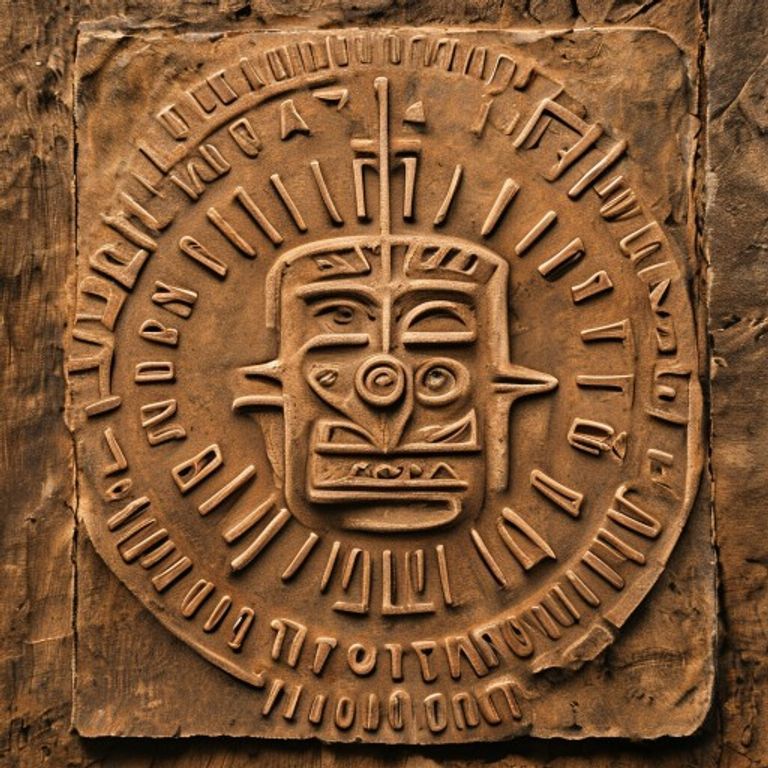
A system of glyphs carved into wooden tablets on Easter Island remains one of the few ancient languages humanity has failed to decipher.
⚠️ Research conducted with the assistance of Deep Research may be subject to referential ambiguity.
🖥️ Clean HTML code using a proprietary tool.
👥 Research by Guilherme Felipe, Curation by Sílvio Lôbo
The Rongorongo Enigma: Deciphering Easter Island's Ghost Script
Amidst the vast blue waters of the South Pacific, nestled over 3,700 kilometers from the nearest coast, lies Easter Island, a landmass shrouded in mystery and reverence. World-renowned for its enigmatic moai, colossal statues that hold ancestral secrets, the island conceals another enigma, perhaps even deeper and more frustrating: the Rongorongo script. A unique system of glyphs, never deciphered, that hovers like a ghostly shadow over the history of the Rapa Nui civilization.
As a senior investigative journalist with years dedicated to unraveling the inexplicable, delving into the Rongorongo case is like trying to grasp mist on a moonless night. Facts blend with speculation, and the truth slips away with every attempt at complete comprehension. This article aims to dissect the layers of this historical mystery, separating the wheat from the chaff, with the rigor that unsolved cases demand.
1. The Context and the Incident: Where, When, and How the Mystery Began
The Rongorongo mystery is not an "incident" in itself, in the sense of a single, dated event that sparked a police investigation. Instead, it is the *discovery* and subsequent *inability to decipher* a writing system that has haunted archaeologists, linguists, and historians for centuries. The context is the Rapa Nui civilization, which flourished on Easter Island in isolation, developing a rich and complex culture, notable for the creation of the moai.
The Rongorongo script was first documented by European missionaries and explorers in the 18th and 19th centuries. The earliest significant accounts date back to Thaddeus Von Bellingshausen's expedition in 1825, who observed local inhabitants using wooden tablets with unknown inscriptions. However, it was Father Eugène Eyraud, in 1864, who described the ritual objects with the script in more detail and associated them with the Rapa Nui ancestors, calling it "written things."
The "incident" that solidified the mystery was the catastrophic loss of knowledge with the subjugation and decline of the Rapa Nui population in the 19th century. Diseases brought by Europeans, slavery (especially by the Peruvians), and the destruction of part of the local culture by aggressive missionaries led to an abrupt interruption in the oral and written transmission of knowledge. Rongorongo, which may never have been widely disseminated, quickly became a mute language, its guardians dead and its secrets taken to the grave.
2. Timeline of Events: A Chronological Reconstruction of Key Facts
The timeline of the Rongorongo mystery is more about *observation and loss* than about "investigation" events in the modern sense:
- 10th-12th Centuries: Estimated period for the colonization of Easter Island and the development of Rapa Nui culture, possibly including the development of Rongorongo. (Hypothesis)
- 18th Century: First contacts with Europeans. Possible observation of rudimentary or declining use of the script.
- 1825: Thaddeus Von Bellingshausen's expedition documents the existence of inscribed tablets.
- 1864: Father Eugène Eyraud describes the Rongorongo script in his letters, naming it and associating it with ritual objects.
- 1868: Peruvian slave trade reaches Easter Island, decimating a large portion of the population and destroying many cultural artifacts. Most elders, potential bearers of Rongorongo knowledge, are taken away or die.
- Following Years (late 19th century): Researchers like William Churchill and Katherine Routledge begin collecting and cataloging the remaining Rongorongo tablets.
- Early 20th Century: Various linguists and anthropologists attempt to decipher the script without success.
- 21st Century: Research continues, with computational approaches and new analyses, but Rongorongo remains an unresolved enigma.
3. Main Theories: Possible Explanations for the Enigma
Theories about the nature and meaning of Rongorongo range from the most scientific to the most fanciful. It is crucial to distinguish serious academic research from rampant speculation.
3.1. Scientific and Linguistic Theories (Focus on Probable Hypotheses):
- Syllabic or Logosyllabic Writing System: The most widely accepted hypothesis is that Rongorongo represents a true writing system, composed of glyphs that may represent syllables or complete words. The complexity of the glyphs suggests a sophisticated system.
- Evidence: The structure of the inscriptions, the repetition of certain glyphs in patterns resembling grammar, and the organization in bustrophedon lines (alternating reading direction).
- Challenges: The lack of a bilingual text (like the Rosetta Stone for Egyptian hieroglyphs) and the loss of associated oral knowledge.
- Counting System or Mnemonic Record: A less ambitious theory suggests that Rongorongo is not a complete writing system but rather a system of symbols for recording events, genealogies, counts, or ritual information. Similar to Inca quipus, but with a more elaborate visual form.
- Evidence: Some glyphs appear pictographic or representational, suggesting they could be used to remember specific information.
- Challenges: The organization in lines and the complexity of some glyphs suggest something beyond a simple memorization system.
- Isolated or Derived Language: The origin of the Rapa Nui language itself is a debate. Rongorongo could represent a writing system developed independently on the island, or it could be an adaptation of a pre-existing Polynesian writing system that did not survive elsewhere.
- Evidence: The uniqueness of the Rapa Nui culture suggests autonomous development.
- Challenges: The absence of clear connections with other Polynesian writing systems.
3.2. Alternative and Speculative Theories:
- Writing Developed by External Influence (Early Arrival Theory): Hypotheses suggest that the Rapa Nui may have had contact with other advanced cultures, which would have introduced writing. However, there is no solid archaeological evidence to support this.
- Conspiracy Theories (Information Concealment): Some enthusiasts believe that Rongorongo contains secrets that were deliberately suppressed by governments or institutions to protect "historical truth" or to maintain control over certain knowledge. Such theories generally lack concrete proof and are based on speculative deductions.
- Paranormal or Extraterrestrial Origin: An even more radical current suggests that the writing may have a non-human origin, or be a remnant of advanced technologies from lost civilizations or extraterrestrials. These theories are considered pseudoscience by the academic community.
It is crucial to emphasize that scientific and linguistic theories, while challenging, are the only ones based on rigorous research methodologies. The others, despite being intriguing, remain in the realm of unfounded speculation.
4. Controversies and Blind Spots: Inconsistencies and Ignored Clues
The Rongorongo case is rife with controversies and gaps that fuel the mystery:
- Loss of Materials: The greatest controversy is the massive loss of Rongorongo tablets. It is estimated that hundreds existed, but today fewer than 30 examples remain preserved in museums worldwide. Deliberate or accidental destruction is a crucial blind spot. Missionaries' reports mention the burning of "pagan" ritual objects, which may have included Rongorongo tablets.
- Lack of a "Rosetta Stone": The absence of a bilingual text is the biggest obstacle. Without a text presenting Rongorongo in parallel with a known language, decipherment becomes exponentially more difficult.
- Conflicting Testimonies: The few records from Rapa Nui natives who supposedly knew how to read Rongorongo in the late 19th century are scarce and sometimes contradictory. Some seemed to memorize sequences of symbols rather than read a fluid language. The ability to read may have been extremely rare or become fragmented knowledge.
- Divergent Interpretations of Glyphs: Even among academics studying Rongorongo, there are disagreements about the exact number of distinct glyphs and the individual meaning of certain symbols.
- Declassified Archive Reports? To date, there are no official police investigation reports or significant government documents that have been declassified and present new concrete clues about the origin or decipherment of Rongorongo. The "investigation" here is predominantly academic and archaeological.
- Expert Opinions: Dendrochronological and material analyses of the tablets help date the objects but not decipher their content. Computational linguistics and statistical analysis of glyphs are the most modern "expert opinions" applied to the case.
5. Curiosities and Legacy: Cultural Impact and Current Status
The Rongorongo case transcends the academic field and has become a cultural icon of mystery and human ingenuity. Its legacy is multifaceted:
- Symbol of a Lost Past: Rongorongo represents the tragedy of a culture that lost much of its ancestral knowledge due to external influences and catastrophes. It is a poignant reminder of the fragility of human knowledge.
- Inspiration for Fiction: The mystery has inspired countless books, documentaries, and works of science fiction, fueling popular imagination about lost civilizations and ancestral secrets.
- Motivation for Continuous Research: The fascination with Rongorongo drives archaeological, linguistic, and anthropological research on Easter Island. New technologies and approaches are constantly applied in the hope of breaking the silence of the glyphs.
- Current Status: The Rongorongo case is far from being "solved" or "filed away." It remains one of the greatest unsolved enigmas in world linguistics and archaeology. Although no official "reopening" in a police sense has occurred, academic research is continuous and fervent. Every new artifact discovery, every improved analysis, adds a new line to our understanding, but the complete decipherment of Rongorongo is still a distant horizon, a treasure of knowledge guarded by time and the silence of Easter Island.
The Rongorongo enigma serves as a powerful reminder that, even in the information age, vast territories of human knowledge remain unexplored, awaiting the inquisitive minds that dare to unravel their secrets.



