


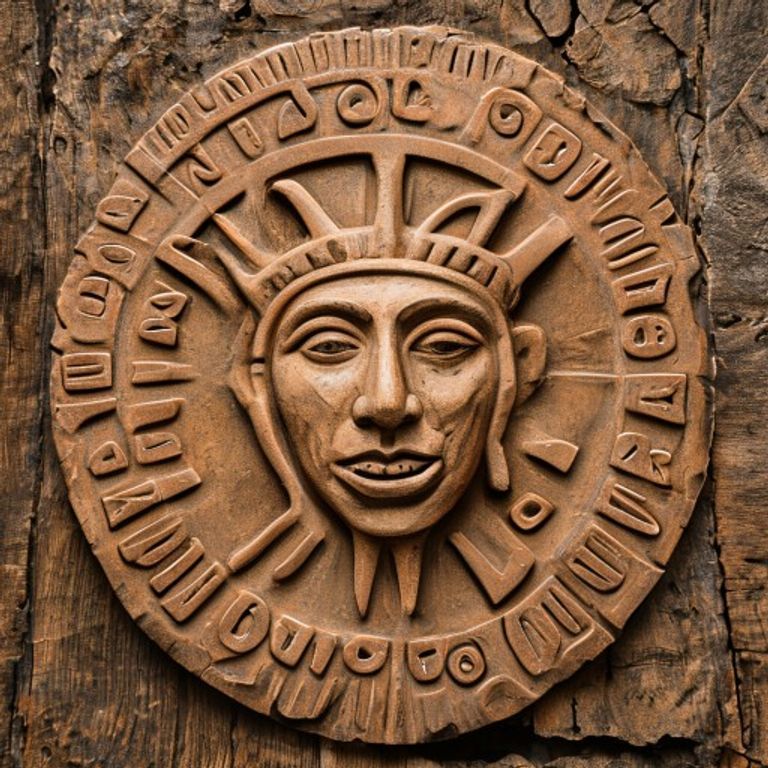
Wooden tablets found on Easter Island covered with pictographic symbols representing Polynesia's only native script, whose meaning and phonetics have been lost over time.
⚠️ Research elaborated with the aid of Deep Research is subject to referential ambiguity.
🖥️Clean HTML code using a proprietary tool.
👥 Research by Guilherme Felipe, Curation by Sílvio Lôbo
The Enigma of the Rongorongo Script: A Mystery That Defies Time
As an investigative journalist with years dedicated to unveiling the veil of oblivion over unsolved cases, the Case of the Rongorongo Script presents itself as one of the most intriguing and frustrating. It is not a crime of passion or a common disappearance, but a linguistic and cultural enigma that echoes from immemorial times, shrouded in a silence that defies decipherment.
1. The Context and the Incident: Where, When, and How the Mystery Began
The mystery of Rongorongo is intrinsically linked to Easter Island (Rapa Nui), an isolated Chilean island territory in the Pacific Ocean. The Rapa Nui civilization, known for its monumental stone statues (moai), developed, in its cultural peak, a unique writing system that remains undeciphered to this day. The artifacts bearing this script are called rongorongo tablets, or simply rongorongo.
The "incident" that gave rise to this mystery is not a singular event, but the very existence and subsequent disappearance of the knowledge to read and write rongorongo. The first Europeans to arrive on the island, starting in the 18th century, found a society where writing existed, but where few, if any, understood its meaning. Accounts from explorers like Jacob Roggeveen in 1722 mention the existence of tablets with strange inscriptions, but systematic exploration and decipherment attempts would begin much later.
The true "beginning" of the investigation into rongorongo as a mystery to be solved, from a Western perspective, can be traced back to the 19th century, with the arrival of missionaries and researchers who encountered the remnants of this script. The difficulty in finding native speakers capable of interpreting the tablets, coupled with the degradation and loss of many artifacts due to internal conflicts, visits from foreign ships (some with predatory intentions), and the ravages of time, turned the decipherment attempt into a race against time and entropy.
2. Timeline of Events
- 13th-16th Century (Estimated): Period of flourishing Rapa Nui culture, during which the rongorongo writing system was developed and used.
- 1722: Dutch explorer Jacob Roggeveen is the first European to land on Easter Island, observing the existence of "tablets with curious signs."
- Mid-19th Century: Missionaries and travelers, such as Father Eugène Eyraud, record the presence of many wooden tablets with the mysterious script. Eyraud describes rongorongo as a type of writing but laments the loss of knowledge about its reading.
- Late 19th - Early 20th Century: Most of the original tablets are lost or taken to museums and private collections around the world. The knowledge of the script seems to have become almost completely extinct among the natives.
- 1920s-1930s: Scientific expeditions, such as the one led by Katherine Routledge, attempt to record as many inscriptions as possible and gather information about Rapa Nui culture, including rongorongo.
- Mid-20th Century - Present: Various linguists, anthropologists, and cryptographers have dedicated themselves to deciphering rongorongo, proposing various theories, but without established consensus. The number of artifacts with rongorongo is estimated at around 25 units.
3. The Main Theories
The absence of a "Rosetta Stone" for rongorongo opens a spectrum of speculation, from the most academic to the most fanciful. It is crucial to separate what is based on observable evidence from what is mere conjecture.
3.1. Scientific and Academic Theories (Based on Linguistic and Anthropological Analysis)
- Logosyllabic or Glottic Script: This is the most accepted hypothesis among academics. It suggests that rongorongo may be a mixed system, where symbols represent both entire words (logograms) and syllables (syllabograms). The analysis of the frequency of repetition of certain glyphs and the structure of the inscriptions support this idea. Researchers like Bernard B. G. and E. K. explore this line.
- Counting System or Ritualistic Calendar: Some tablets exhibit patterns that may indicate a use for recording agricultural cycles, lunar calendars, or rituals. However, this theory alone does not explain the complexity of most inscriptions.
- Mnemonic or Genealogical System: Another hypothesis suggests that rongorongo was not a complete writing system in the Western sense, but an aid to memory, used to record genealogies, myths, and important stories, which were then recited by elders.
- External Origin or Influence: Some scholars speculate about the possibility that rongorongo was introduced to the island by peoples from other regions, perhaps through ancient migrations. However, the uniqueness of the script and the lack of direct parallels make this theory less likely.
3.2. Alternative, Conspiracy, or Paranormal Theories (Pure Speculation)
- Extraterrestrial Origin: Given the grandeur of other Rapa Nui achievements, such as the moai, some ufology enthusiasts suggest that rongorongo may have been a gift or legacy from extraterrestrial civilizations, given its complexity and the lack of apparent linear development.
- Atlantean Script or from a Lost Civilization: A variation of ancient advanced civilization theories, which attributes the origin of rongorongo to lost continents like Atlantis or Lemuria, whose remnants would have influenced Rapa Nui culture.
- Esoteric or Magical Messages: Given the ritualistic nature of Rapa Nui culture, some theories suggest that rongorongo contained hidden messages for spiritual, mystical, or divinatory purposes, inaccessible to common understanding.
It is imperative to emphasize that non-scientific theories lack any empirical or methodological basis and fall more into the realm of fiction and speculation than rigorous investigation.
4. Controversies and Blind Spots
The "Case of the Rongorongo Script" is rife with controversies and blind spots that hinder its resolution:
- Irreparable Loss of Artifacts: The biggest obstacle is the massive loss of tablets. It is estimated that there were hundreds, perhaps thousands, of rongorongo artifacts on the island. What remains is only a fraction, often damaged and without precise archaeological context.
- Contradictory Testimonies and Forgetfulness: The accounts of the first European contacts are often vague and, at times, contradictory. The rapid extinction of knowledge about reading the script left the natives unable to transmit the key to decipherment.
- Lack of Linguistic Parallels: Rongorongo does not resemble any other known writing system in Polynesia or elsewhere in the world, making comparison and the search for similarities a challenge.
- Ideological Interpretations: Some researchers have been accused of imposing their own views and cultural biases in their attempts at decipherment, trying to mold rongorongo into already known writing systems.
- Missing or Poorly Documented Evidence: It is believed that some valuable tablets and information were lost during turbulent ship visits, looting, and neglect over the centuries. Initial documentation was not always exhaustive or accurate.
5. Curiosities and Legacy
The legacy of rongorongo transcends mere linguistic curiosity. It has become a symbol of the genius and mystery of an isolated civilization, a reminder of the fragility of knowledge and the importance of cultural preservation.
- The "Myth" of Decipherment: The promise of deciphering rongorongo has been a lure for academics and enthusiasts for generations, with countless attempts and claims of success that have never achieved consensus.
- Cultural Impact: Rongorongo has inspired works of art, literature, and is a central element in the cultural identity of contemporary Rapa Nui, even though its reading has been lost.
- Current Status: The case has not been "reopened" in the sense of a criminal investigation, as there is no crime to solve. However, academic and archaeological research continues. Rongorongo remains one of the great unsolved enigmas of global linguistics and archaeology. The existing tablets are scattered in museums and collections, and the challenge of decipherment persists, keeping alive the mystery of a script that speaks of a silent past.
The Case of the Rongorongo Script is, in its essence, an invitation to reflect on the limits of our knowledge and the depth of the mysteries that history can hold, whispering through wooden symbols, waiting for someone who can finally hear its voice.



