


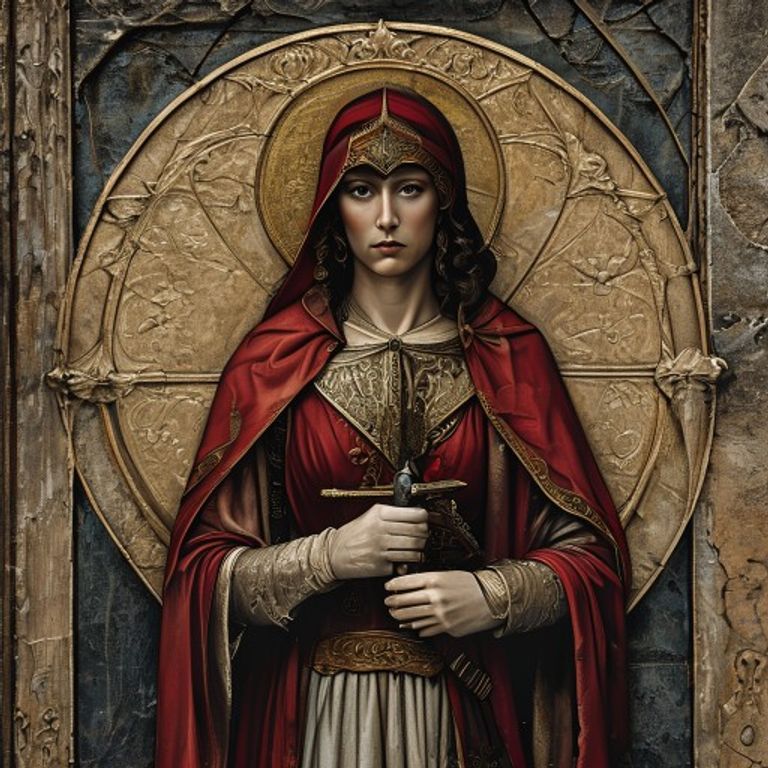
An ancient medieval sword from the twelfth century is veritably embedded in a solid rock inside a chapel in Tuscany, perfectly mirroring the famous legend of King Arthur.
⚠️ Research elaborated with the aid of Deep Research is subject to referential ambiguity.
🖥️Clean HTML code using a proprietary tool.
👥 Research by Guilherme Felipe, Curation by Sílvio Lôbo
The Mystery of the Sword in the Stone: Unraveling the Case of San Galgano
In a Tuscan landscape dotted with vineyards and golden hills, lies an age-old enigma that transcends mere archaeology. The story of the Sword in the Stone of San Galgano, firmly embedded in a rock in the heart of the abandoned Montesiepi Abbey, defies simple explanations and continues to fuel the fascination of historians, skeptics, and mystics. This article investigates the origin, theories, and controversies surrounding this unique artifact, seeking to separate fact from legend with the rigor of an experienced investigative journalist.
What might be a simple religious relic has become one of Italy's most intriguing historical mysteries, attracting visitors and researchers in search of answers that the stone and the sword, in their eloquent silence, seem reluctant to offer.
1. The Context and the Incident: Where, When, and How the Mystery Began
The epicenter of this mystery is the Abbey of San Galgano, located near Chiusdino, in the Tuscany region of Italy. The abbey, built between the 12th and 13th centuries, is an impressive testament to Cistercian architecture, but it is its annex, the Chapel of Montesiepi, that houses the true enigma.
The story dates back to 1180, the year of the death of Galgano Guidotti, a local knight who, according to tradition, decided to abandon his life of luxury and conflict to become a hermit. Legend narrates that, in a moment of spiritual epiphany, Galgano thrust his sword into a stone on Montesiepi hill, symbolizing his renunciation of violence and his pursuit of an ascetic life. It is believed that the sword miraculously fused with the rock, becoming impossible to remove.
After Galgano's death, the rock with the sword became a pilgrimage site. Centuries later, the impressive Abbey of San Galgano was built nearby, dedicated to the saint. The Chapel of Montesiepi, however, kept the sword as its main focus, encased in glass for its preservation and display.
2. Timeline of Events
Reconstructing the exact timeline of such an ancient event, steeped in oral tradition and hagiography, presents its challenges. However, the main milestones are generally accepted:
- 12th Century: Galgano Guidotti lives a secular life and, in 1180, abdicates it, thrusting his sword into a stone at Montesiepi.
- Late 12th - Early 13th Century: The rock with the sword becomes a site of veneration, attracting devotees.
- 13th Century: Construction begins on the grand Abbey of San Galgano nearby to honor the saint.
- Subsequent Centuries: Devotion to Saint Galgano and fascination with the sword in the stone continue to grow.
- Recent Decades: The mystery of the sword attracts renewed attention, with scientific investigations and analyses attempting to decipher the artifact's nature.
3. Main Theories: A Mosaic of Explanations
The inexplicable nature of the sword embedded in rock has given rise to a myriad of theories, ranging from the most pragmatic to the most fantastical.
3.1. Scientific and Archaeological Hypotheses
- Metallurgical Analysis: Expert analyses conducted over the years, including carbon dating and metal tests, suggest that the sword dates back to the 12th century, aligning with the era of Saint Galgano. The metallurgy of the blade, a type of iron with few impurities, is consistent with the technology of the time. The analysis also attempted to determine the method of fixation, but the thickness of the blade in the rock and the presence of patina and deterioration make definitive conclusions difficult.
- Geological and Structural Engineering: One hypothesis suggests that the rock in which the sword is embedded is not a solid rock but rather a more complex structure or a pre-prepared and placed stone block. The rock may have a natural or artificial cavity into which the blade was inserted and cemented in some way, or even forged with a binding material that mixed with the stone over time. The possibility that the rock was sculpted to accommodate the sword is also not ruled out.
- Symbolism and Interpretation: Some academics argue that the story may have a strong symbolic component. The embedded sword could represent spiritual victory over worldly temptations, or a covenant with God. The difficulty in removing the sword would be a metaphor for the depth of Galgano's commitment.
3.2. Alternative and Paranormal Theories
- Miracle and Divine Intervention: For many faithful, the simplest and most profound explanation is divine intervention. They believe that God, in response to Galgano's devotion, performed a miracle, fusing the sword to the rock as a sign. This is the traditional hagiographic interpretation.
- Arthurian Connections: Given the similarity to the legend of King Arthur's Sword in the Stone, some theories speculate about possible influences or shared narratives. However, the dating of Galgano's death precedes the best-known versions of the Arthurian legends in English.
- Unknown or Paranormal Forces: On a more mystical spectrum, some suggest the influence of inexplicable energies, dimensional portals, or even the intervention of non-human entities that could have manipulated the rock and the sword. These theories lack concrete scientific evidence.
4. Controversies and Blind Spots
Despite numerous analyses, the case of the Sword of San Galgano presents gaps and points of contention:
- Lack of Detailed Official Reports: While some metallurgical analyses have been conducted, detailed public reports with definitive conclusions on the method of the sword's fixation are scarce or difficult to access. Documentation of older expert reports may be lost or disorganized in historical archives.
- The Nature of the Rock: The exact composition and structural integrity of the rock are still subjects of debate. The difficulty in conducting deep excavations or tomographies of the rock for preservation reasons limits knowledge about what might lie beneath the visible surface.
- Testimonies and Historiography: The hagiography of Saint Galgano, written centuries after his death, is the primary source of the narrative. The distinction between historical facts and legendary elements is tenuous, making it difficult to separate truth from devotion. The absence of direct eyewitness accounts of the moment Galgano thrust the sword contributes to the aura of mystery.
- The Blade and the Hilt: The sword itself, although dated, still presents elements that could be further explored. The exact origin of the metal, the forging technique, and the details of the hilt, which is largely hidden, could provide additional clues.
5. Curiosities and Legacy
The legacy of the Sword of San Galgano transcends its religious and historical origins, exerting a significant cultural impact:
- Tourist and Spiritual Icon: The Abbey and the Chapel of Montesiepi attract thousands of visitors annually, both for their historical and architectural value and for the curiosity surrounding the sword. It is a place of deep spiritual significance for many pilgrims.
- Artistic and Literary Inspiration: The story of the sword in the stone has inspired countless works of art, music, poems, and tales over the centuries, solidifying its place in the popular imagination.
- Symbol of Renunciation and Spirituality: Beyond the physical mystery, the sword represents a powerful symbol of renunciation of worldly pleasures and the pursuit of a spiritual path. The force with which it is embedded in the stone echoes the depth of Galgano's decision.
- Current Status: The case remains officially unresolved in terms of a fully proven and accepted explanation. The sword continues to be displayed in the Chapel of Montesiepi, protected and venerated, a silent enigma amidst the beauty of Tuscany. There are no active police investigations, but academic and popular curiosity persists, fueling new analyses and speculations, keeping the mystery alive for future generations.
The Sword of San Galgano, with its blade embedded in unyielding rock, remains a portal to the past, an invitation to reflection, and an enduring testament that not all of humanity's mysteries can be fully unraveled by logic and science, leaving room for faith, fascination, and the eternal search for answers.



