


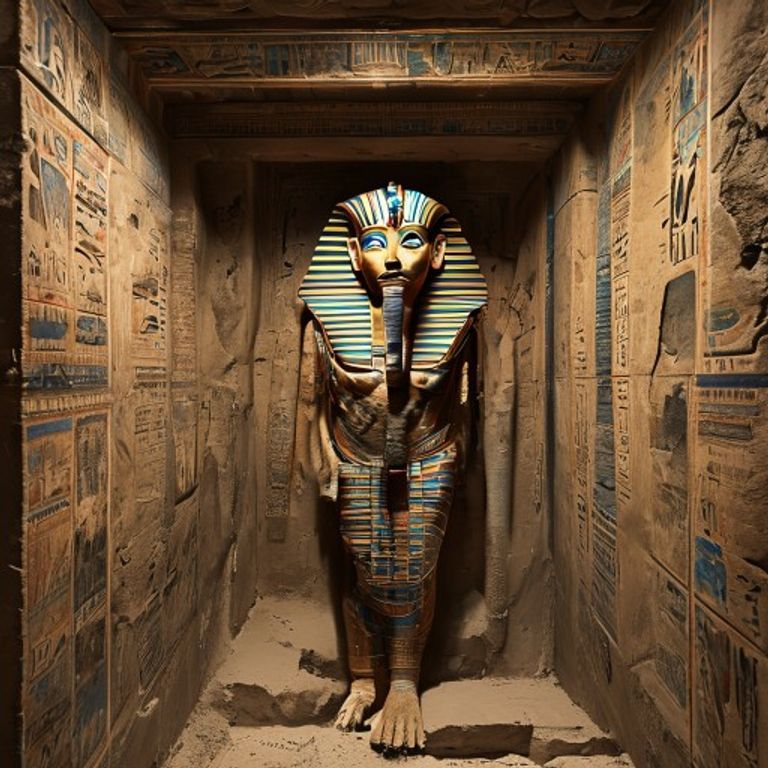
The Mystery of Tutankhamun's Tomb: A Curse or Historical Convenience?
The Valley of the Kings in Egypt, an arid desert dotted with ancient tombs, holds secrets that defy time and reason. Among them, the case of the discovery of the tomb of the young pharaoh Tutankhamun in 1922 is not just an archaeological milestone but also fertile ground for speculation and conspiracy theories that persist to this day. What should have been a triumph of science turned into a stage for misfortune, fueling the legend of the "Curse of Tutankhamun." But beyond popular fascination, what are the facts and shadows that loom over this story?
1. The Context and the Incident: The Awakening of a Sleeping Pharaoh
The discovery of the intact tomb of Tutankhamun (KV62) by British archaeologist Howard Carter, funded by Lord Carnarvon, was a monumental event. Located in the Valley of the Kings, near Luxor, the tomb was surprisingly well-preserved after more than three millennia. The entrance, sealed and hidden by layers of debris from neighboring tombs, had remained untouched since its closure, around 1323 BC.
The "incident" that initiated the mystery was not the discovery itself, but rather the series of unusual and seemingly inexplicable deaths that followed, involving individuals directly or indirectly linked to the expedition. This sinister coincidence quickly fueled the narrative of an ancient curse, cast to protect the pharaoh's eternal sleep.
2. Timeline of Events: The Shadow of Death
The crucial timeline for the "Case of Tutankhamun's Tomb" spans the years following the opening of the tomb:
- November 1922: Howard Carter and his team discover the sealed entrance to Tutankhamun's tomb.
- February 1923: The burial chamber is opened, revealing the pharaoh's sarcophagus.
- April 1923: Lord Carnarvon, the expedition's main financier, dies in Cairo. The official cause was a generalized infection after being bitten by a mosquito and scratching the wound.
- 1923-1930: Several other deaths of individuals connected to the tomb occur. Among them, notable cases include:
- George Jay Gould I, one of the tomb's visitors, dies of pneumonia in 1923.
- Arthur Mace, a key member of Carter's team, dies in 1928 from an unspecified illness.
- Richard Bethell, Carter's secretary, dies in 1929 after a period of illness.
- 1930: Howard Carter, the discoverer, passes away peacefully in his sleep at the age of 56 in London, due to lymphoma.
3. Main Theories: From Science to the Supernatural
The mystery of Tutankhamun's tomb has given rise to a myriad of theories, ranging from scientific rigor to pure fantasy:
Scientific and Forensic Theories (Most Likely):
- Bacterial or Fungal Contamination: The tomb, sealed for millennia, may have harbored spores of pathogenic fungi or bacteria. Inhaling these agents in a closed, poorly ventilated environment could have led to respiratory infections and other health complications in more susceptible individuals. Reports from research on toxic mold in ancient Egyptian structures support this hypothesis.
- Pre-existing Conditions and Coincidence: The individuals who died after the discovery were mostly elderly or had pre-existing health problems. Life in the early 20th century, with poor sanitation and limited access to modern medicine, made diseases like pneumonia and infections much more dangerous. The temporal proximity of the deaths would then be a tragic statistical coincidence.
- Exhaustion and Stress: Carter's team worked tirelessly under adverse conditions and the pressure of the discovery. Physical and psychological stress, combined with exposure to questionable hygiene conditions, could have weakened the immune systems of those involved, making them more vulnerable to illness.
Alternative, Conspiracy, or Paranormal Theories:
- The Pharaoh's Curse: The most popular theory. It is based on the belief that inscriptions or mystical energies were deliberately placed in the tomb to punish anyone who violated it. This narrative is widely fueled by the media and popular culture, transforming the case into a supernatural horror story.
- Human Interference or Sabotage: Some theories suggest that the deaths were not natural but the result of deliberate actions. However, concrete evidence to support this hypothesis is lacking, and the logistics of committing multiple murders in such a short period and in such a dispersed manner would be extremely complex.
- Unknown Telluric or Cosmic Energy: A more esoteric branch suggests that the opening of the tomb released some form of cosmic or telluric energy that negatively affected the health of those involved. This theory lacks any proven scientific basis.
4. Controversies and Blind Spots: The Gaps in the Investigation
Despite the scientific rigor that marked Carter's expedition, the "case" of the curse is marked by controversies and blind spots:
- Focus on the Curse: The media of the time, eager for sensationalism, gave disproportionate focus to the deaths, ignoring more rational explanations. This created a bias that hindered objective analysis of the facts.
- Absence of Formal Police Investigations: The deaths, although noted, were not, for the most part, the subject of rigorous police investigations. The official cause of Lord Carnarvon's death, for example, was based on a medical diagnosis of the time, which may have been influenced by the context of the "curse."
- Lost or Ignored Evidence: The nature of the discovery, in a pre-digital era, may have led to the loss or inadvertent disposal of potential evidence. The vast number of artifacts removed from the tomb also presents a logistical challenge in tracing any item that might have a connection to the "curse."
- Lack of Clear Communication: Communication between Howard Carter and the Egyptian authorities, as well as the press, was not always clear, allowing rumors and speculation to flourish.
5. Curiosities and Legacy: The Pharaoh Who Haunts the Imagination
The cultural impact of the "Case of Tutankhamun's Tomb" is undeniable. The "Curse of Tutankhamun" has become a popular trope in films, books, and other media, fueling a lasting fascination with Ancient Egypt and its mysteries.
Current Status: The case, as a formal "investigation," has been shelved for decades. There has been no official reopening of investigations. However, the discussion about the causes of death and the validity of the "curse" continues in academic circles and among mystery enthusiasts.
Tutankhamun's tomb, now one of Egypt's most visited tourist attractions, remains a silent testament to a bygone era. While science continues to unravel the secrets of mummification and Egyptian civilization, the mystery surrounding the young pharaoh's "curse" persists, a reminder of the power that narratives, especially those shrouded in mystery and death, hold over the human imagination.



