


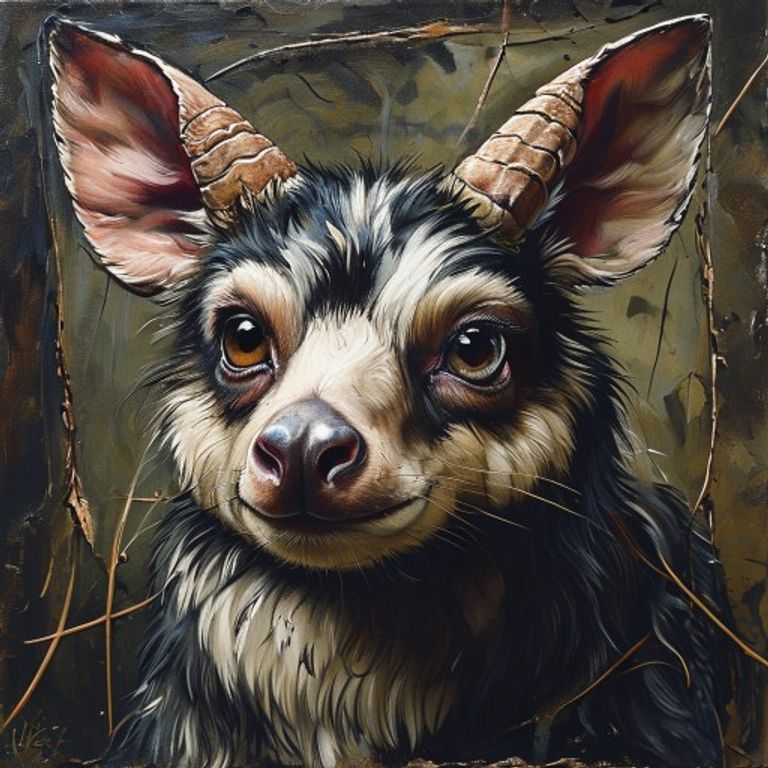
Hundreds of rural animals have been found dead in the Americas with puncture wounds in their necks and inexplicably drained of their blood.
⚠️ Research conducted with the aid of Deep Research is subject to referential ambiguity.
🖥️Clean HTML code using a proprietary tool.
👥 Research by Guilherme Felipe, Curation by Sílvio Lôbo
The Mystery That Bites: Deciphering the Chupacabra Case
By [Your Senior Journalist Name], Specialist Researcher in Historical Mysteries
In Puerto Rico, 1995. A date and a place that, for many, have become synonymous with silent and inexplicable terror. It was in that year that the first reports of a mysterious creature, which attacked and sucked the blood of farm animals, began to echo, giving rise to the legendary Chupacabra. What began as isolated reports from desperate farmers evolved into a global cultural phenomenon, fueling popular imagination and challenging rational explanations. This article aims to dissect the case, separating myth from reality and searching for traces of truth in a tangle of fear, misinformation, and perhaps, something more sinister.
1. The Context and the Incident: The Beginning of the Panic
The narrative of the Chupacabra emerged at a time of uncertainty and cultural effervescence in Puerto Rico. The island, with its rural landscapes and rich tapestry of folklore, seemed the perfect stage for the emergence of a new urban legend. Initial reports described a being with reptilian or alien characteristics: glowing red eyes, spines on its back, and a bipedal form, with surprising agility and strength.
The attacks, primarily targeting goats, but also sheep, chickens, and other domestic animals, were marked by a peculiarity: the bodies were found without a drop of blood, with precise puncture wounds in the neck. This distinctive characteristic – the "blood-sucking" – gave the creature its name and raised the alarm in agricultural communities, which saw their livelihoods threatened by an unknown and relentless predator.
The dissemination of news, boosted by local media and later by the international press, contributed to the Chupacabra's rapid ascent into the pantheon of mysterious creatures. Fear spread, and with it, the search for answers.
2. Timeline of Events: A Trail of Enigmas
A chronological reconstruction of the events surrounding the Chupacabra is fundamental to understanding the case's evolution:
- August 1995: The first reports of unusual attacks on farm animals begin to emerge in the region of Canóvanas, Puerto Rico. Madelyne Tolentino, one of the first witnesses to describe the creature, reports having seen an unknown being.
- September to December 1995: Attacks multiply in various areas of Puerto Rico, causing panic among farmers. The description of the creature, with variations, begins to solidify.
- 1996: The phenomenon transcends Puerto Rico's borders, with similar reports emerging in Mexico, Central America, and eventually, the United States. International media begins to cover the case more intensely.
- Late 1990s: Several supposed "Chupacabra corpses" are found. Initial examinations of some of these specimens (usually wild animals with health problems) begin to suggest more earthly explanations.
- 2000s onwards: Public interest in the Chupacabra gradually wanes in Puerto Rico, but the myth solidifies in other regions, with new variants of the creature being described. Sporadic reports continue to emerge, keeping the legend alive.
3. Main Theories: In Search of Explanations
The Chupacabra case attracts a wide range of theories, varying from scientific and police explanations to alternative and paranormal hypotheses.
3.1. Scientific and Police Hypotheses (The Most Likely)
- Wild Dogs or Hybrids: This is perhaps the most accepted explanation by the scientific community and authorities. Animals like wild dogs, coyotes, or foxes, especially those suffering from severe sarcoptic mange, can present a disfigured appearance, with hair loss, thickened skin, and in some cases, unusual aggression. Mange can cause these animals to attack more frequently and in a disoriented manner, lacking the usual dexterity of a healthy predator. The puncture wounds in the neck can be attributed to the bites of these animals trying to immobilize their prey. The lack of blood would be explained by the natural blood loss of the attacked animal before death, or by decomposition.
- Wild Animals with Rare Diseases: Other degenerative diseases in wild animals can alter their appearance and behavior, leading to unusual attacks. The scarcity of sightings of typical predators in some areas could create an ecological vacuum that favors these sick animals.
- Mistakes and False Alarms: On some occasions, Chupacabra reports may have resulted from individuals seeing known animals in unusual conditions, or misinterpreting an isolated incident as part of a larger pattern. Fear and suggestion, amplified by the media, may have led to "seers" and "witnesses" of a phenomenon that did not exist in its described form.
3.2. Alternative, Conspiracy, or Paranormal Theories
- Genetic/Biological Experiments: A popular theory suggests that the Chupacabra could be the result of secret genetic experiments conducted by governments or corporations. The idea is that a creature created in a laboratory escaped and is causing the attacks. This hypothesis feeds on a general sense of distrust towards powerful institutions.
- Aliens or Extraterrestrial Creatures: The description by some witnesses evokes the image of extraterrestrial beings, leading to the theory that the Chupacabra would be a creature from another planet, perhaps used to collect biological samples or as part of an unknown plan.
- Unknown Cryptid Creatures: For proponents of cryptozoology, the Chupacabra represents an animal species not yet cataloged by science, inhabiting remote and unknown areas. This theory is based on the premise that the world still holds many biological secrets.
- Mutation or Accelerated Evolution: Some speculate that the Chupacabra would be the result of accelerated environmental mutations, perhaps caused by pollution or other anomalies.
It is crucial to note that while scientific explanations often rely on physical evidence and known natural processes, alternative and paranormal theories lack concrete proof and are sustained more by speculation and belief.
4. Controversies and Blind Spots: The Cracks in the Investigation
The investigation into the Chupacabra case, when it existed in formal terms, was marked by inconsistencies and blind spots that fueled the mystery:
- Lack of Pattern in Investigation: In many areas where attacks occurred, there was no centralized and rigorous police or scientific investigation. Reports were often treated as isolated incidents of wild animals, without further investigation to uncover a possible common pattern.
- Questionable Physical Evidence: Several supposed "Chupacabra corpses" presented to the media and researchers turned out, upon examination, to be common animals (dogs, coyotes, raccoons) affected by diseases or deformities. However, the way these "discoveries" were publicized and sometimes disappeared generated suspicion.
- Conflicting Testimonies: Descriptions of the creature varied considerably among witnesses, making it difficult to create a unified and reliable profile. Some descriptions were more humanoid, others more reptilian, and the physical dimensions and characteristics varied significantly.
- Superficial Official Reports: Although police authorities in Puerto Rico registered incidents of animal attacks, investigative reports considering the possibility of an unknown creature were rarely elaborated. The focus was generally on finding and neutralizing a known predator.
- The "Code of Silence": In some communities, fear and disbelief from authorities led to a certain "silence" among residents, who stopped reporting attacks for fear of being ridiculed or not taken seriously.
5. Curiosities and Legacy: The Shadow That Lingers
The cultural impact of the Chupacabra is undeniable. The creature has become an icon of popular culture, inspiring films, television series, books, video games, and countless articles on the internet. The legacy of the Chupacabra lies in its ability to capture the imagination, to make us question what lurks in the shadows and at the limits of scientific knowledge.
Although the initial frenzy has subsided, the Chupacabra case has not been officially reopened nor completely shelved. It remains in a fascinating limbo, a testament to the persistence of mystery in a world increasingly explained by science. New "sightings" and alleged attacks continue to emerge periodically in various parts of the world, keeping the flame of the enigma alive. The Chupacabra, in its most basic form, represents the unknown that inhabits our landscapes and, perhaps, our deepest fears.
The true nature of the Chupacabra may never be fully revealed. However, the investigation into its emergence and dissemination teaches us valuable lessons about human psychology, the power of media, and the eternal search for answers in the face of the inexplicable.



