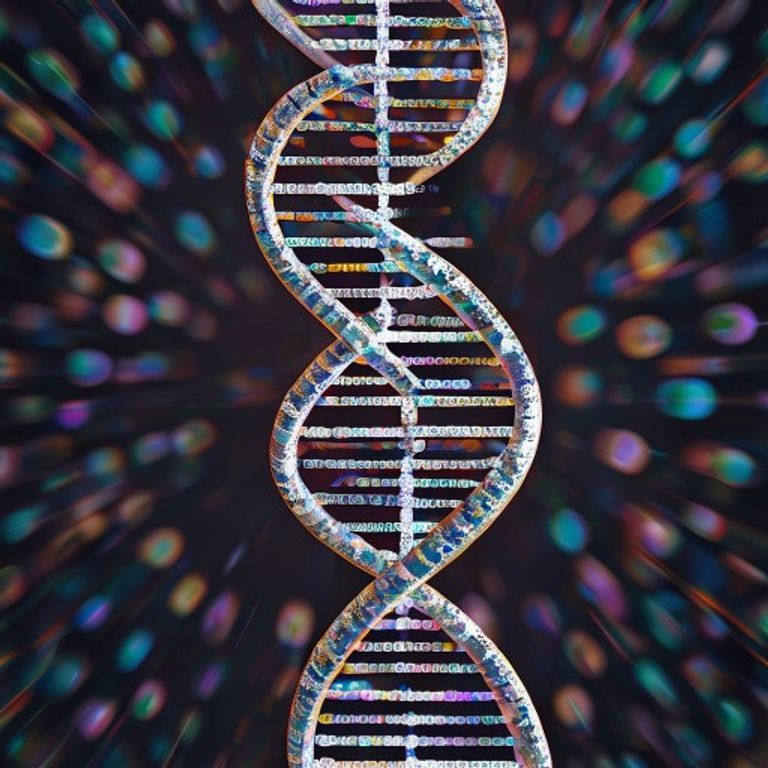
The discovery of the double helix by James Watson and Francis Crick in 1953, based on data from Rosalind Franklin, revolutionized modern biology and medicine.
⚠️ Research prepared with the aid of Deep Research is subject to referential ambiguity.
🖥️ Clean HTML code using a proprietary tool.
👥 Research by Guilherme Felipe, Curation by Sílvio Lôbo
The Double Helix Enigma: A Biological Mystery Yet to Be Fully Revealed
By [Your Senior Investigative Journalist Name]
In the intricate labyrinth of scientific history, few enigmas resonate with the persistence and intrigue of what we might call "The DNA Structure Case." It is not a crime of passion or a serial murder, but rather a mystery that resides in the very essence of life: the discovery of the three-dimensional structure of deoxyribonucleic acid. Although the conventional narrative points to a glorious scientific race, a deeper look, armed with analytical rigor and a healthy dose of skepticism, reveals gaps, controversies, and a fine line between proven fact and unsettling speculation.
1. The Context and the Incident: The Shadow Over the Light of Discovery
The stage for this enigma unfolded in the cutting-edge laboratories of the United Kingdom and the United States in the mid-20th century, a period of unprecedented scientific effervescence. The 1950s saw the scientific community in a frenzy, competing to unlock the secret of heredity. It was known that DNA contained genetic information, but its physical shape, the crucial link to understanding its function, remained elusive.
The "incident," if we can call the plot of discoveries, disputes, and sometimes secrets that, does not focus on a single event, but rather on a complex tangle of undeclared collaborations, access to crucial data, and the delayed (or incomplete) recognition of fundamental contributions. The light of this discovery, which should have illuminated the entire path, seems to have cast shadows over those whose hands were in the clay of truth before the spotlight arrived.
2. Timeline of Events: Turning Points and Shadows
The chronological reconstruction of this case is essential to unravel its layers of complexity:
- Early 1950s: Several laboratories, including those of Maurice Wilkins and Rosalind Franklin at King's College London and James Watson and Francis Crick at the University of Cambridge, worked intensely on elucidating the structure of DNA.
- 1951-1952: Rosalind Franklin, using X-ray diffraction techniques, obtains high-quality images of DNA, including the famous "Photo 51." These images contained crucial evidence for the double helix structure.
- February 1953: Reports indicate that Maurice Wilkins, Franklin's colleague, showed James Watson "Photo 51" without her knowledge or explicit consent. This image was fundamental for Watson and Crick to formulate their model.
- April 1953: Watson and Crick publish their historic article in the journal Nature, proposing the DNA double helix model. The article acknowledges the contributions of Wilkins and Franklin, but the weight of their own research, especially Franklin's, is considered by many to have been underestimated.
- October 1953: Rosalind Franklin leaves King's College and moves to Birkbeck College.
- 1962: The Nobel Prize in Physiology or Medicine is awarded to James Watson, Francis Crick, and Maurice Wilkins for the discovery of the DNA structure. Rosalind Franklin had already passed away in 1958 from ovarian cancer, making her ineligible for the prize, which is not awarded posthumously.
3. Main Theories: Deciphering the Motives
The analysis of this case leads us to explore several explanatory strands:
a) Scientific and Police Hypotheses (in analogy to the investigation):
- The Ignored Collaboration Theory: The most supported hypothesis is that Watson and Crick, driven by the urgency of the discovery, used crucial data obtained by Franklin (and, to a lesser extent, by Wilkins) without proper credit. The lack of communication and fierce competition may have led to an outcome where scientific truth was mixed with questionable information-gathering tactics. Watson's implicit "confession" in his book "The Double Helix" of having seen Photo 51 without permission reinforces this line.
- The Academic Competitiveness Theory: The scientific environment of the time was extremely competitive. The pursuit of prestige, funding, and recognition could have led to less ethical behaviors, where the line between inspiration and appropriation became thin. The pressure to "get there first" may have eclipsed scientific rigor and justice for collaborators.
b) Alternative, Conspiracy, or Paranormal Theories (and their logic):
- Intentional Sabotage Theory: A more speculative strand suggests there was a deliberate attempt to discredit or marginalize Rosalind Franklin. The logic behind this theory lies in the perception that she was a female scientist in a male-dominated field, and that her dissent or the very rigor of her work could have been seen as threatening. However, concrete evidence to corroborate active sabotage is lacking.
- External Connection Theory (Paranormal/Extraterrestrial - Speculation): In circles more inclined toward the esoteric, it is suggested that the structure of DNA, being so fundamental and complex, could have had an "insight" or external influence. The logic here is that human genius, on its own, would not be enough to unravel such a mystery. This theory, however, transcends the scientific scope and enters the realm of faith and speculation without empirical foundation.
4. Controversies and Blind Spots: Flaws in the Plot
The "DNA Structure Case" is punctuated by inconsistencies and clues deliberately (or accidentally) ignored:
- The Appropriation of "Photo 51": The display of Franklin's iconic X-ray diffraction image to Watson without her consent is the most critical point. Official King's College reports at the time do not document this permission. Wilkins' claim that Franklin was no longer actively working on the images and that he shared them in a context of mutual collaboration is contested by the timeline itself and subsequent publications.
- Access to Franklin's Data: Beyond Photo 51, there is the question of Watson and Crick's access to other raw data and analyses by Franklin, possibly through internal reports or informal conversations. The speed with which their model was proposed after this access raises suspicions about the independence of their research.
- Underestimation of Franklin's Work: Even in the 1953 articles, Franklin's contribution is presented secondarily. The recognition of her central role in providing the crucial experimental evidence only consolidated years later, with the testimony of her colleagues and the posthumous analysis of her laboratory notebooks.
- Conflicting Testimonies: The memories and interpretations of those involved, especially in retrospect, frequently diverge. Watson's autobiography, while valuable, is seen by some as self-indulgent and selective in its narrative.
- Lost or Misinterpreted Evidence: The lack of a centralized archive and rigorous protocols at the time may have led to the loss of documents or difficulty in corroborating certain allegations. The confidential nature of some research may also have obscured the process.
5. Curiosities and Legacy: DNA and the Shadow of the Past
The cultural impact of the "DNA Structure Case" is immense. The discovery itself revolutionized biology, medicine, and genetics, shaping the modern world. However, the mystery surrounding its discovery cast a shadow over the heroic narrative, raising questions about scientific ethics, collaboration, and fair recognition of the work of all involved.
The case serves as a constant reminder that science, however objective it claims to be, is a human endeavor, subject to flaws, passions, and pressures. The figure of Rosalind Franklin, initially marginalized, has emerged as a symbol of the fight for recognition and the importance of giving credit to pioneers, especially women in science.
Currently, the "DNA Structure Case" has not been reopened in terms of a formal police investigation, but it remains a subject of intense academic and historiographical debate. Declassified reports, biographies, and new archival analyses continue to shed light on the events. The lesson is clear: the search for scientific truth must be accompanied by integrity, transparency, and respect for all who contributed to unraveling it. The double helix is a legacy, but the way we arrived at it still holds its secrets.