


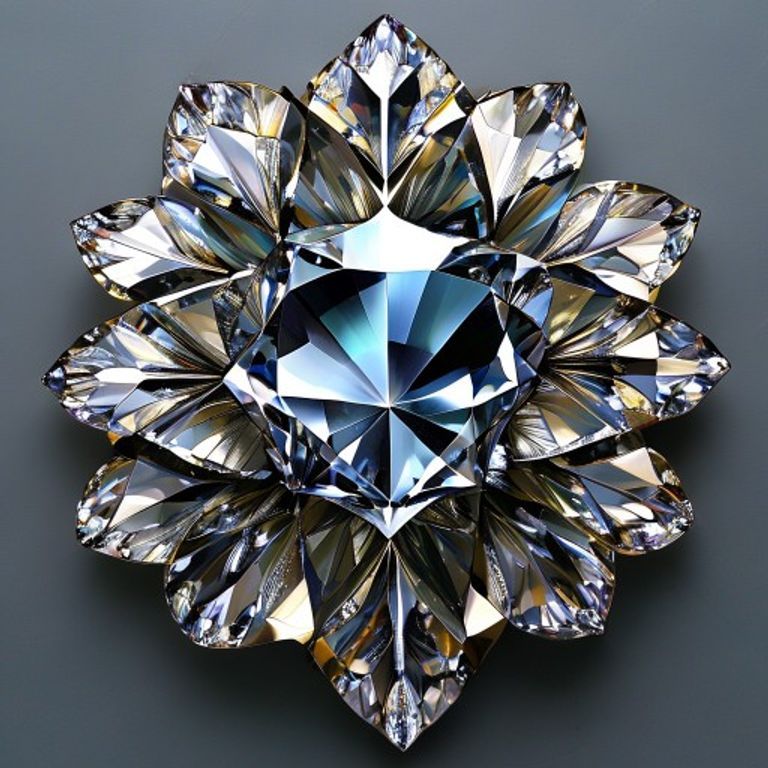
A legendary blue gem of inestimable value supposedly carries an ancient and fatal curse that brings bankruptcy, tragedy, and death to almost all its owners.
⚠️ Research elaborated with the aid of Deep Research is subject to referential ambiguity.
🖥️Clean HTML code using a proprietary tool.
👥 Research by Guilherme Felipe, Curation by Sílvio Lôbo
The Enigma of the Hope Diamond: A Cursed Jewel or a Saga of Crime and Mystery?
The Hope Diamond, a gem of deep and mesmerizing blue, transcends mere material beauty. Its history is punctuated by accounts of misfortune, audacious thefts, and mysteries that defy time. As an investigative journalist with decades of experience in unraveling enigmas, I have delved into the depths of this legendary case, separating the factual from the fanciful to shed light on the complex tapestry of truths and speculations surrounding this unique jewel.
1. The Context and the Incident: Where, When, and How the Mystery Began
The starting point of the Hope Diamond's saga, or at least its modern notoriety, can be traced back to the 17th century. The exact origin of the stone is shrouded in obscurity, but the most accepted narrative links it to a larger, rougher diamond known as the French Blue Diamond, or simply the Blue Diamond of the Crown. This diamond, according to reports, was acquired in India by the French explorer Jean-Baptiste Tavernier in the mid-17th century.
Tavernier, a renowned jewel merchant, described the stone in his writings, indicating its impressive size and an intense, rare, and coveted blue color. It is believed that the diamond arrived in France and eventually adorned the court of King Louis XIV. It was there that its aura of magnificence began to be tinged with whispers of something darker. The crown, and the diamond itself, were stolen during the French Revolution in 1792, disappearing from the royal treasury without clear traces.
It is here that the mystery deepens: the diamond that reappeared years later, known as the Hope Diamond, possessed similar characteristics but was significantly smaller. The prevailing theory is that the original diamond was illegally cut to disguise its theft and sell the parts separately. The "incident" that marks the beginning of the modern enigma, therefore, is the theft and subsequent disappearance and reappearance (in altered form) of one of history's most precious jewels.
2. Timeline of Events
- c. 1666-1668: Jean-Baptiste Tavernier acquires a large blue diamond in India, later known as the French Blue.
- 1678: The diamond is sold to King Louis XIV, who has it recut and names it the Blue Diamond of the Crown.
- 1792: The Blue Diamond of the Crown and other French crown jewels are stolen during the French Revolution. The whereabouts of the original diamond become unknown.
- c. 1812: A 44.5-carat blue diamond, with characteristics very similar to the French Blue, appears in London in the possession of a jewel merchant. This is believed to be the Hope Diamond, possibly recut.
- 1824: The diamond is acquired by Henry Philip Hope, a banker and art collector, from whom the jewel will eventually inherit its name.
- 1839: The diamond is listed in the catalog of Henry Philip Hope's collection.
- 1901: The Hope Diamond is sold to Pierre Cartier, the renowned jeweler.
- 1910: Pierre Cartier sells the diamond to Evalyn Walsh McLean, an American socialite. It is under McLean's possession that the diamond's "curse" gains greater notoriety.
- 1949: After Evalyn Walsh McLean's death, the Hope Diamond is acquired by jeweler Harry Winston.
- 1958: Harry Winston donates the diamond to the Smithsonian National Museum of Natural History in Washington, D.C., where it remains to this day.
3. Main Theories
The mystery of the Hope Diamond unfolds in several layers of theories, from rational and investigative explanations to narratives bordering on the paranormal.
3.1. Crime and Investigative Theories (Most Likely)
- Theft and Recutting: This is the most accepted theory by the gemological and historical community. The version holds that the original French Blue was indeed stolen and subsequently recut to hide its origin and facilitate its sale. The Hope Diamond would be the result of this adulteration process. The reduction in size and slight difference in facets would be evidence of this cutting. The difficulty lies in unequivocally proving the link between the two stones, given the lack of detailed documentation of the original French Blue's cut and the possible destruction of evidence.
- Fraud or Exchange: A variation of the previous theory suggests that the diamond that reappeared might not be a legitimate part of the original, but rather a similar stone that was falsified or exchanged at some uncertain point in history. The complexity of the transactions and the lack of reliable records open up this possibility.
3.2. Alternative and Conspiracy Theories
- The French Crown's Cover-up: Some theories suggest that the French monarchy itself, or elements within it, might have orchestrated the "theft" to sell the diamond in times of financial crisis, creating the narrative of a theft to justify its absence.
- Involvement of Malicious Jewelers: The idea that unscrupulous jewelers, perhaps Tavernier himself or individuals associated with him, might have subtracted a portion of the diamond or recut it for their own financial gain is a circulating hypothesis.
3.3. Paranormal and Curse Theories
- The Jewel's Curse: This is undoubtedly the most popular and culturally widespread theory. The belief that the Hope Diamond carries a curse dates back to accounts of the bad luck that befell its owners: Louis XIV and Marie Antoinette (who, although she did not directly own the stone, is linked to it by the era and the theft), followed by a long list of misfortunes for subsequent owners, including bankruptcies, divorces, tragic deaths, and accidents. The logic behind this theory is the observation of an apparent correlation between possession of the diamond and negative events. However, this correlation can be explained by confirmation bias and the often turbulent nature of the lives of wealthy and famous people, who attract media attention.
- Supernatural Origin: Some more fanciful accounts suggest that the stone was extracted from a sacred temple in India, and that its deep beauty and unusual color are the result of forces beyond geology, thus attracting negative energies or entities.
4. Controversies and Blind Spots
The investigation of the Hope Diamond is marked by significant gaps and inconsistencies that fuel the mystery.
- Lack of Detailed Documentation: The absence of precise records about the French Blue, especially regarding its cuts and facets, makes comparison with the Hope Diamond difficult. The French Revolution, with its chaos and destruction of archives, contributed to this gap.
- Conflicting Testimonies: Over the centuries, different accounts have emerged about the diamond's origin and fate. The lack of physical evidence to support all these narratives leads to a tangle of contradictory information.
- The "Disappearance" and Reappearance: The period between the theft of the French Blue and the emergence of the Hope Diamond is a vast blind spot. There are no reliable official records detailing how the diamond was recovered (or recut) and who its possessors were during this time lapse.
- The "Curse": Although there are numerous cases of bad luck associated with its owners, science and expertise have not found any physical property in the diamond that could be linked to a curse. The most plausible explanation, under analytical scrutiny, is confirmation bias and human tendencies to attribute causality to correlated events.
- Insufficient Expertise (At the Time): Gemological expertise in earlier eras was less advanced than today. The possibility that subtle discrepancies in crystalline structure or isotopic composition could have been useful in linking the two stones, but were not detected, is real.
5. Curiosities and Legacy
The Hope Diamond has transcended its status as a jewel to become a cultural icon, a symbol of mystery and fascination.
- Cultural Impact: The narrative of the Hope Diamond's "curse" has inspired books, films, and various works of fiction. It has become an archetype of the jewel that brings both fortune and misfortune in equal measure.
- Exhibition at the Smithsonian: Harry Winston's decision to donate the diamond to the Smithsonian in 1958 was an act of generosity that ensured its preservation and public access. The jewel is one of the museum's most visited attractions.
- Modern Scientific Analysis: In recent times, the diamond has undergone rigorous scientific analysis. Modern studies have confirmed its chemical composition, probable origin (from a specific mine in India), and its characteristic phosphorescent luminescence (a blue color that emits a reddish glow in the dark, a rare characteristic). These analyses, however, do not provide concrete evidence of a "curse" but reinforce its geological uniqueness.
- Current Status: The Hope Diamond is firmly established at the Smithsonian National Museum of Natural History in Washington, D.C. The case has not been "reopened" in the sense of a criminal investigation, as the current focus is on its preservation and scientific study. However, the mystery of its origin and the legends surrounding it remain a fascinating historical enigma.
The Hope Diamond continues to shine, not only with its intrinsic beauty but with the aura of mystery that surrounds it. Its secrets, buried in centuries of turbulent history and speculation, ensure that it will remain one of the most captivating enigmas in the world of jewels and history.



