


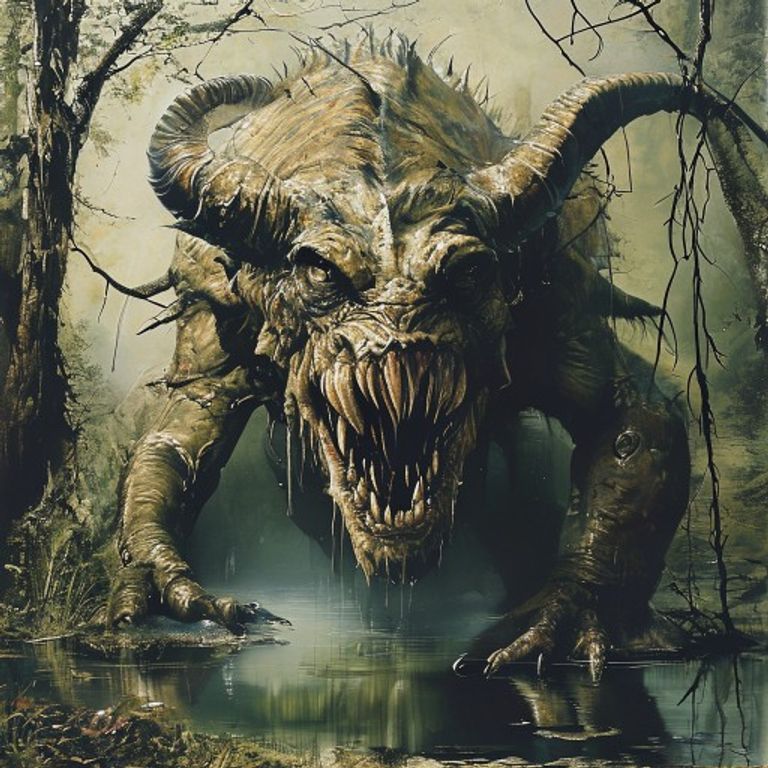
Numerous sightings and controversial photographs fuel the legend of a prehistoric creature living in the deep waters of Scotland.
⚠️ Research elaborated with the aid of Deep Research is subject to referential ambiguity.
🖥️Clean HTML code using a proprietary tool.
👥 Research by Guilherme Felipe, Curation by Sílvio Lôbo
The Loch Ness Enigma: A Dive into the Depths of an Unending Mystery
For decades, the dark and icy waters of Loch Ness, Scotland, have been the stage for one of the most persistent mysteries of the 20th and 21st centuries: that of the legendary "Loch Ness Monster," or "Nessie." What began as a handful of isolated sightings, fueled by ancient folklore, exploded into a global phenomenon after an incident that, even 90 years later, defies definitive explanations. As an investigative journalist with a fascination for what eludes easy answers, we dive into the depths of this enigma, separating fact from fiction, evidence from speculation, and truths hidden by the Scottish mists.
1. The Context and the Incident: The Awakening of a Legend
The modern history of the Loch Ness Monster didn't begin with a scientific discovery, but rather with a singular event. The Loch Ness region, with its dramatic landscape and immense body of water – about 37 kilometers long and reaching depths of up to 230 meters – has always been fertile ground for local legends about aquatic creatures. However, the monster's international notoriety gained momentum on April 23, 1933.
On that day, Aldie Mackay, wife of the Drumnadrochit Hotel manager, reported seeing a "huge and strange" creature crossing the road in front of the lake, near Foyers. Her description was of a large, long body with a long neck, moving in a "undulating" manner. The news was published in the local newspaper Inverness Courier, with editor Evan Barron coining the term "Loch Ness Monster." This account, more than any previous one, lit the fuse of a media firestorm that would transform a folktale into a global enigma.
2. Timeline of Key Events
The saga of the Loch Ness Monster is punctuated by a series of sightings, expeditions, and controversies:
- 6th Century: The first record commonly associated with an aquatic creature in Loch Ness dates back to the Life of Saint Columba, written by Adomnán. It describes Saint Columba driving away an "aquatic beast" that had attacked a man.
- 1933: The crucial year. Following Aldie Mackay's sighting, other reports emerged, including those of George Spicer and his wife, who claimed to have seen a creature with a long neck emerging from the water and crossing the road.
- 1934: The publication of the famous "Surgeon's Photograph," credited to Dr. Robert Kenneth Wilson, a London surgeon. The image shows a neck and head emerging from the water, becoming the iconic image of the monster.
- 1950s-1970s: A period of great investigative fervor. Several expeditions were organized, using sonar and underwater equipment. One of the most notable was the use of sonar by the Daily Mail team in 1960, which claimed to have detected a large, moving creature.
- 1972: The expedition of R. Gordon Cooper, a former NASA astronaut, using sonar and underwater cameras. The results were inconclusive.
- 1975: The expedition led by the Academy of Applied Science, which produced ambiguous underwater images of a shape that some interpreted as a fin.
- 1987: "Operation Deepscan," one of the largest lake-scanning attempts, involving 20 sonar-equipped boats. The operation detected several unusual "contacts," but none conclusive about a specific creature.
- 1994: The shocking admission that the 1934 "Surgeon's Photograph" was a hoax. Photographer Christian Spurling confessed on his deathbed that the photo was a trick set up by him, photographer Marmaduke Wetherell (who had been ridiculed after finding fake "footprints" of a crocodile), and a friend, using a toy submarine with a wooden neck and head.
- 2003: The BBC conducted a major expedition with over 600 "observers" and advanced equipment, including high-definition sonar. The research found no evidence of unknown creatures.
- 2018: A comprehensive genetic study conducted by the University of Otago, New Zealand, which analyzed DNA samples from the lake's water. The study found no traces of DNA from large reptiles (like plesiosaurs) or unknown fish, but did find a significant amount of eel DNA.
3. The Main Theories: Between Science and the Fantastic
Over the decades, countless theories have emerged to try and explain the sightings at Loch Ness. They range from plausible scientific explanations to paranormal speculation and conspiracies:
3.1. Most Likely Scientific and Police Hypotheses
- Giant Eels: Suggested after the 2018 DNA study, this hypothesis proposes that the "creatures" sighted could be unusually large eels. European eels can grow considerably, and in an environment with little predatory pressure and abundant food, exceptional growth would not be impossible.
- Surviving Plesiosaurs: This is the most popular theory, postulating that Nessie is a prehistoric marine reptile that survived the extinction of the dinosaurs. The logic lies in the described morphology (long neck, large body) resembling these animals. However, this theory faces serious obstacles: a cold freshwater environment would be unsuitable for most plesiosaurs, and the survival of a viable population in isolation for millions of years is highly improbable.
- Large Fish: Varieties of large fish, such as sturgeon or catfish, have been suggested. Some sturgeon species can reach impressive sizes and have characteristics that could be misinterpreted.
- Natural Phenomena and Optical Illusions: Unusual water ripples caused by strong winds, boat movements, or even light reflections on submerged objects can create illusions that resemble creatures.
- Land Animals or Birds: Reports of creatures emerging from the water could be explained by swimming deer, diving seabirds, or even floating animal carcasses that appear animated under certain conditions.
- Groups of Animals: Coordinated movements of small groups of animals, such as otters or water birds, can create the illusion of a single large, elongated creature.
3.2. Alternative, Conspiracy, or Paranormal Theories
- Cryptozoology: The belief in creatures unknown to science. The Loch Ness Monster has become a major focus of cryptozoology, which seeks to validate the existence of beings like Bigfoot or the Yeti.
- Hoaxes and Deliberate Frauds: The admission of the "Surgeon's Photograph" hoax opened the door to the idea that many other sightings could be staged, either for attention, fame, or money.
- Psychic or Energetic Phenomena: Some less orthodox theories suggest that the monster is not a physical creature, but rather a manifestation of psychic energy, an "echo" of past events, or an ethereal apparition.
- Government or Scientific Conspiracies: More conspiratorial hypotheses speculate that governments or scientific organizations have found the creature but kept the information secret to avoid panic, for secret study purposes, or to protect the lake's ecosystem.
4. Controversies and Blind Spots
The investigation of the Loch Ness Monster case is rife with blind spots and controversies that make it difficult to obtain a definitive answer:
- The Nature of the Evidence: Most of the "evidence" consists of eyewitness accounts, low-quality photographs and videos, and ambiguous sonar data. The difficulty in obtaining clear and irrefutable photographic or film material is a persistent obstacle.
- The Surgeon's Photograph Hoax: The revelation that the monster's most iconic image was a hoax cast a shadow of doubt over all other sightings and evidence presented since then.
- Conflicting Testimonies: Eyewitness accounts, while genuine in many cases, can be influenced by suggestion, faulty memory, or even the expectation of seeing something unusual. Descriptions of size, shape, and behavior vary significantly.
- Limited Official Investigations: Although expeditions have been conducted, many lacked adequate funding, cutting-edge technology, or scientific rigor to be conclusive. The vastness and depth of the lake make complete exploration a monumental challenge.
- "Missing" or Ignored Evidence: In some historical accounts, there are mentions of pieces of leather or other materials that were allegedly found and were supposedly of unknown animal origin, but which were lost or never properly analyzed.
- The Lack of Fossil Remains: If a creature like a plesiosaur were alive, it would be reasonable to expect to find carcasses or fossil remains over time. The absence of this type of evidence is a strong argument against the prehistoric reptile theory.
5. Curiosities and Legacy: An Indelible Cultural Icon
The Loch Ness Monster has transcended the category of a mere local mystery to become a global cultural icon. Its impact is multifaceted:
- Tourism: The monster is the main tourist attraction in the Loch Ness region, drawing millions of visitors each year. Visitor centers, boat tours, and Nessie-themed souvenirs boost the local economy.
- Pop Culture: The monster's figure has inspired countless books, films, documentaries, TV shows, and even video games. Its image is instantly recognizable worldwide.
- Scientific and Philosophical Debate: The case continues to fuel debates about the nature of evidence, the credibility of testimonies, the limits of scientific knowledge, and the persistence of folklore and belief in modern times.
- Current Status: The Loch Ness Monster case has not been officially reopened or closed. It remains in limbo, an active mystery that continues to be investigated by enthusiasts and explored by the media. While the scientific community tends to favor more terrestrial or illusory explanations, the possibility of something "unknown" still captures the imagination.
- A Symbol of Uncertainty: Perhaps Nessie's greatest legacy is reminding us that, even in a world increasingly mapped and explained by science, there are still spaces for the unknown, for mystery, and for wonder. The waters of Loch Ness, like the depths of nature itself, hold secrets that challenge our understanding, and it is in this space of uncertainty that the legend of Nessie continues to live, immortalized by the Scottish mists and human imagination.



