


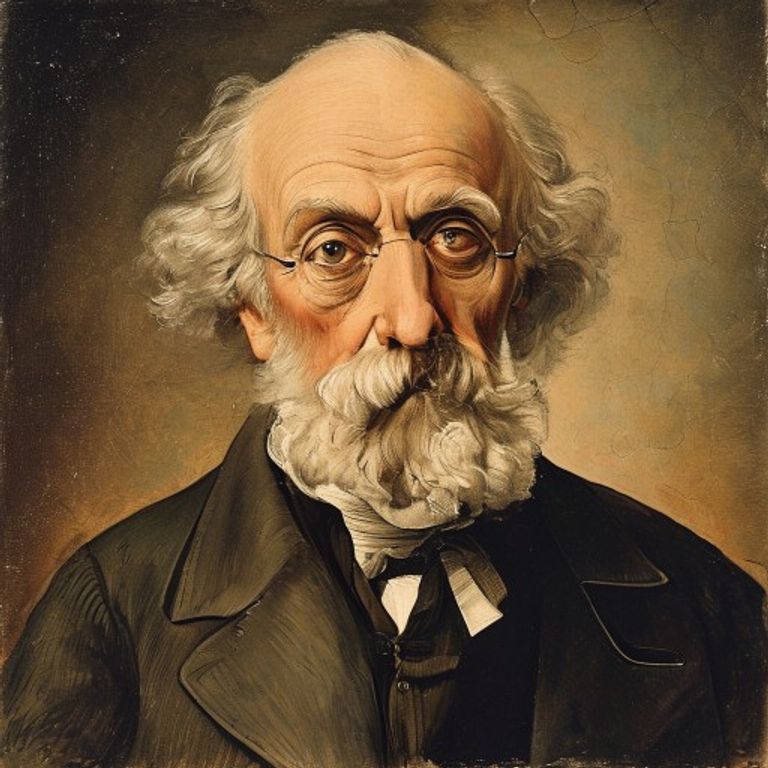
The development of the rabies vaccine in 1885 and the invention of the pasteurization process, revolutionizing preventive medicine and food safety on a global scale.
⚠️ Research prepared with the aid of Deep Research is subject to referential ambiguity.
🖥️ Clean HTML code using a proprietary tool.
👥 Research by Guilherme Felipe, Curation by Sílvio Lôbo
The Enigma of Louis Pasteur: The Theft That Opened a Scientific Pandora's Box
The figure of Louis Pasteur, one of the greatest names in modern science, synonymous with revolutionary discoveries in microbiology and immunology, is immortalized for his contributions to public health and the advancement of knowledge. However, behind the scientific pantheon hides a peculiar and, to some extent, inexplicable chapter: the mysterious theft of crucial samples from his laboratory, an incident that, although almost forgotten, casts a shadow over the early days of his most impactful research. This is not a common crime, but an event that, due to its nature and the central character involved, raises questions about motivations, security, and the very course of scientific history.
1. The Context and the Incident: Where, When, and How the Mystery Began
The incident occurred in 1877, in Paris, France, on the premises of Louis Pasteur's laboratory at the renowned Pasteur Institute. During that period, Pasteur was immersed in his research on fermentation and infectious diseases, seeking to unravel the mechanisms behind biological processes that until then remained a mystery to science.
The theft itself was discovered on a morning like any other, when Pasteur's assistants arrived at the laboratory and noticed the absence of certain biological samples. These were specific organic materials, cultures of microorganisms carefully prepared and, it is believed, essential for the experiments in progress. The loss was not just of material, but of valuable time and potential scientific advancement that could have been compromised.
What makes this incident particularly intriguing is the apparent lack of a clear motive for the theft and the absence of significant signs of forced entry, suggesting that the perpetrator might have had legitimate access or prior knowledge of the laboratory's security protocols. The police were called, but subsequent investigations did not reach a definitive conclusion, leaving the case in a limbo of uncertainty.
2. Timeline of Events
Reconstructing the exact timeline of a case with so little documented information is a challenge. However, based on sparse reports and the chronology of Pasteur's research, we can outline the following milestones:
- Before 1877: Louis Pasteur, already a renowned scientist, was intensely dedicated to his research on germ theory and fermentation.
- 1877 (Exact date imprecise): The theft of biological samples is discovered at Pasteur's laboratory in Paris. The exact nature of the samples and the volume are unknown.
- Immediately after the discovery: Pasteur's team and police authorities begin preliminary investigations.
- Subsequent period: The lack of concrete leads and the difficulty in identifying suspects lead to the cooling of the official investigation. The case remains unsolved.
- Later years: Pasteur continues his research, eventually culminating in discoveries such as pasteurization and vaccines, but the theft incident is rarely mentioned in his accounts or those of his contemporaries.
3. The Main Theories
The absence of a confession, hard evidence, and the peculiar nature of the crime gave rise to several theories, ranging from plausible explanations to bolder speculations.
3.1. Scientific and Police Hypotheses (Most Likely)
- Theft for Scientific Competition: The most frequently raised theory is that a scientific rival, envious or desperate to advance their own research, had stolen the samples to gain an undue advantage. Laboratories and universities of the time were scenes of intense rivalry, and access to cutting-edge materials could be crucial.
- Industrial/Pharmaceutical Espionage: Although the pharmaceutical industry as we know it today was in its infancy, there were already commercial interests surrounding medical discoveries. Someone could have stolen the samples with the intention of commercializing or replicating Pasteur's findings before he could formally publish them.
- Action by a Disgruntled Employee or Internal Access: The possibility that the theft was perpetrated by someone with internal access to the laboratory – an assistant, a technician, or even an employee with privileged access – cannot be ruled out. Motivations could range from personal resentment to greed.
- Administrative Error or Accidental Loss: Although less likely given the gravity of what was reported, one cannot entirely exclude the possibility that the samples were poorly stored, misplaced, or accidentally discarded, and that the subsequent discovery was attributed to a theft.
3.2. Alternative, Conspiracy, or Paranormal Theories
- Political Sabotage: In a frequently turbulent France, one cannot ignore the possibility that the theft had political motivations, aiming to discredit or delay Pasteur's work for ideological or power-related reasons.
- Extortion or Blackmail: The samples could have been stolen to be used as a bargaining chip in some form of extortion against Pasteur or the institute. The silence surrounding the incident may have been part of an agreement.
- Inexplicable Phenomena: Although highly speculative, in some circles of unexplained mysteries, the possibility of an anomalous event that resulted in the disappearance of the samples, without direct human intervention, is suggested. This theory lacks any factual evidence.
4. Controversies and Blind Spots
The "Louis Pasteur" case is a labyrinth of gaps and unanswered questions. The main controversies and blind spots include:
- Lack of Detailed Official Reports: The police reports of the time, if they exist in an accessible form, appear to be scarce and do not offer significant details about the crime scene, key testimonies, or the lines of investigation followed. Declassified files on the incident are practically non-existent or not publicly disclosed.
- Conflicting or Absent Testimonies: There are no public records of eyewitness or suspect testimonies that emerged from the investigations. The absence of any detailed account from Pasteur's assistants about the exact moment of discovery or any anomaly observed in the laboratory is a crucial blind spot.
- Missing or Ignored Evidence: The exact nature of the stolen samples and their specific scientific value remain vague. If there was any physical evidence left by the thief – fingerprints, objects, etc. – there is no public mention of its identification or analysis. The possibility that important clues were ignored by the police, whether due to incompetence, lack of resources, or disinterest, is real.
- Pasteur's Silence: Louis Pasteur himself, a central figure, rarely (or never) made public mention of the incident in his correspondence or publications. This raises the question of whether the theft was downplayed by him to avoid alarm, if it was part of an agreement to maintain discretion, or if the loss was considered irrelevant to the advancement of his main research (which seems unlikely given his dedication).
5. Curiosities and Legacy
Despite its dark nature, the theft incident at Pasteur's laboratory holds a certain fascination:
- The Theft That Wasn't a Theft? The irony of such a striking event involving a scientist whose legacy is the prevention of disease and scientific organization, but which seems to have been swallowed by silence and a lack of resolution, is notable.
- Cultural and Scientific Impact: The direct impact of this theft on Pasteur's career is difficult to measure. He continued to make monumental discoveries, which suggests that the loss of the samples, while regrettable, was not a crippling blow to his general research. However, it opens a window into the difficulties and risks that scientists faced at the time.
- Current Status: The "Louis Pasteur Case" (if it can be called that) is, for all practical purposes, shelved. There is no indication that it has been reopened by police authorities or that new evidence has emerged in historical archives. It remains a small but intriguing unsolved mystery in the history of science, a reminder that even the greatest geniuses can be subject to inexplicable events that defy logic and investigation.
This episode, although marginal compared to the magnitude of Pasteur's discoveries, serves as a somber reminder that the history of science is woven not only by successes and breakthroughs but also by unanswered questions and the shadows that the secrets of the past can cast.



