


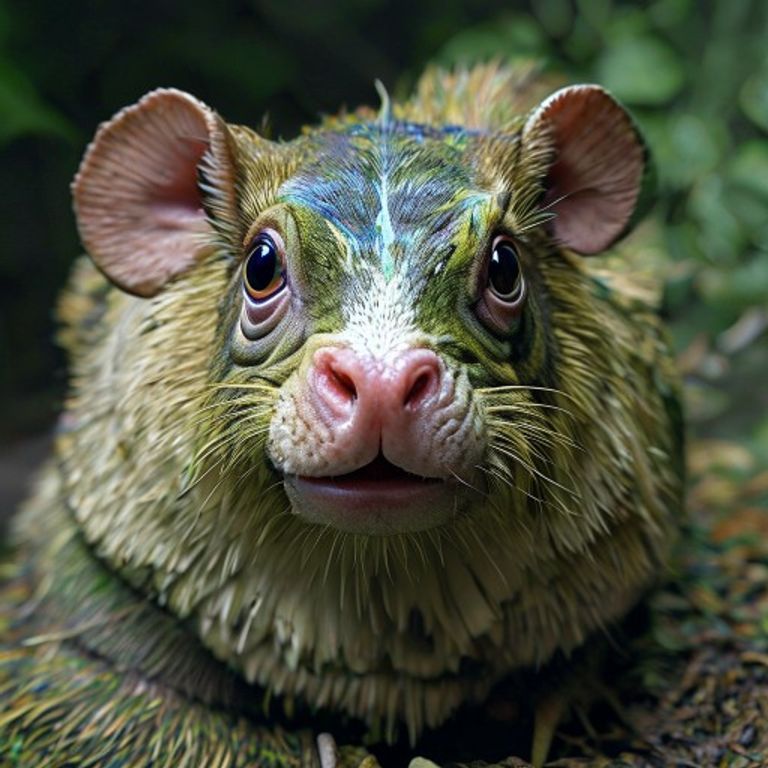
Reports of bipedal, amphibian-like creatures, measuring about one meter tall, which have been sighted by police officers and civilians on Ohio roads over the decades.
⚠️ Research conducted with the aid of Deep Research is subject to referential ambiguity.
🖥️ Clean HTML code using a proprietary tool.
👥 Research by Guilherme Felipe, Curation by Sílvio Lôbo
The Loveland Frog: An Unknown Creature That Haunted Colorado
In the heart of Colorado, on the outskirts of the small town of Loveland, an arachnid-like mystery took hold of the popular imagination and police reports. What began as a bizarre encounter on the night of May 16, 1957, quickly turned into one of the most intriguing cases of cryptozoology and unidentified creature sightings in the United States.
1. The Context and the Incident: Where, When, and How the Mystery Began
The setting for the birth of an enigma was the rural area of Loveland, Colorado, a landscape dotted with farms and open fields. The night of May 16, 1957, however, would be marked by an encounter that would defy conventional explanations. It was on this night that 10 people, in two separate cars, reported seeing a creature they described as a "frog" or "giant frog," but with entirely anomalous characteristics.
The first group, consisting of Howard Carpenter and James and Doris Barrows, was driving along Chapman Road when the driver, Carpenter, spotted the creature emerging from a ditch by the side of the road. Struck by its size and unusual appearance, he braked sharply. The creature, described as being approximately 1.2 meters tall and weighing about 75 to 100 kilograms, possessed rough, scaly skin, a robust body, and long, powerful legs. What caught their attention most, however, were its features that deviated from the norm for an amphibian: tentacles that projected from its head and a body that appeared more robust and muscular than that of a common frog.
Shortly after, another car with Gerald Harding and his wife, accompanied by their children, Floyd and Donna, witnessed the same scene from a short distance away. The creature, after a brief moment of display, jumped across the road and disappeared into the undergrowth. The encounter lasted only a few seconds but left the witnesses in a state of shock and bewilderment.
2. Timeline of Events
- May 16, 1957 (night): The first sighting occurs on Chapman Road, Loveland, Colorado. Howard Carpenter, James, and Doris Barrows report the vision of an anomalous creature.
- Shortly after the first sighting: The second group, Gerald Harding, his wife, and their children Floyd and Donna, witness the same creature jumping across the road.
- May 17, 1957: News of the incident spreads through the local community. The Larimer County Sheriff, Earl Gregg, is called to investigate.
- May 19, 1957: Sheriff Gregg and his team conduct a search of the area where the creature was sighted. No tracks or physical evidence are found.
- Following weeks and months: Reports of similar creatures or unusual sounds in the Loveland area continue to emerge, fueling the mystery.
- 1977: The case is revisited by the media and the public, gaining national and international notoriety.
- Present: The "Loveland Frog Case" remains an unsolved enigma, a landmark in the history of cryptozoology.
3. Main Theories
The bizarre nature of the encounter gave rise to a myriad of explanations, ranging from scientific skepticism to more fantastic speculations.
3.1. Scientific and Police Explanations
- Misidentification or Collective Hallucination: This is the most skeptical hypothesis and one frequently considered by investigators. Psychological pressure, fear, and darkness may have led the witnesses to misinterpret a common animal. A creature like a large frog, a raccoon, a coyote, or even a deer seen in low-light conditions and under stress could, theoretically, be misinterpreted. The phenomenon of collective hallucination, where a group of people shares a false perception, is also considered, although less likely for multiple observers in separate vehicles. Forensics: No physical traces were found to corroborate the presence of an unknown creature, which weakens theories that require the presence of an animal.
- Mutant or Sick Animal: Another scientific possibility would be that of a common animal that has suffered some genetic mutation or is severely ill, altering its appearance and behavior. A rare disease or exposure to environmental toxins could, in theory, cause deformities. Forensics: Without identifying the source species, this theory is difficult to prove or refute.
- Failed Scientific Experiment: Speculations point to the possibility of secret experiments in nearby laboratories that could have resulted in the escape of a genetically modified or unknown animal. Forensics: There are no public records or reliable leaks that point to such activity in the region at the time.
3.2. Alternative, Conspiracy, and Paranormal Theories
- Unknown Cryptid: This is the theory that resonates most with cryptozoology enthusiasts. The description of the creature aligns with the idea of an unknown amphibian species, perhaps endemic to the region or a survivor of past eras. The "Loveland Frog" becomes an example of a cryptid, like Bigfoot or the Loch Ness Monster. Curiosity: The description of the tentacles is a particularly intriguing point for this theory, as it does not fit any known amphibian.
- Extraterrestrial Intervention: Although it seems more speculative, the alien theory suggests that the creature could be an alien life form, perhaps a biological being studying Earth or a specimen brought by a ship. The "unnatural" aspect of the creature may have led to this interpretation. Controversy: This theory lacks any concrete evidence and relies purely on imagination and the interpretation of the unusual elements of the report.
- "Blue Book" Project and Local Mysticism: During the Cold War, the US Air Force investigated numerous reports of UFOs and unexplained aerial phenomena through Project Blue Book. Some theorists suggest that the Loveland Frog case may have been a cover-up for a broader phenomenon related to UFOs, or even that the reports themselves were influenced by a climate of paranoia and speculation about the unknown. Furthermore, the Loveland region has a history of interest in spiritualism and paranormal phenomena, which may have created fertile ground for the interpretation of unusual events. Legacy: The absence of a satisfactory official explanation allows these theories to continue circulating.
4. Controversies and Blind Spots
Despite the seemingly convincing testimony of multiple observers, the Loveland Frog case presents several blind spots and inconsistencies that hinder a definitive resolution.
- Lack of Physical Evidence: The total absence of footprints, excrement, fur, or any other physical trace of the creature is the biggest obstacle to a scientific investigation. Sheriff Earl Gregg conducted searches in the area but found nothing that could corroborate the existence of the animal.
- The Nature of the "Tentacles": The description of the tentacles is particularly disturbing and unusual for an amphibian. The ambiguity in this description (were they antennae? muscular appendages?) leaves room for interpretation. Could it have been an effect of the lighting, the vegetation, or simply a detail misperceived in the moment of shock?
- The Moment of the Jump: The fact that the creature "jumped across the road" and disappeared into the vegetation is a testament to its strength and agility. This, for some, suggests a large animal with significant musculature.
- Variations in Reports: Although the 10 witnesses share a general description, details such as the exact color of the skin or the extent of the tentacles may have slight variations, which is common in eyewitness testimony under stress.
- The Lack of Formal Reopening: Despite its fame, the case was never officially reopened with new forensic or scientific investigations. Public scrutiny and media attention occurred decades after the initial event.
5. Curiosities and Legacy
The Loveland Frog Case transcended the local sphere to become a cultural phenomenon and a landmark in the lore of mysterious creatures.
- Cultural Impact: The story of the "Loveland Frog" captured the public imagination, inspiring articles, documentaries, mentions in books about the inexplicable, and fueling discussions in online forums dedicated to mysteries and cryptozoology. The creature became a peculiar icon of American folklore.
- Nicknames and Descriptions: The creature is often described as a mix between a frog, a monkey, and an extraterrestrial, with characteristics that defy biological classification.
- Current Status: The case remains, for all practical purposes, archived and unresolved. Local authorities have no new information or active lines of investigation. However, the legend persists, and new reports of sightings of bizarre creatures in the region periodically emerge, fueling the original mystery.
- The Power of the Unknown: The legacy of the Loveland Frog lies in its ability to remind us that, even in a world increasingly explored and cataloged, there are still spaces for mystery and for the possibility that there are more things between heaven and earth than our science can explain.
The Loveland Frog remains an enigma that defies easy explanations, a reminder that nights in Colorado may hold secrets that jump from the shadows to haunt our imagination.



