


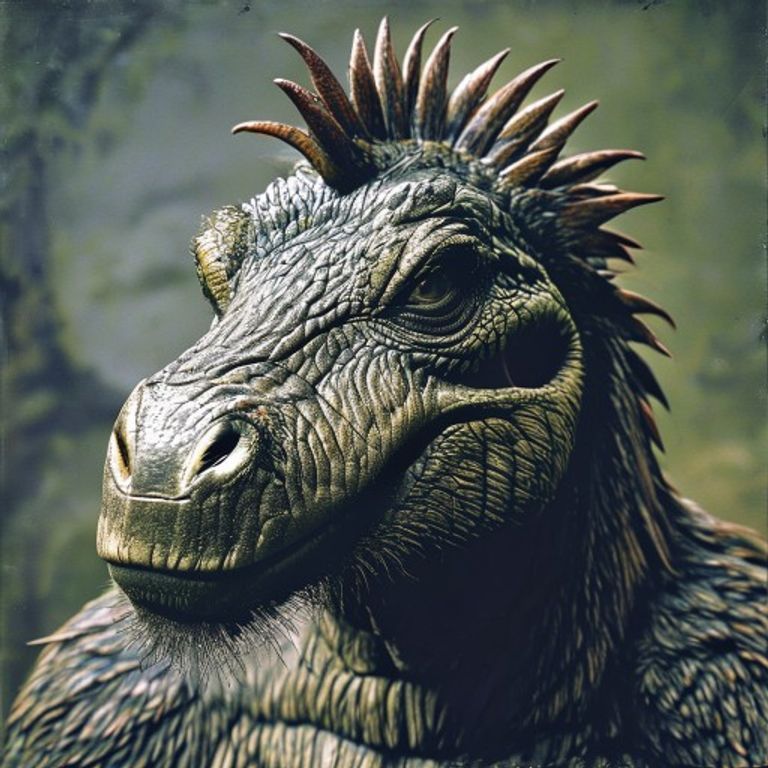
Persistent reports and local legends describe a gigantic sauropod-like dinosaur creature inhabiting the remote and unexplored Congo River basins.
⚠️ Research conducted with the assistance of Deep Research is subject to referential ambiguity.
🖥️Clean HTML code using a proprietary tool.
👥 Research by Guilherme Felipe, Curation by Sílvio Lôbo
The Mokele-Mbembé Enigma: A Case of Legendary Creature or Collective Illusion in the Congolese Jungles?
The dark and unexplored depths of the Congo Basin hold secrets that defy logic and have fueled human imagination for centuries. Among the mysteries emerging from these green expanses, the case of Mokele-Mbembé stands out. Reports of a colossal, semi-aquatic, dinosaur-like creature inhabiting the murky, remote waters persist, fueling a debate between the cryptozoological, anthropological, and purely folkloric. As a long-time investigative journalist, I delved into the entrails of this enigma, seeking to separate the dust of myths from the hidden truth.
1. The Context and the Incident: A Whisper in the Jungle
The Mokele-Mbembé mystery is not a recent story. Its origins are lost in the oral tradition of the Pygmy peoples and other ethnic groups inhabiting the region of Lake Télé and the Likouala-Mossaka river, in present-day Congo-Brazzaville. These communities describe a fearsome creature that attacks hippos and even canoes. The first documented reports that caught the attention of the Western world emerged in the early 20th century.
One of the most cited accounts is that of the Scottish missionary John MacCulloch Reid, in 1909. Reid, based on local reports, described a creature he called "Mokele-Mbembé," claiming that the natives feared it deeply. He described it as having a long neck, a bulky body, and a single horn on its head, characteristics that immediately evoke the image of a sauropod. However, it is crucial to note that Reid never saw the creature personally, relying on third-party testimonies.
2. Timeline of Events: Tracing the Legend
The history of Mokele-Mbembé is marked by a pattern of sporadic reports, expeditions, and controversies:
- Pre-20th Century: Oral tradition of the indigenous peoples of the Congo Basin describing a giant aquatic creature.
- 1909: Reports by missionary John MacCulloch Reid, documenting the name "Mokele-Mbembé" and its characteristics based on local testimonies.
- 1930s-1940s: Various reports from explorers and hunters, such as the German Otto von Müller and the Frenchman Marcelin Guillet, who claimed to have sighted or had contact with the creature. However, the details are often vague and concrete evidence is non-existent.
- 1959: Zoologist Bernard Heuvelmans, one of the fathers of cryptozoology, included Mokele-Mbembé in his book "On the Track of Unknown Animals," consolidating its status as a mystery to be investigated.
- 1980s: Expeditions led by American zoologist Roy P. Mackal attempted to find Mokele-Mbembé. Mackal collected testimonies and conducted searches, but without success in obtaining definitive proof. He documented the creature with specific details, including the ability to move quickly in water and scaly skin.
- 1992 and 2000: More recent expeditions, such as the one led by Marcellin Agnagna, a Congolese researcher, and later by David G. Lynam, continued to search for evidence, but without conclusive results. Agnagna, in particular, reported collecting footprint samples that he claimed could belong to an unknown creature, although subsequent analyses were inconclusive.
3. Main Theories: Between Biology and Fantasy
The persistence of the Mokele-Mbembé mystery has given rise to a series of theories, ranging from plausible scientific explanations to bold speculations:
- Cryptozoological Hypothesis (Unknown Creature): This is the most popular theory among Mokele-Mbembé enthusiasts. The idea is that the creature is a real animal, a survivor of prehistoric species, possibly a long-necked sauropod, that has remained hidden in the vast and inaccessible forests. The theory is based on the consistency of reports about its physical characteristics and behavior. However, the lack of concrete physical evidence, such as remains, carcasses, or unequivocal photographs, is the main obstacle.
- Existing Zoological Explanations: Several researchers and skeptics suggest that Mokele-Mbembé reports may be misinterpretations or sightings of known, but rare or unusual, animals in the region.
- Hippos: Hippos are powerful and dangerous creatures that inhabit Africa's rivers. In certain visibility conditions or when seen from a distance in the water, their shape can be distorted, leading to misinterpretations. Reports of attacks on hippos by larger creatures may simply be an exaggerated perception of the strength of known predators or the inherent aggressiveness of a hippo.
- Crocodiles: Nile crocodiles are formidable predators and can be mistaken for something larger at a distance, especially in murky waters.
- Elephants or Other Large Mammals: In moments of disorientation or partial sightings, other large animals can be misidentified.
- Giant Turtles: Some species of freshwater turtles can reach considerable sizes, and their shape, seen from a distance, can evoke the idea of an elongated neck.
- Collective Illusion and Folklore: This theory suggests that Mokele-Mbembé is largely a creation of local folklore, fueled by stories passed down orally and amplified by explorers and researchers. The strength of cultural beliefs and the desire to find something extraordinary can lead to the interpretation of natural phenomena or sightings of known animals as evidence of a mythical creature. The very nature of the region, vast and mysterious, contributes to the creation and maintenance of such legends.
- Conspiracy and Paranormal Theories: Although less prevalent in scientific circles, there are speculations that include the idea that governments or secret organizations may be aware of Mokele-Mbembé's existence and are hiding the truth to protect the creature or exploit its secrets. Some more fringe theories also associate it with paranormal or extraterrestrial phenomena, but these lack any empirical basis.
4. Controversies and Blind Spots: Where the Investigation Fails
The investigation into the Mokele-Mbembé case is marked by significant gaps and controversies:
- Lack of Concrete Physical Evidence: This is the most critical blind spot. Despite decades of reports, no carcass, bone, scale, tooth, or unequivocal footprint has been recovered and authenticated by reputable scientific institutions. The samples allegedly collected by Agnagna, for example, were not widely accepted as definitive proof.
- Conflicting and Imprecise Testimonies: Although many natives and some explorers report having seen something unusual, the details vary considerably. The exact description of the creature, its size, and behavior are not always consistent, raising questions about the accuracy of observations and the influence of suggestion.
- The Influence of Expectation: In many expeditions, researchers already carried the expectation of finding a specific creature. This can lead to a tendency to interpret ambiguous sightings or natural phenomena as evidence for Mokele-Mbembé's existence, a bias known as confirmation bias.
- Logistical and Access Difficulties: The Congo Basin is one of the most remote and difficult-to-access regions on the planet. The dense rainforest, dangerous rivers, and political instability in some areas hinder long-term expeditions and the collection of rigorous scientific evidence. This allows the legend to persist partly due to the impossibility of a complete investigation.
- Disappearance or Loss of Evidence: In some historical accounts, there are mentions of photographs or samples that were allegedly collected but were subsequently lost or disappeared, adding a layer of mystery and suspicion, although without evidence of intentional misconduct.
5. Curiosities and Legacy: Mokele-Mbembé in Popular Culture
Mokele-Mbembé has transcended the boundaries of the Congolese jungles, becoming an icon in cryptozoology and popular culture. Its image evokes fascination with extinct dinosaurs and the mystery of the unknown.
- Impact on Cryptozoology: Mokele-Mbembé is frequently cited as one of the "classic cases" of cryptozoology, inspiring countless books, documentaries, and articles. It fuels the debate about the possibility of unknown species coexisting with humanity.
- Media Portrayals: The creature has inspired fiction books, films, and even video games, solidifying its presence in the collective imagination as a prehistoric "dragon" or dinosaur.
- Current Status: The Mokele-Mbembé case remains officially unresolved. Although scientific expeditions have ceased in their past intensity, the mystery continues to attract the attention of enthusiasts and amateur researchers. There is no official report of the case being reopened by mainstream scientific bodies, and most scientists classify it as a myth or a case of misidentification.
In the end, Mokele-Mbembé resides on the thin line between what we can prove and what we merely believe. Whether it is a survivor from a lost world, a manifestation of ancestral fears, or simply a distorted echo of nature, the enigma of the Congo Basin continues to challenge us to look into the shadows and ask: what else might be hidden in the unexplored depths of our planet?



