


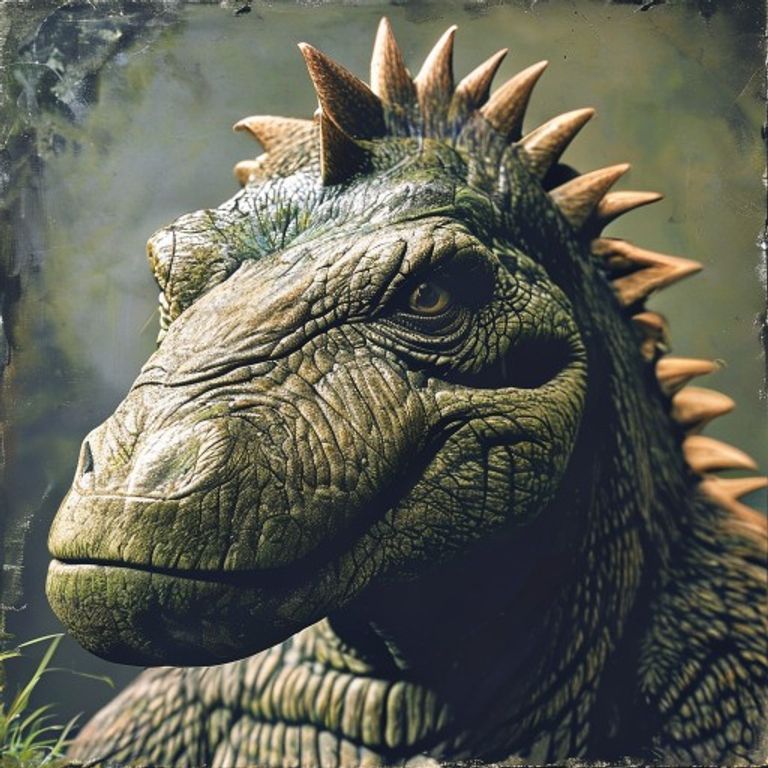
Explorers and Pygmies from the Congo River basin describe a gigantic long-necked aquatic creature that many cryptozoologists suspect to be a still-living sauropod dinosaur.
⚠️ Research conducted with the assistance of Deep Research is subject to referential ambiguity.
🖥️Clean HTML code using a proprietary tool.
👥 Research by Guilherme Felipe, Curation by Sílvio Lôbo
Mokele-mbembe: The Living Dinosaur of the Congo and the Shadow of Uncertainty
By [Your Name], Senior Investigative Journalist
In the unfathomable depths of the lush and treacherous jungles of the Congo Basin, an ancient mystery pulses, defying scientific logic and fueling human imagination for over a century. The Mokele-mbembe, a creature echoing the terrors of prehistoric dinosaurs, emerges from the mists of folklore and fragmented accounts, weaving a web of intrigue that attracts explorers, cryptozoologists, and, occasionally, the inattentive gaze of authorities. This article aims to dissect the enigma, separating the wheat from the chaff, and illuminating the contours of one of the most persistent unsolved mysteries of our time.
1. The Context and the Incident: The Whisper That Became Legend
The myth of the Mokele-mbembe, which roughly translates to "one who stops the flow of water" in some local languages, is deeply rooted in the oral traditions of the peoples inhabiting the vast swampy and forested regions of the Congo. However, the transition from oral legend to an object of broader scrutiny dates back to the early 20th century. The first notable appearance in Western literature occurred in 1909, with German explorer Georg Schweinfurth, who recorded stories about a dinosaur-like creature inhabiting the rivers and swamps of the region. Schweinfurth, though skeptical, gave credence to indigenous accounts, describing a colossal creature with a long neck and a single horn or protuberance on its head.
The incident that truly catapulted the Mokele-mbembe to the forefront of cryptozoology, however, was the account of explorer and hunter William J. Gibbons. In 1913, Gibbons described encountering footprints approximately 1.2 meters long and briefly spotting a creature he compared to a giant reptile. His descriptions, though lacking concrete photographic or biological evidence, were published in newspapers and magazines, fueling global fascination. Gibbons' narrative, along with earlier accounts, solidified the image of the Mokele-mbembe as a possible remnant of sauropod dinosaurs or plesiosaurs, living in isolation in the impenetrable depths of the Congo.
2. Timeline of Events: Fragments of a Relentless Search
- Early 20th Century: Indigenous reports of a giant aquatic creature circulate in the Congo Basin regions.
- 1909: Georg Schweinfurth, a German explorer, documents tales of a colossal reptilian creature, with reports of a single horn.
- 1913: William J. Gibbons, an explorer and hunter, reports sighting a dinosaur-like creature and finding enormous footprints. His description is widely publicized.
- 1930s and 1940s: Sporadic expeditions, often with hunting or exploration objectives, but without conclusive results regarding the Mokele-mbembe. The story begins to solidify as a mystery.
- 1980s: Zoologist and cryptozoologist Bernard Heuvelmans, author of "On the Track of Unknown Animals," dedicates attention to the case, compiling reports and encouraging new expeditions.
- 1981: The expedition of Roy P. Mackal, a biology professor at the University of Chicago, travels to the Congo with the aim of documenting the Mokele-mbembe. The expedition returns with some native accounts and possible sound evidence, but no definitive proof.
- 1982: The expedition of Marcellin Agnagna, a Congolese professor, claims to have obtained a partial skull of an unknown animal. The authenticity and origin of the skull remain contested.
- 1990s onwards: Several other expeditions, documentaries, and independent investigations are conducted, but the Mokele-mbembe remains elusive, staying in the realm of anecdote.
3. Main Theories: From Reality to Fantasy
The persistence of the Mokele-mbembe enigma has generated a range of theories attempting to explain its existence, varying from the strictly scientific to the purely speculative.
3.1. Scientific and Police Hypotheses (Most Likely)
- Dinosaur Remnant (Sauropod/Plesiosaur): This is the most popular and imagination-capturing hypothesis. The theory posits that the Mokele-mbembe is an isolated survivor of sauropod dinosaur species (long-necked, herbivorous) or plesiosaurs (long-necked marine reptiles, although more associated with saltwater aquatic environments, adaptation to freshwater rivers and lakes is not impossible). The Congo Basin, with its vast and inaccessible unexplored areas, would be an ideal refuge for a prehistoric species to have remained hidden. The main scientific objection is the viability of a single population surviving and reproducing for millions of years in an isolated ecosystem without more concrete signs of its existence.
- Misinterpreted Existing Animals: This theory suggests that sightings and reports may be mistaken attributions of real animals that inhabit the region.
- Hippos and Giant Crocodiles: Large hippos emerging from the water or crocodiles of less-known and considerable species could be mistaken for a larger and more exotic creature, especially in low light conditions or at a distance. The silhouette and movements in the water could generate erroneous impressions.
- Elephants, Giraffes, or Other Large Mammals: On rare occasions and under specific circumstances, large mammals could be sighted in aquatic environments, and their shapes distorted by water and vegetation could lead to misinterpretations.
- Freshwater Whales or Dolphins: Although less likely, the existence of large cetaceans adapted to freshwater environments, like the Amazon river dolphin, could inspire the idea of colossal aquatic creatures in the Congo. However, there is no evidence of such species in the Congo Basin.
- Natural or Geological Phenomena: Abnormal waves, unusual ice formations at high altitudes (although the Congo Basin is predominantly equatorial), or even underwater earth movements could generate disturbances in the water that would be interpreted as the passage of a giant creature.
3.2. Alternative, Conspiracy, or Paranormal Theories
- Mythological or Spiritual Creature: For many local peoples, the Mokele-mbembe is not just an animal but a spiritual entity or part of ancestral folklore, possessing supernatural characteristics or a symbolic role. A strictly scientific interpretation may overlook this cultural dimension.
- Unknown Cryptids: Beyond dinosaurs, the Mokele-mbembe could be a species of large reptile or amphibian yet undiscovered by science, which evolved independently or adapted to the unique conditions of the Congo Basin.
- Psychosomatic or Collective Phenomenon: The strong belief and consistent reports could, in theory, lead to a kind of "collective vision" or suggestion, where individuals perceive what they expect or have heard about.
- Concealment Conspiracy: Some conspiracy theories suggest that governments or powerful organizations are aware of the Mokele-mbembe's existence and deliberately conceal this information to avoid public panic, preserve the ecosystem, or exploit the creature.
4. Controversies and Blind Spots: Where the Light Doesn't Reach
Despite numerous expeditions and the generated interest, the case of the Mokele-mbembe is rife with controversies and blind spots that prevent a definitive resolution.
- Lack of Concrete Evidence: The absence of captured or deceased specimens, recent fossils, high-quality and unequivocally attributable photographs or videos of the Mokele-mbembe is the biggest obstacle. Most "evidence" consists of footprints, witness accounts, and blurry or unclear images.
- Reliability of Testimonies: Indigenous accounts, while valuable for understanding local history and culture, are often transmitted orally for generations, which can lead to distortions and amplifications over time. Furthermore, pressure to please explorers or the influence of previous reports can affect the veracity of testimonies.
- Expeditions with Questionable Objectives: Many of the early expeditions were motivated by hunting, adventure, or the pursuit of fame, which may have compromised objectivity and scientific rigor. The need to "bring something back" may have led to biased interpretations or the fabrication of evidence.
- Agnagna's Skull: The partial skull allegedly found by Marcellin Agnagna in 1982 generated significant controversy. Its authenticity, the species it belonged to, and whether it was actually found in the Congo Basin are still subjects of intense debate and skepticism from the scientific community. Without independent and complete expertise, its relevance is limited.
- Accessibility and Environmental Conditions: The Congo Basin is an extremely challenging environment for exploration, with dense forest, dangerous rivers, tropical diseases, and political instability. This makes rigorous and prolonged investigations incredibly difficult, limiting access to remote areas where the creature supposedly inhabits.
- Disappearance of Evidence: Reports of lost equipment, damaged video tapes, or evidence that supposedly disappeared under mysterious circumstances contribute to the aura of conspiracy and frustration.
5. Curiosities and Legacy: The Shadow That Persists
The Mokele-mbembe has transcended its status as a local legend to become an icon of cryptozoology, exerting a profound cultural impact and fueling the imagination of generations.
- Cryptozoology Icon: The Mokele-mbembe is one of the most famous and persistent "cryptids," frequently cited in books, documentaries, and debates about unknown animals. Its image as a living dinosaur evokes a primal fascination with the possibility that Earth still holds monumental secrets.
- Influence on Popular Culture: The mystery has inspired science fiction books, films, games, and even marketing campaigns. The idea of a "lost world" inhabited by prehistoric creatures finds in the Mokele-mbembe one of its most emblematic representatives.
- The Role of Media: Media coverage, often sensationalist, played a crucial role in popularizing the case, transforming native and explorer accounts into a global phenomenon. However, this same coverage did not always bring the journalistic and scientific rigor necessary for in-depth investigation.
- Current Status: The case of the Mokele-mbembe remains officially unresolved and has not been reopened by any governmental biological research agency. It is largely shelved within the scientific sphere, relegated to the domain of cryptozoology and popular beliefs. However, the fascination with the creature persists, and the hope that one day new expeditions, with more advanced technologies and more rigorous scientific methods, may finally unravel the mystery, never completely fades. The Congo Basin, with its secrets closely guarded by nature, continues to be the silent stage where the myth of the Mokele-mbembe echoes, a constant invitation to explore the unknown and reflect on the limits of what we believe to be possible.



