


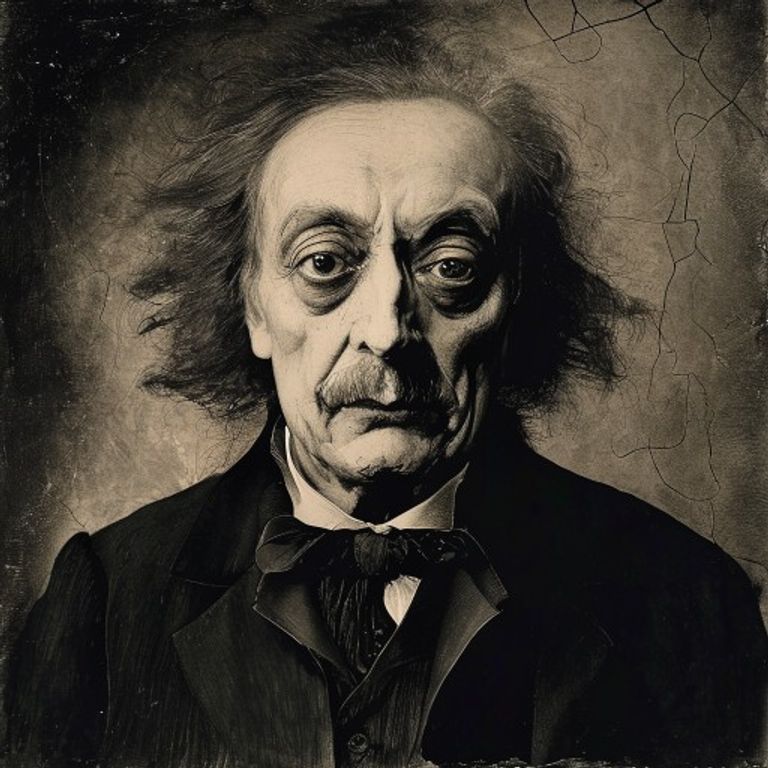
The writer's passing in 1849 after being found delirious in Baltimore wearing clothes that were not his own; the exact cause of death and the whereabouts of his final days remain unknown.
⚠️ Research conducted with the aid of Deep Research is subject to referential ambiguity.
🖥️ Clean HTML code using a proprietary tool.
👥 Research by Guilherme Felipe, Curation by Sílvio Lôbo
The Mystery of Edgar Allan Poe's Death: The Shadow of the Inexplicable Looms Over Baltimore
The brilliant mind that gave us "The Raven," "The Black Cat," and "The Tell-Tale Heart," Edgar Allan Poe, perished in a manner as enigmatic as his own dark narratives. On October 7, 1849, the city of Baltimore saw one of its most brilliant, yet tormented, sons fade away. His death, shrouded in nebulous circumstances and contradictory reports, has become one of the most persistent enigmas in American literary history, challenging investigators and readers for nearly two centuries.
The Context and the Incident: An Unknown Farewell
Edgar Allan Poe, a man of intense passions and constant struggles against poverty and addiction, was in Baltimore for a literary event. However, his journey ended tragically in a charity hospital. The lack of a detailed medical record, the rapid deterioration of his condition, and the disappearance of crucial evidence created a vacuum of information that gave rise to a range of speculations.
The starting point of the mystery lies in the discovery of Poe in a state of delirium and extreme confusion on the streets of Baltimore, wearing clothes that were not his own and uttering incoherent names. He was rushed to Washington College Hospital, where he passed away four days later, without ever regaining consciousness enough to explain what had happened to him.
Timeline of Events: Fragments of a Tragedy
Reconstructing the final week of Edgar Allan Poe is an exercise in assembling pieces of an incomplete puzzle:
- September 26, 1849: Poe leaves his home in Fordham, New York, with the intention of visiting his sick mother in Richmond, Virginia, and subsequently heading to Philadelphia.
- September 27, 1849: Poe arrives in Baltimore. He meets his cousin Neilson Poe, who reports that the writer seemed "very distressed" and "under the strong influence of alcohol," although Poe swore he was abstinent.
- September 30, 1849: Poe is found near Bryant's tavern, in a state of extreme confusion and uttering names that made no sense. He was wearing ragged clothes and a hat that did not belong to him.
- September 30, 1849: He was taken to Washington College Hospital, under the care of Dr. John J. Moran, the physician who attended him in his final days and signed the death certificate.
- October 3, 1849: Edgar Allan Poe passes away at the hospital. The official cause of death listed was "cerebral congestion, or apoplexy," a vague term that masked many other conditions at the time.
- October 4, 1849: Poe's body is buried in Westminster Cemetery, in Baltimore, in an improvised grave without immediate identification.
The Main Theories: Seeking Truth in the Fog
Over the years, several theories have attempted to unravel the enigma of Poe's death, each with its own logic and evidence base:
1. Poisoning (Police/Scientific Theory):
This is one of the most persistent theories. Poe's debilitated appearance and state of delirium could be symptoms of poisoning, whether accidental or intentional. Suggested substances include:
- Carbon Monoxide: Exposure to faulty gas heaters or alcohol vapors.
- Heavy Metals: Arsenic or mercury, frequently used in hair dyes or medicines of the time.
- Psychotropic substances: Drugs that induced delirium and confusion.
Controversy: The absence of a detailed autopsy and the lack of concrete evidence make this theory difficult to prove or refute.
2. Political Radicalism and "Cooping" (Historical/Police Theory):
This theory, which gained strength in the 20th century, suggests that Poe may have been a victim of a scheme known as "cooping." Practiced during fraudulent elections in the 19th-century US, "cooping" involved drugging and kidnapping individuals to force them to vote multiple times under duress, often dressing them in different outfits for each vote. Poe was found wearing clothes that were not his own, a crucial detail for this hypothesis.
- Evidence: Reports from Poe's friends indicating he was involved in political activities in Baltimore. The state of confusion and the change of clothes fit the description of "cooping."
- Controversy: The lack of direct eyewitnesses to the kidnapping or the act of voting multiple times, and the absence of electoral records confirming Poe's participation.
3. Alcohol Abuse (Dependency Theory):
Poe struggled with alcoholism throughout his life. A severe relapse, combined with his debilitated state, could have led to delirium tremens or an alcoholic coma, resulting in his final symptoms.
- Evidence: Testimonies describing him as drunk or under the influence of alcohol in the days leading up to his death.
- Controversy: Poe was traveling to a conference and, according to reports, had promised abstinence. The magnitude of the delirium and confusion seems to go beyond simple drunkenness.
4. Illness (Medical Theory):
Other diseases could have been the cause, including:
- Rabies: Some symptoms, such as delirium and spasms, can resemble rabies.
- Cerebral Tuberculosis: Poe suffered from a condition that, at the time, resembled tuberculosis.
- Heart or Brain Disease: A stroke or cerebral hemorrhage may have led to his rapid deterioration.
Controversy: The lack of conclusive medical examinations prevents confirmation.
5. Alternative Theories (Paranormal and Conspiracy):
- Murder by Literary Rivals: A more fanciful theory suggests that jealous rivals may have conspired to silence him.
- Involuntary Involvement in a Crime: Poe may have witnessed something that put him in mortal danger.
- Supernatural: Although there is no evidence, the gothic nature of his works fuels supernatural speculations.
Controversy: These theories lack any concrete factual foundation and belong more to the realm of legend.
Controversies and Blind Spots: The Gaps in the Investigation
The mystery of Poe's death is punctuated by flaws and inconsistencies that only add layers of perplexity:
- Vague Death Certificate: The official cause ("cerebral congestion, or apoplexy") was a generic and imprecise diagnosis for the time, failing to clarify the root cause.
- Missing Documentation: Detailed medical reports from Dr. Moran, who claimed to have recorded the events of Poe's final days, were never found.
- Conflicting Testimonies: Witness accounts regarding Poe's state and the circumstances of his discovery vary, creating a fragmented picture.
- The Lack of an Autopsy: A full autopsy, which could have revealed the exact cause of death, was never performed.
- The Disappearance of Poe's Clothes: The clothes he was wearing when found and his own clothes, which he was supposedly not wearing, disappeared from the records.
Curiosities and Legacy: The Eternal Shadow of the Master of the Macabre
The case of Edgar Allan Poe's death transcended the literary sphere, becoming a cultural icon. The image of the tormented genius, who dies under mysterious circumstances, aligns perfectly with the atmosphere of his tales.
- The Informal "Poet's Corner": For decades, Poe's grave remained anonymous. In 1875, his remains were exhumed and reburied with a monument.
- The Persistent Enigma: Despite several attempts to reopen the case and unofficial investigations, no definitive proof has emerged to solve the mystery. The case remains officially cold.
- Literary and Cinematic Inspiration: Poe's life and death continue to inspire novels, films, and plays, solidifying his place as one of the most fascinating and tragic enigmas in history.
Thus, the shadow of Edgar Allan Poe looms over Baltimore, an eternal reminder that, sometimes, reality can be as dark and inscrutable as the mysteries he dared to unravel on his pages.



