


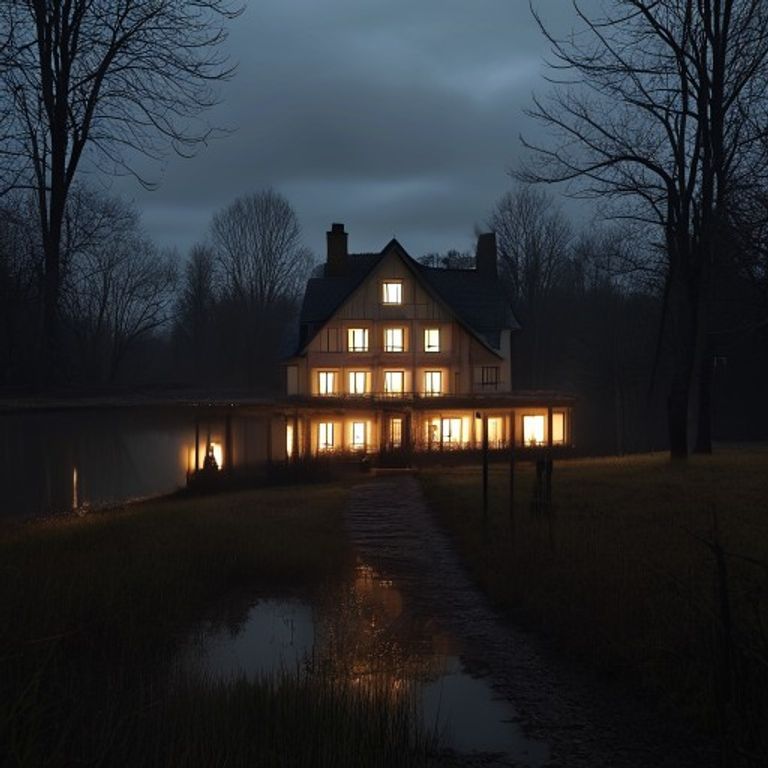
Unexplained luminous phenomena occurring in a valley in Norway, ranging from white orbs to colored lights captured by cameras and research station radars.
⚠️ Research conducted with the aid of Deep Research is subject to referential ambiguity.
🖥️ Clean HTML code using a proprietary tool.
👥 Research by Guilherme Felipe, Curation by Sílvio Lôbo
The Mystery of the Hessdalen Lights: A Luminous Enigma in the Deep Norwegian Wilderness
The Hessdalen Valley, nestled in the mountains of central Norway, has become the epicenter of one of the most persistent and fascinating enigmas of the 20th century. Since the late 1970s, reports of strange aerial lights, defying conventional explanations, have captured the attention of scientists, military personnel, and curious onlookers, turning the quiet rural landscape into the stage for a mystery that refuses to be solved.
As a senior investigative journalist, I have delved into the archives, encountered often contradictory testimonies, and analyzed the scarce but intriguing physical evidence. The case of the Hessdalen Lights is not just a compendium of UFO sightings; it is a complex tapestry of natural phenomena, forced explanations, and the persistent doubt that haunts the human mind when faced with the inexplicable.
The Context and the Incident: Where, When, and How the Mystery Began
The first manifestations of what would become known as the "Hessdalen Lights" date back to the late 1970s, with a significant increase in recorded sightings starting in 1981. The valley, located in the municipality of Holtålen, in Trøndelag, Norway, is characterized by its remote, mountainous, and sparsely populated landscape—a setting conducive to the emergence of anomalous phenomena. Initial reports described bright lights, usually yellow in color, moving erratically in the sky, sometimes emitting sounds or humming noises.
The mystery gained momentum as the sightings became more frequent and intense. Local residents, including farmers, students, and even some government representatives, began reporting detailed encounters with these lights. The scientific community, initially skeptical, was gradually drawn in by the persistence and variety of the descriptions, encouraging more systematic investigations.
Timeline of Key Events
A chronological reconstruction of the facts is crucial to understanding the evolution of the mystery:
- Late 1970s: First sporadic reports of strange lights in the valley.
- 1981-1984: Period of intense sighting activity. Local and national media begin covering the phenomenon, generating public interest. The phenomenon is dubbed the "Hessdalen Lights."
- 1983: Creation of the Hessdalen Project, an initiative led by Norwegian physicist and ufologist Erling Strand. The project aimed to document and investigate the lights scientifically, installing monitoring equipment and collecting data.
- 1984: Reports of unusual radiation activity and electromagnetic fields in the area, associated with the sightings.
- 1990s and 2000s: The activity of the lights seems to decrease in frequency, but research continues. New monitoring technologies are implemented, including cameras, sensors, and spectroscopy equipment.
- 2007: A notable increase in sighting activity, with witnesses describing lights that exhibited complex behaviors, including the emission of rays.
- 2010s onwards: Research continues with the Hessdalen Observatory, focused on continuous data collection and the analysis of luminescent phenomena in the valley.
The Main Theories
Over the decades, several theories have been proposed to explain the Hessdalen Lights, ranging from conventional scientific explanations to more speculative hypotheses:
Conventional Scientific and Physical Theories
- Geophysical Phenomena:
- Atmospheric Electricity and Electrical Discharges: The theory suggests that the lights could be unusual forms of electrical discharges in the atmosphere, possibly linked to mineral deposits in the area that create favorable electrostatic conditions. The presence of quartz, for example, is notable in the region.
- Piezoelectric Effects: Pressure exerted on rocks containing piezoelectric minerals, such as quartz, under the action of geological stress or tectonic tension, could generate electric fields and luminescence.
- Plasma Emission: Some scientists have proposed that the lights could be manifestations of natural plasma, generated by chemical or physical reactions in the atmosphere, possibly amplified by local electromagnetic fields.
- Meteorological Phenomena:
- Ball Lightning: Although rare, "ball lightning" is an atmospheric electrical phenomenon that manifests as a luminous, wandering sphere. Some reports from Hessdalen bear similarities to descriptions of this phenomenon.
- Reflections and Optical Illusions: The characteristics of the terrain, nighttime lighting, and even the reflection of car headlights or aircraft lights could, under certain conditions, create optical illusions leading to misinterpretations.
- Aircraft and Military Equipment:
- Secret Aircraft Tests: An initial line of investigation considered the possibility that the lights were the result of secret tests of new military technologies or experimental aircraft. The proximity to military bases (albeit distant) fueled this hypothesis.
- Drones or Unidentified Vehicles: Modern technology raises the possibility of sophisticated drones or unmanned aerial vehicles, possibly used for surveillance or research purposes, which could be mistaken for UFOs.
Alternative, Conspiracy, or Paranormal Theories
- Vehicles of Extraterrestrial Origin (UFOs): This is the most popular theory among ufology enthusiasts. The erratic nature of the movements, the absence of sound in many reports, and the apparent intelligence demonstrated by the lights suggest to some a deliberate, non-human control.
- Paranormal or Psychic Phenomena: A minority of theories suggest that the lights could have a psychic or paranormal origin, perhaps linked to a collective mental energy or manifestations from parallel dimensions. This hypothesis lacks any empirical evidence.
- Energy from Unknown Sources or Ancient Civilizations: Some bolder speculations suggest that the lights could be manifestations of an unknown energy, possibly left behind by ancient civilizations or non-corporeal entities.
- Clandestine Experiments with Advanced Technology: Similar to the military theory, but with a more conspiratorial slant, it suggests that governments or secret organizations are conducting cutting-edge technological experiments in the area, using the lights as camouflage or as a byproduct.
Controversies and Blind Spots
The investigation of the Hessdalen Lights, despite efforts, has been marked by controversies and significant gaps:
- Lack of Conclusive Evidence: Although there are numerous reports and monitoring equipment, obtaining irrefutable physical evidence that allows for a definitive identification has been elusive. Photographs and videos are often of low quality or open to interpretation.
- Disappearance of Evidence: There have been reports of metallic and anomalous objects found in the area that allegedly disappeared under questionable circumstances after being collected for analysis. The lack of access to these samples fuels cover-up theories.
- Official Discredit and Disinterest: At many times, Norwegian authorities have shown limited interest in an in-depth investigation, relegating the phenomenon to a local curiosity or a low-priority air safety issue.
- Contradictions in Testimonies: As in any case with multiple witnesses, there are contradictions in the reports of the sightings, particularly regarding colors, shapes, and behaviors of the lights. This can be attributed to psychological factors, perception errors, or the changing nature of the phenomenon itself.
- Difficulty in Reproducing Conditions: The unpredictability of the sightings makes it extremely difficult to reproduce the conditions necessary to conduct controlled experiments, which limits the validation of scientific theories.
- Subjectivity of Interpretation: The absence of a universally accepted explanatory model leads to strong subjectivity in the interpretation of collected data, with researchers and skeptics tending to favor hypotheses that align with their own worldviews.
Curiosities and Legacy
The Mystery of the Hessdalen Lights has transcended the borders of Norway, becoming an icon in popular culture and the ufology imagination:
- Cultural Impact: The phenomenon has inspired documentaries, books, articles, and debates worldwide. Hessdalen has become a destination for "UFO hunters" and those fascinated by the unknown.
- Continuous Scientific Study: Despite the controversies, the Hessdalen Project (now operating as the Hessdalen Observatory) remains active, conducting research and collecting data. The persistence of the initiative demonstrates a scientific commitment to unraveling the mystery.
- The "Hessdalen Network": The research community in Hessdalen has developed an observation network with cameras and sensors, some of which are operated remotely, allowing for continuous monitoring of the area.
- Current Status: The case remains, for the most part, unsolved. Although some scientific explanations have been proposed and partially corroborated, none of them can encompass the entirety of the reports and observed anomalies. The mystery of the Hessdalen Lights continues to challenge logic and invite speculation, maintaining its place as one of the most captivating luminous enigmas in recent history.
The Hessdalen Lights remind us that, even in a world that is increasingly mapped and explained, there are still corners where the sky lights up in ways that challenge our understanding. The silence of the Norwegian mountains echoes an enigma that, perhaps, will never be fully unraveled.



