


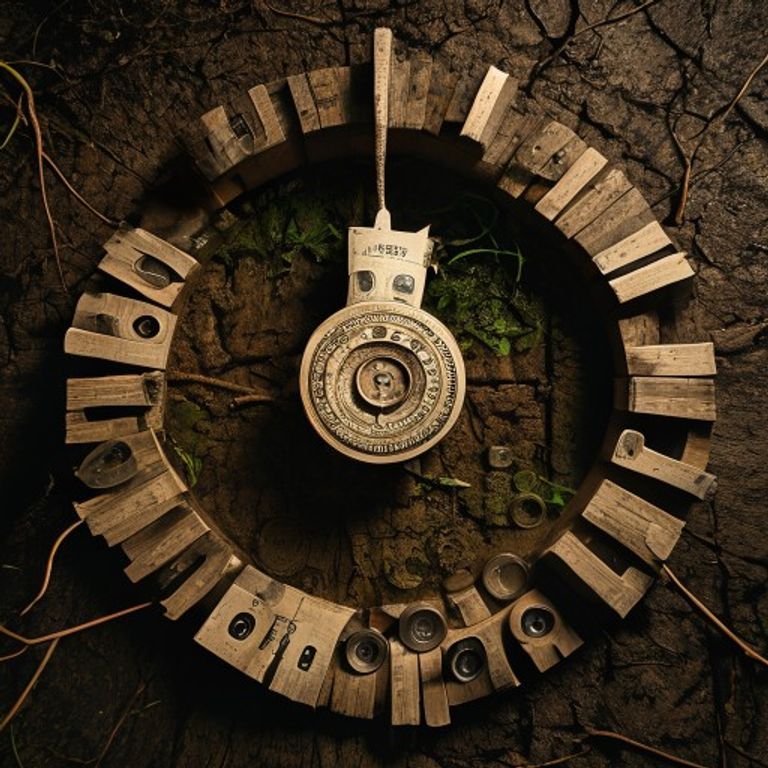
An excavation in Canada begun in the eighteenth century in search of hidden treasure within a complex system of tunnels and flood traps that has thwarted hundreds of explorers.
⚠️ Research prepared with the aid of Deep Research is subject to referential ambiguity.
🖥️ Clean HTML code using a proprietary tool.
👥 Research by Guilherme Felipe, Curation by Sílvio Lôbo
The Mystery of the Oak Island Money Pit: A Legacy of Secrets and Daydreams
For decades, the small and remote Oak Island, off the coast of Nova Scotia, Canada, has been the stage for one of the most persistent and fascinating mysteries of contemporary history. What began as a search for alleged pirate treasure in 1795 has evolved into a saga of fruitless excavations, bizarre theories, and a trail of destruction that, to this day, intrigues treasure hunters, historians, and skeptics alike.
This article aims to unravel the layers of this enigma, separating concrete facts from the wild speculations that surround the legendary "Money Pit".
1. The Context and the Incident: A Cry from the Past
The story has its roots in the summer of 1795. Three young men, Daniel McGinnis, John Smith, and Anthony Vaughan, spotted a strange depression in the ground under an unusual tree formation in the southern part of Oak Island. It is believed that an old tree had been cut down, with a block and tackle still visible, suggesting an artificial origin.
Curiosity led them to dig. What they found was a deep pit where, every few meters of depth, layers of stones, tree branches, and, according to reports, wooden planks protected the shaft. With each new layer, the hope of treasure grew, fueled by the belief that it was a pirate hideout, possibly belonging to Captain Kidd or even the Knights Templar.
2. Timeline of Events: A Saga of Frustrations
The search for the Oak Island treasure was not an isolated event, but a series of expeditions spanning over two centuries, each marked by a mix of hope and disappointment:
- 1795: Initial discovery of the pit and first excavations by the young men McGinnis, Smith, and Vaughan.
- Early 19th Century: Formation of the Onslow Company, one of the first organized societies to excavate the pit. They discovered layers of wood every 10 feet and, at a depth of 90 feet, a stone with enigmatic inscriptions.
- Subsequent Decades: Multiple attempts at excavation and treasure hunting, with the formation of various companies and the use of increasingly advanced technology.
- 1861: The Oak Island Association attempted to excavate the pit. During the work, a man named Edgar Smith (possibly a descendant of one of the original discoverers) reportedly died after a ventilation shaft collapsed. This is considered the first death associated with the excavations.
- Late 19th and Early 20th Century: Several companies, including the Truro Company and the New York Company, faced failures and significant financial losses.
- 1930s: Robert Restall and his family moved to the island with the goal of finishing the excavations. Another death occurred in the family, that of his son, Robert "Bobby" Restall, and their dog.
- 1950s and 1960s: The Triton Alliance, with the participation of prominent figures such as the son of John Wayne, invested heavily, but without success.
- 1970s: The Triton Alliance claimed to have found evidence of a flooded chamber with artifacts, including a chest and wood fragments. A man, Rick Lagina, claimed to have seen a human hand through a hole in an underground chamber.
- 1980s: The Triton Alliance declared bankruptcy.
- 2000s to the Present: The popular television series "The Curse of Oak Island", starring brothers Rick and Marty Lagina, has reignited public interest, driving new expeditions and discoveries, though none conclusive regarding a treasure.
3. The Main Theories: From Pirate Gold to the Templar Enigma
Over the years, countless theories have attempted to explain the origin and nature of the alleged treasure, ranging from the plausible to the downright fanciful:
3.1 Historical-Pirate Theories
- Classic Pirate Treasure: The most popular theory is that the pit was built to hide treasure accumulated by famous pirates such as Captain Kidd or Blackbeard. The complexity of the construction would suggest an attempt to protect valuable loot from plunder.
- Marie Antoinette's Treasure: A less widespread but intriguing theory suggests that the treasure could belong to French royalty, possibly hidden during the French Revolution.
3.2 Conspiracy and Esoteric Theories
- Knights Templar: One of the most elaborate theories suggests that the Knights Templar, a medieval military order, took important religious artifacts, such as the Holy Grail or the Ark of the Covenant, to Oak Island, protecting them from the Catholic Church. The stone with inscriptions found in 1861, with undeciphered symbols, fuels this speculation.
- The Atlantean Civilization: Some more eccentric hypotheses suggest that the pit was built by an ancient and advanced civilization, perhaps the Atlanteans, to house lost knowledge or technology.
- Shakespeare and the Hidden Truth: There are theories linking the pit to the works of William Shakespeare, suggesting it contained clues to a treasure or secret information related to his identity and the historical context of his plays.
3.3 Scientific and Criminal Theories (Less Popular, More Factual)
- Elaborate Hoax: Some researchers suggest that the entire "treasure" may have been an elaborate scam to attract investors into lost funds. The layers of wood and the "flooding" could be artificial, designed to sustain the illusion.
- Natural Formation with Human Attribution: It is possible that the original depression was a natural geological formation, and the initial "discovery" and subsequent construction of protective mechanisms were attributed to human efforts to create an engaging story.
- Still No Treasure: The most pragmatic hypothesis, and perhaps the hardest for enthusiasts to accept, is that the pit never contained a significant treasure, and the excavations have perpetuated a legend without a real basis.
4. Controversies and Blind Spots: The Shadows of the Investigation
The saga of the Money Pit is marked by a series of inconsistencies and obscure details that fuel the mystery:
- The Inscribed Stone: The stone found in 1861, with its indecipherable symbols, is one of the greatest enigmas. Its authenticity and the meaning of the inscriptions have never been definitively established, with conflicting reports about its current whereabouts.
- The Flooding Phenomenon: The water that supposedly floods the pit at certain depths is one of the biggest obstacles. Theories point to complex systems of water channels or underground tunnels that divert seawater, but these have never been proven.
- Limited Official Reports: Many of the early excavation reports are incomplete, vague, or have been lost over time, making it difficult to accurately reconstruct the events and findings.
- Disappearance of Evidence: Objects supposedly found and described in historical accounts have disappeared without a trace, fueling suspicion of manipulation or irretrievable loss.
- The Number of Victims: Although the series "The Curse of Oak Island" mentions six deaths, official records are harder to compile, and the exact number and circumstances of each death are not always clear.
- The Triton Alliance "Treasure": The Triton Alliance's claims about artifacts found in 1970 were never fully corroborated or presented conclusively to the scientific and archaeological community.
5. Curiosities and Legacy: The Legend That Remains
The Mystery of the Money Pit has transcended the boundaries of archaeology and history, becoming a cultural phenomenon:
- Inspiration for Fiction: The enigma has inspired countless books, films, and television series, fueling the imagination of millions.
- The Fascination of Discovery: The hope of finding hidden treasure, whether pirate, Templar, or of another nature, continues to attract adventurers and investors.
- The Lagina Legacy: The series "The Curse of Oak Island" brought new life to the mystery, documenting the most recent excavations and keeping the public engaged in every new discovery, however small.
- Ongoing Research: Although no monumental treasure has been found, research and excavations on Oak Island continue, driven by the belief that the final answer may still be hidden in the depths of the earth.
- A Symbol of Unsolved Enigmas: The Money Pit has become an archetype of historical mysteries that defy logic and science, a reminder that the past still holds secrets that, perhaps, will never be fully unraveled.
Until a definitive discovery is made, or until the mystery is declared a historical hoax, the Oak Island Money Pit will continue to be a beacon of intrigue, an invitation to speculation, and a testament to the enduring human fascination with irresolvable enigmas.



