


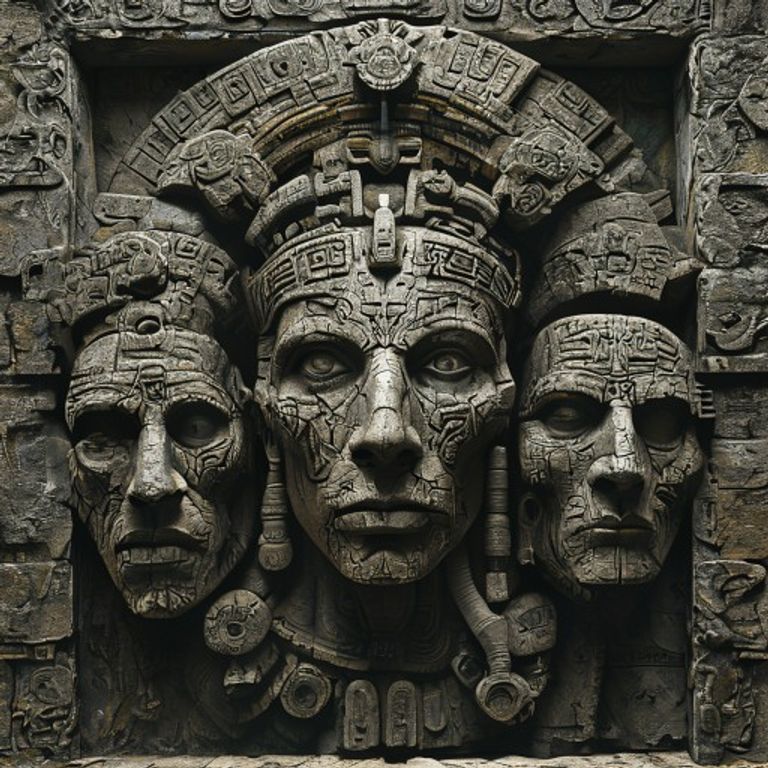
Monumental stone sculptures in Mexico with African features that lead to theories about transoceanic contact long before the age of discovery.
⚠️ Research conducted with the aid of Deep Research is subject to referential ambiguity.
🖥️ Clean HTML code using a proprietary tool.
👥 Research by Guilherme Felipe, Curation by Sílvio Lôbo
The Mystery of the Olmec Heads: A Shadow in the Heart of Mesoamerica
In La Venta, a revered archaeological site in the state of Tabasco, Mexico, lies an enigma that challenges centuries of investigation. The monumental Olmec heads, colossal basalt sculptures dating from approximately 1200 BC to 400 BC, are a silent testament to the power and sophistication of the Olmec civilization. However, what has become one of archaeology's most enduring mysteries does not lie in their existence, but in the inexplicable disappearance of so many others, an incident that casts a shadow of uncertainty over the dawn of Mesoamerican history.
1. The Context and the Incident: Where History Lost Its Way
The Olmec civilization, considered the "mother culture" of Mesoamerica, flourished in a region of dense tropical forests and swamps. Its artistic and architectural achievements are remarkable, notably the colossal heads, which range from 1.5 to 3 meters in height and can weigh up to 40 tons. These sculptures, with distinct facial features and helmets, represent figures of authority, possibly rulers. What has become known as "The Mystery of the Olmec Heads" does not refer to the origin or purpose of these heads, but rather to an event or series of events that resulted in the destruction or removal of a considerable number of these works of art, even before they were discovered by modern archaeologists.
The incident, although its exact nature remains obscure, seems to have occurred sometime after the decline of the Olmec civilization and before the advent of systematic archaeological expeditions in the 20th century. Evidence at sites such as San Lorenzo, La Venta, and Tres Zapotes suggests that many heads were deliberately damaged, buried, or relocated, often with signs of violence and the intent to mutilate or conceal. This is not a single occurrence, but rather a pattern observed at various Olmec sites, raising the question: who, or what, orchestrated this destruction?
2. Timeline of Events: Fragments of a Silenced Past
Reconstructing a timeline for this mystery is inherently challenging due to the nature of the enigma itself: the absence of clear contemporary records regarding the destruction of the heads. However, we can trace a chronology of observable and inferred events:
- c. 1200 BC - 400 BC: Peak period of the Olmec civilization. Construction and erection of the colossal heads in various urban centers, such as San Lorenzo, La Venta, and Tres Zapotes.
- c. 400 BC onwards: Decline of the Olmec civilization. Beginning of a period of instability, internal wars, or socio-political changes.
- Indeterminate period (post-Olmec, pre-modern): Actions that led to the destruction and/or concealment of the colossal heads. Archaeological evidence indicates that many heads were toppled, some broken, and others buried, often face down or in non-monumental locations.
- 19th Century and Early 20th Century: First expeditions and discoveries of Olmec heads by explorers and researchers. Initial reports already mention the damaged state of some sculptures.
- Mid-20th Century onwards: More systematic archaeological investigations reveal the extent of the destruction and concealment, solidifying the mystery. The lack of a consensual explanation for these actions makes the enigma even more intriguing.
3. The Main Theories: Unraveling Layers of Possibility
Over the decades, several theories have emerged to try to explain the fate of the Olmec heads. They range from pragmatic scientific explanations to speculations that border on the fantastic:
Scientific and Archaeological Theories (Most Likely):
- Internal Conflicts and Civil Wars: One of the most accepted explanations is that the destruction was the result of conflicts between rival factions within Olmec society itself or between different Olmec city-states. The heads, representing power and authority, could have been symbolic targets, disfigured to delegitimize defeated rulers or dynasties. Relocation could have been a way to "steal" the power or influence associated with these figures.
- Religious and Social Changes: Drastic changes in religious beliefs or social structures could have led to the rejection of symbols of previous power. New ideologies might have viewed the heads as representations of obsolete deities or rulers, justifying their desecration or concealment to make way for new forms of cultural and religious expression.
- Natural Phenomena and Catastrophes: Although less likely as a sole explanation, natural disasters such as intense earthquakes or floods could have contributed to the toppling and damage of some heads. However, the consistency of signs of intentional damage on multiple sculptures at different locations weakens this hypothesis as a primary cause.
- Material Repurposing: In a scenario of resource scarcity, or to make way for new constructions or sculptures, the basalt of the heads could have been repurposed. However, the nature of the destruction – often centered on disfiguring the faces – suggests a more symbolic purpose than a purely utilitarian one.
Alternative and Speculative Theories:
- External Invasions: Hypotheses suggest the possibility of invasions by external groups that did not share Olmec culture. These invasions could have led to the deliberate destruction of symbols of power to subvert the existing order. However, there is a lack of concrete archaeological evidence of large-scale invasions that explain the widespread destruction.
- Acts of Despair or Rebellion: A popular uprising against an oppressive elite could have resulted in the destruction of the idols of power. This theory, while plausible in terms of human motivation, lacks direct evidence to support it.
Conspiracy or Paranormal Theories (Without Proven Scientific Basis):
- Ancient Aliens: Some pseudoscientific theories postulate that the heads were created or influenced by extraterrestrial civilizations, and their destruction would be an act of alien intervention or a sign that they took with them something that should not be revealed. This is speculation without any basis in archaeological or scientific evidence.
- Lost Advanced Civilizations: Another strand suggests the existence of a terrestrial civilization prior to the Olmec, extremely advanced, whose remnants were destroyed or hidden. The theory attributes the destruction to a catastrophic event or the very nature of these civilizations.
4. Controversies and Blind Spots: Cracks in the Armor of Evidence
The investigation into the fate of the Olmec heads is marked by gaps and inconsistencies, fueling the mystery:
- Absence of Contemporary Records: The main controversy lies in the almost total lack of written or iconographic records left by the Olmecs themselves that explain the destruction of their own monumental works. The Olmec society did not develop a writing system complex enough to document historical events in the same way as other ancient civilizations.
- Evidence of Deliberate Destruction, But No Author: Although experts in archaeology and forensic geology have analyzed the damage, finding tool marks and breakage patterns that indicate human intent, the identity of the perpetrators remains unknown. There are no traces of bodies, weapons, or artifacts that point directly to a specific group.
- Ignored or Lost Clues: In some excavations, there are reports of findings that were subsequently lost or not properly documented due to a lack of resources or inadequate methodology in the early stages of archaeological exploration. This may have led to the loss of crucial clues.
- Divergent Interpretations of Evidence: The same evidence – such as the orientation of the buried heads or the types of tools used to damage them – can be interpreted in different ways by different researchers, leading to heated academic debates and the absence of a definitive consensus.
- The Scale of the Phenomenon: The fact that the destruction and concealment occurred at multiple Olmec sites, and at different times, suggests a complex and possibly multifaceted phenomenon, making it difficult to attribute it to a single cause.
5. Curiosities and Legacy: Echoes of a Timeless Enigma
The Mystery of the Olmec Heads has transcended the field of archaeology to become an icon of Mesoamerican antiquity and a popular fascination:
- Cultural Impact: The Olmec heads are powerful symbols of Mexican cultural identity and one of the most recognized monuments in world archaeology. Their aura of mystery only amplifies their appeal.
- Continuation of Research: Although the central mystery remains unsolved, archaeological research continues. New dating and forensic analysis techniques may eventually shed more light on the events.
- Shelved, But Not Forgotten: The case has not been officially "reopened" or "closed" in a criminal sense, as there was never a crime to be classified. However, the mystery remains active in academic debates and ongoing research. It is a constant reminder of how little we know about ancient civilizations and how history can be shaped by the loss of information.
- Inspiration for Fiction: The enigma has inspired countless works of fiction, including books and films, exploring the most diverse theories, from extraterrestrial invasions to ancestral conflicts.
The Olmec heads continue to stare at us, bearers of a secret that lies in the depths of time. What happened to so many of these sculpted wonders? The answer, if ever found, will lie not in a single revelation, but in the meticulous interpretation of fragments of a past that refuses to be completely unraveled, an eternal testament to the complexity and mystery of the human journey.



