


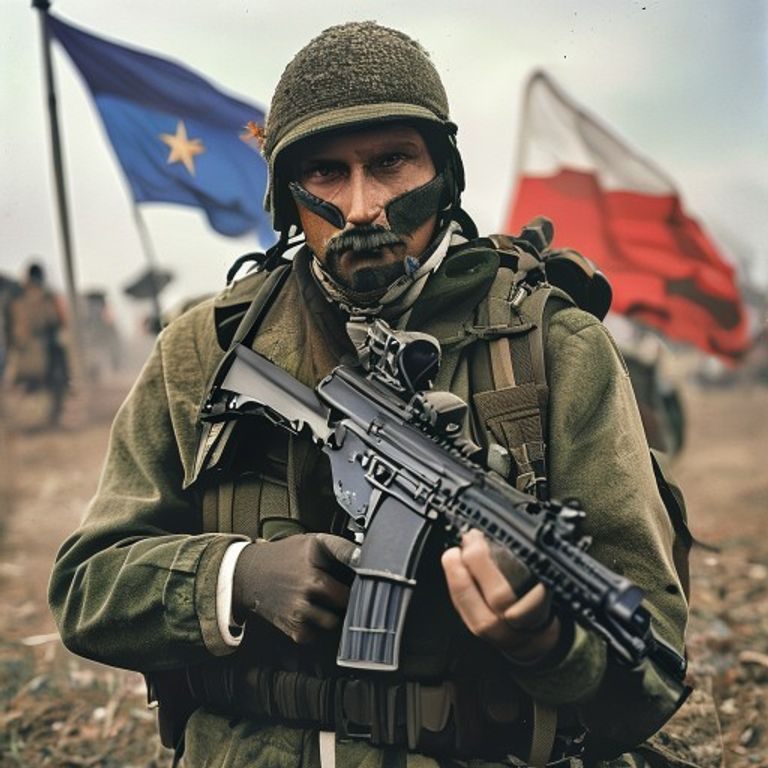
The largest armed conflict to occur in South America in the nineteenth century, which profoundly altered the borders and economies of the countries involved in the River Plate Basin.
⚠️ Research prepared with the aid of Deep Research is subject to referential ambiguity.
🖥️ Clean HTML code using a proprietary tool.
👥 Research by Guilherme Felipe, Curation by Sílvio Lôbo
The Enigma of the Paraguayan War: A Conflict That Still Haunts Historians
The Paraguayan War, also known as the War of the Triple Alliance, which tore South America apart between 1864 and 1870, is often remembered as one of the bloodiest and most devastating conflicts on the continent. However, behind the horrific death tolls and widespread destruction lies a persistent mystery, an enigma that, after more than a century, continues to challenge historians and researchers, casting shadows over the true motives and consequences of one of the greatest conflicts in Brazilian history. This article delves into a specific and widely discussed, yet still uncertain, aspect: the role and fate of key figures, the manipulation of information, and the hidden consequences that intertwine with the official narrative of the war.
1. The Context and the Incident: Where, When, and How the Mystery Began
The mystery surrounding the Paraguayan War is not limited to a single event, but rather a set of informational gaps and inconsistencies that accumulated during and after the conflict. The initial spark for the conflict is complex and multifaceted, involving territorial disputes and political and economic disagreements in the River Plate Basin. Paraguay, under the government of Solano López, sought to strengthen its autonomy and industrial development, while Brazil, Argentina, and Uruguay, with distinct interests, saw their ambitions threatened by the Paraguayan rise. What becomes a mystery is how the narrative regarding the motives for the war, the conduct of operations, and the treatment of the defeated was constructed and, in many cases, distorted. Primary sources are often biased, influenced by the interests of the victors, and the declassification of documents is a slow and irregular process. The "incident" that gave rise to this perplexity is the very obscure nature of many aspects of the war, where propaganda and the need to justify the immense human and material cost may have obscured inconvenient truths. The figure of Solano López, for example, oscillates between that of a megalomaniacal tyrant and a national hero who fought for his country's sovereignty. This ambiguity, whether intentionally cultivated or the result of a scarcity of definitive evidence, is the core of the mystery.
2. Timeline of Crucial Events (and their Uncertainties)
The chronological reconstruction of the Paraguayan War, although filled with known dates and battles, is marked by blind spots where official information diverges or is incomplete. * 1864: Paraguay seizes the Brazilian ship Marquês de Olinda in response to Brazilian intervention in the Uruguayan civil war, which supported the Colorado Party, a rival to the Paraguayan-backed Blancos. This event is often cited as the trigger. * Late 1864 - 1865: Paraguay invades Mato Grosso and, subsequently, Rio Grande do Sul. * May 1, 1865: Signing of the Treaty of the Triple Alliance between Brazil, Argentina, and Uruguay, formalizing the war against Paraguay. * 1866-1868: A period of intense battles, such as those of Tuiuti and Curupaiti, with heavy casualties on both sides. It is in this phase that conflicting reports begin to emerge regarding strategies, orders, and the actual number of combatants. * 1869: Allied forces advance into Paraguayan territory, with Solano López retreating into the interior. Reports of the disorganization of the Paraguayan army and the brutality of the allied troops become more frequent. * March 1, 1870: Death of Solano López at the Battle of Cerro Corá. The official narrative describes his heroic end, but there are questions about the exact circumstances of his death and what he really knew or planned. The mystery lies in many of the "minor" events within this timeline: the exact number of deserters, the reasons for certain strategic defeats, the fate of Paraguayan documents and archives after the fall of Asunción, and the secret agreements that may have been made between the allies.
3. The Main Theories: Deciphering the Enigma
Attempts to explain the gaps and contradictions of the Paraguayan War give rise to several theories, ranging from rigorous document analysis to more audacious speculations. * **Theory of Historiographical Manipulation (Cautious Hypothesis):** * Logic: The winning countries (Brazil and Argentina, mainly) had the power to shape the historical narrative in their favor. Documents were selected, censored, or destroyed to justify the war and demonize the enemy. The glorification of their own leaders and the villainization of Solano López were tools to consolidate power and national image. * Evidence/Anchoring: Analysis of official Brazilian and Argentine reports that sometimes omit tactical errors or exaggerate achievements. The absence of detailed Paraguayan records due to post-war destruction. * **Theory of the Hidden Economic Agenda (Grounded Historical Speculation):** * Logic: Beyond territorial and political disputes, the war was allegedly motivated by economic interests, such as control of navigation routes in the River Plate Basin, the expansion of the market for Great Britain (which allegedly financed the allied war effort), and the imposition of an economic model favorable to emerging capitalist countries. The weakening of Paraguay, a country with an autonomous development model, was a strategic objective. * Evidence/Anchoring: Studies on the role of British bankers and merchants in the region. The British interest in dismantling Paraguayan protectionist policies. * **Theory of Solano López's Madness or Megalomania (Critical Theory):** * Logic: This is the most widespread view in traditional historiography, which portrays Solano López as a tyrannical and irresponsible leader who, out of vanity or delusions of grandeur, led his country to ruin. His strategic decisions were allegedly irrational and excessive. * Evidence/Anchoring: Accounts from Paraguayan officers who disagreed with López and desertions. Criticisms of his military leadership and the excessive exploitation of Paraguay's human resources. * **Theory of Heroic National Resistance (Historiographical Counterpoint):** * Logic: In contrast to the megalomania theory, this view praises Solano López as a visionary leader who fought bravely for Paraguayan sovereignty against the aggression of the neighboring "giants." The Paraguayan people, including women and children, allegedly demonstrated admirable resistance in the face of oppression. * Evidence/Anchoring: Testimonies from Paraguayan survivors who describe bravery and sacrifice. Paraguay's ability to resist for so long with limited resources. * **Conspiracy and Paranormal Theories (Borderline Speculation):** * Logic: Although less substantial in terms of rigorous historical evidence, there are theories suggesting large-scale manipulations by secret powers, the use of experimental weaponry (based on anecdotal reports), or even paranormal interventions that influenced the course of the war. These theories generally lack concrete proof and are based on interpretations of isolated events or unverified reports. * Evidence/Anchoring: Lack of solid evidence. Based on second-hand reports, rumors, and liberal interpretations of documents.
4. Controversies and Blind Spots: Where the Light of Investigation Fails
Investigations into the Paraguayan War, both at the time and subsequently, were marked by significant controversies and blind spots. * **Destruction of Paraguayan Archives:** The fall of Asunción in 1869 and the subsequent years of occupation led to the destruction or dispersal of a large part of the Paraguayan government's archives. This severely limits the ability to reconstruct the Paraguayan perspective in a complete and independent manner. * **Conflicting Testimonies:** Accounts from officers, soldiers, and civilians, both Paraguayan and allied, frequently diverge on crucial details regarding battles, strategies, orders, and the treatment given to prisoners. The difficulty in corroborating these testimonies, especially after so many years, creates a fertile field for debate. * **Subjective Official Reports:** Official reports, especially those issued by victorious generals, tend to glorify their own actions and minimize errors or failures. The absence of an independent investigative body at the time allowed the official narrative to be largely controlled by the victors. * **"López's Gold":** There are legends about the treasure of Solano López, which was supposedly hidden. The search for this treasure has sometimes overshadowed the search for concrete historical facts. Its whereabouts and even its existence in large volume are objects of speculation. * **The Secret Treaty of the Triple Alliance:** Although the public treaty of 1865 is known, the existence of secret clauses or subsequent agreements between the allies that shaped the post-war period and the division of territories is still a point of debate and speculation.
5. Curiosities and Legacy: A Silent Echo in History
The cultural impact and legacy of the Paraguayan War are immense, and the mystery surrounding it contributes to its permanence in the popular and academic imagination. * **Demographic Impact:** Paraguay, in particular, suffered a catastrophic demographic collapse. It is estimated that more than half of its male population died, a shocking number that still raises debates about the brutality and disproportionality of the war. * **Nationalism and Identity:** The war was a catalyst for the formation of national sentiment in Brazil, Argentina, and Uruguay. However, in Paraguay, the memory of the conflict is complex, marked by tragedy and the struggle for a place in history, often interpreted as a victim of imperialism. * **Status of the Case:** The "Paraguayan War Case," in the sense of an unsolved mystery, has not been formally "reopened" by any official body. However, the work of historians, researchers, and gradual access to declassified archives (albeit limited) continue to fuel the debate and challenge established narratives. * **The Myth of Solano López:** The figure of Solano López remains a controversial icon. He is remembered both as a national hero who fought for Paraguayan sovereignty and as the one responsible for the decimation of his people. The absence of a clear consensus on his legacy fuels the mystery. * **The Legacy of Disinformation:** The war serves as a grim reminder of how information can be manipulated in times of conflict, and how the search for historical truth is an arduous and continuous task that requires a critical eye and the constant re-evaluation of sources. The Paraguayan War is not just a dark chapter in South American history, but also a persistent enigma. The gaps in records, contradictory testimonies, and the need to reinterpret events in light of new evidence ensure that this conflict will continue to be the subject of investigation and debate for many generations. What really happened in the trenches, in the strategy rooms, and behind the diplomatic scenes may still have secrets to reveal, awaiting the tireless gaze of those dedicated to unveiling the veils of the past.



